


Non-contact IV tester

Quantum Efficiency Tester
PL/EL Integrated System
PV-Reflectumeter
3D Confocal Microscope
In-Line Four Point Probe Tester
Four Point Probe Tester
In-Line Thin Film Thickness Tester
Raman Spectrometer
FTIR Spectrometer
Spectrophotometer
Automatic Spectroscopic Ellipsometer
Contact Resistance Tester
Ultra depth of field 3D microscope
Auto Visual Tester
VMM PV Vision Measuring Machine
Solar Cell Horizontal Tensile Tester
Steady State Solar Simulator for Solar Cell
Solar Cell UV Aging Test Chamber
Solar Cell Comprehensive Tensile Tester
Visual Inspection Tester
Wet Leakage Current Tester
PV Module EL Tester
PV Module UV Preconditioning Chamber
Steady State Solar Simulator for PV Module
Current Continuous Monitor
Potential Induced Degradation Test
Bypass Diode Tester
LeTID Test System
Reverse Current Overload Tester
Impulse Voltage Tester
Hipot Insulation Tester
Ground Continuity Tester
Hipot Insulation Ground Tester
Damp Heat Test Chamber
Humidity Freeze Test
Thermal Cycle Test Chamber
Dynamic Mechanical Load Tester
Static Mechanical Load Tester
Hail Impact Tester
Robustness of Termination Tester
Module Breakage Tester
Cut Susceptibility Tester
Peel Shear Strength Tester
Universal Testing Machine (Single-arm)
Universal Testing Machine (Double-arm)
Glass Transmittance Tester
Acetic Acid Test Chamber
EVA Degree of Crosslinking Test System
Junction Box Comprehensive Tester
Drop ball tester
Semi-automatic scanning four-probe tester
Stylus Profilometer
Maximum Power Point Tracker
Perovskite Glass Transmittance Tester
Perovskite P1 Laser Scribing Multifunctional Testing Machine
Perovskite Online PL Tester
Perovskite Online Sheet Resistance Tester
Online Perovskite Film Thickness Tester
Perovskite Process Inspection Workstation
Portable EL Tester
Portable Thermal Imaging Tester
Solar Module Multi-Channel Testing System
PV Inverter Power Quality Tester
IV Tester
IVEL Cell Sorting Machine
Laser-Induced Firing & Ni/Cu Electroplating for TOPCon Metallization
Date : 7 August 2026Views : 1340
Laser-Induced Firing and Ni/Cu Electroplating for TOPCon Solar Cell Metallization: Silver-Free Technology
Crystalline silicon solar cell technology holds over 95% global market share, with TOPCon solar cell metallization achieving 26.4% efficiency through its tunnel oxide passivated contact structure. Traditional silver paste screen printing incurs high costs and carbon footprints. Ni/Cu electroplating offers silver-free metallization with fine line widths and low series resistance, yet laser ablation damage causes open circuit voltage (Voc) losses. This study integrates laser-induced firing (LIF) with Ni/Cu electroplating for contact resistance reduction and solar cell efficiency improvement in TOPCon solar cell metallization.
Understanding TOPCon Solar Cell Metallization and Ni/Cu Electroplating
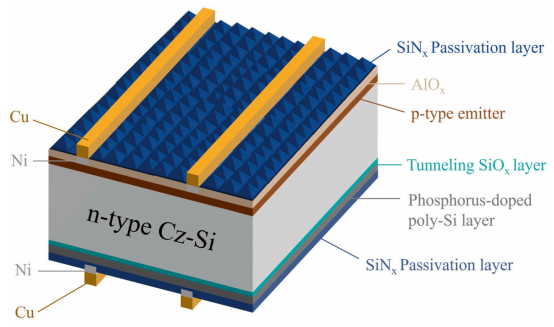
TOPCon cell structure with Ni/Cu metallised electrodes
TOPCon solar cell metallization utilizes a tunnel oxide passivated contact — approximately 2.0 nm tunnel oxide with 90 nm phosphorus-doped polysilicon on n-type silicon solar cell substrates (182.20 × 186.75 mm, 135 μm thick). In TOPCon solar cell metallization, this passivation structure must be preserved during electrode formation, making Ni/Cu electroplating a preferred method over screen printing for achieving silver-free metallization.
Tunnel Oxide Passivated Contact in Silicon Solar Cell Technology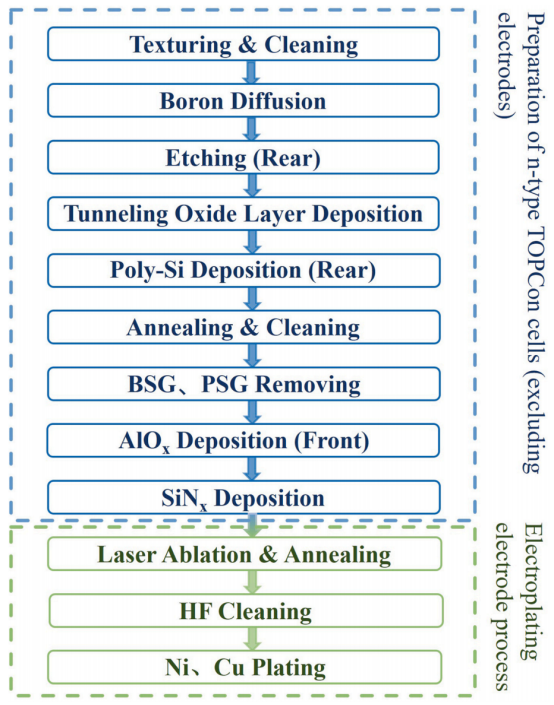
Process flow for the fabrication of TOPCon cells with Ni/Cu electroplated electrodes
The tunnel oxide passivated contact in a silicon solar cell enables carrier tunneling while suppressing recombination. TOPCon solar cell metallization requires precise metal contact formation through this layer. Ni/Cu electroplating preserves the passivation quality better than screen printing, as Ni/Cu plated electrodes form through electrochemical deposition rather than high-pressure paste application. This makes Ni/Cu electroplating essential for advanced TOPCon solar cell metallization.
Screen Printing vs Electroplating: The Silver Cost Problem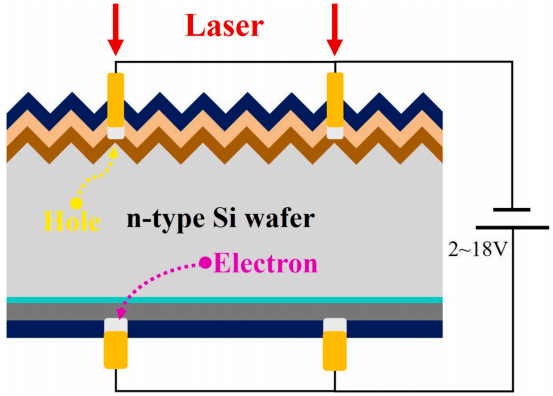
Schematic diagram illustrating the principle of the laser-induced sintering process
Screen printing vs electroplating represents a critical decision in TOPCon solar cell metallization. Screen printing uses expensive silver paste, while Ni/Cu electroplating enables silver-free metallization with line widths below 20 μm and lower series resistance. However, Ni/Cu electroplating requires laser ablation for pattern opening, introducing laser ablation damage that must be repaired. Laser-induced firing (LIF) addresses this challenge in TOPCon solar cell metallization.
Ni/Cu Electroplating Process for TOPCon Solar Cell Metallization
The Ni/Cu electroplating process for TOPCon solar cell metallization includes: texturing, boron diffusion (800 nm emitter), tunnel oxide deposition, polysilicon deposition, 900°C annealing, SiNx passivation, 355 nm picosecond laser ablation, 700°C damage repair annealing, HF cleaning, Ni plating, low-temperature sintering, and Cu plating to form Ni/Cu plated electrodes. Each step in Ni/Cu electroplating directly impacts TOPCon solar cell metallization quality.
Laser Ablation Damage in Solar Cell ManufacturingLaser ablation damage is the primary challenge in Ni/Cu electroplating for TOPCon solar cell metallization. Residual lattice damage from laser pattern opening causes open circuit voltage (Voc) losses in Ni/Cu plated electrodes. While 700°C annealing partially repairs damage, laser-induced firing (LIF) provides superior remediation for TOPCon solar cell metallization, enabling significant contact resistance reduction.
Laser-Induced Firing (LIF) for Contact Resistance Reduction
Laser-induced firing (LIF) applies reverse-biased current through Ni/Cu plated electrodes, generating Joule heat at the metal-silicon interface for contact resistance reduction and solar cell efficiency improvement in TOPCon solar cell metallization. The baseline Ni/Cu electroplating efficiency was 24.29% (open circuit voltage (Voc) 696.27 mV, fill factor (FF) 81.74%).
LIF Mechanism: Ni-Si Alloy Formation and Reverse Voltage OptimizationAt 14 V, laser-induced firing (LIF) reduced series resistance from 1.51 mΩ to 1.16 mΩ (23.17% decrease), improved shunt resistance by 57.01%, and achieved solar cell efficiency improvement of 0.401% absolute in TOPCon solar cell metallization. Dark saturation current density analysis showed J02 minimized at 14 V, confirming suppressed recombination at Ni/Cu plated electrodes. Raman spectroscopy crystallinity revealed 0.76%-1.84% silicon crystallinity improvement. Ni-Si alloy formation was enhanced through localized Joule heating during laser-induced firing (LIF). Above 16 V, excessive heat caused new thermal damage to Ni/Cu electroplating in TOPCon solar cell metallization.
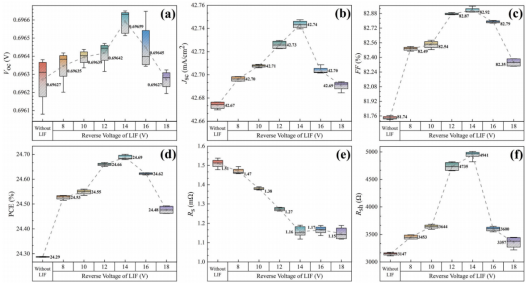
Electrical performance (Voc, Jsc, FF, PCE, Rs, Rsh) of Ni/Cu electroplated TOPCon cells under different LIF reverse voltages
Laser-Induced Firing (LIF) Timing in the Ni/Cu Electroplating SequenceThree LIF introduction points were tested in Ni/Cu electroplating: after Ni plating (Group A), after sintering (Group B), and after Cu plating (Group C). Group C achieved optimal TOPCon solar cell metallization results because the Cu layer provided lower resistance, enabling uniform thermal distribution during laser-induced firing (LIF). Raman spectroscopy crystallinity confirmed Group C's superiority in Ni/Cu electroplating for TOPCon solar cell metallization.
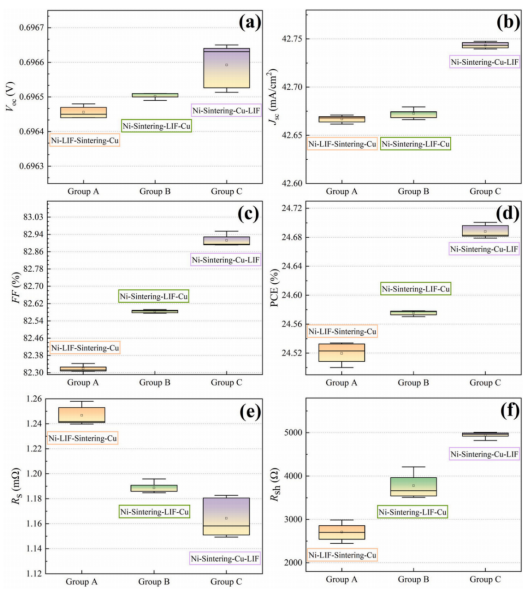
Electrical performance comparison of three LIF introduction timing groups (A, B, C) in Ni/Cu electroplating
Laser-Induced Firing vs Traditional Sintering for TOPCon Solar Cell Metallization
Group D eliminated sintering entirely, applying laser-induced firing (LIF) (6 V/45 W) directly after Ni plating in the Ni/Cu electroplating sequence, then Cu plating. This silver-free metallization approach achieved Ni-Si alloy formation with higher crystallinity than sintering, as LIF's instantaneous temperature exceeds sintering temperature, forming more stable NiSi phase for TOPCon solar cell metallization.
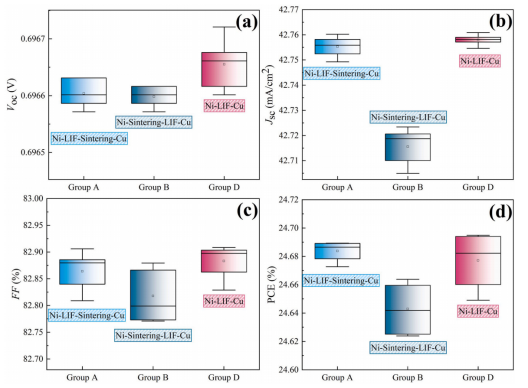
Electrical performance comparison of Group D versus Groups A and B in TOPCon solar cell metallization
TLM Contact Resistance Tester: Uniformity MeasurementUsing a TLM contact resistance tester, contact resistance distribution was mapped across TOPCon solar cell metallization surfaces. Baseline variation was 3.53 Ω; Group D achieved only 0.45 Ω — demonstrating that laser-induced firing (LIF) provides superior uniformity over sintering furnaces in Ni/Cu electroplating. The TLM contact resistance tester confirmed contact resistance reduction across the entire silicon solar cell surface using Ni/Cu plated electrodes.
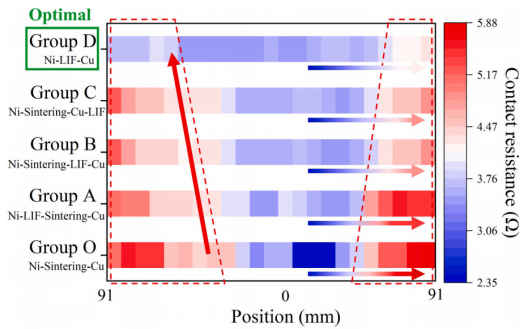
Lateral uniformity distribution of contact resistance across different process groups (O, A, B, C, D)
Solar Cell Efficiency Improvement Results with Ni/Cu Electroplating
At 6 V, laser-induced firing (LIF) in Group D achieved: open circuit voltage (Voc) 696.72 mV, fill factor (FF) 82.96%, and 24.74% efficiency — 0.45% absolute solar cell efficiency improvement over untreated Ni/Cu electroplating in TOPCon solar cell metallization. Dark saturation current density and Raman spectroscopy crystallinity confirmed superior interface quality with Ni/Cu plated electrodes in TOPCon solar cell metallization.
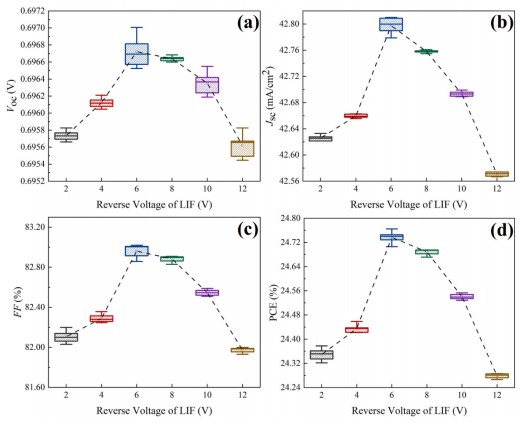
Group D process (Ni-LIF-Cu) electrical performance at different reverse voltages (2-12 V)
Frequently Asked Questions
Q: What is laser-induced firing in photovoltaic cells?
A: Laser-induced firing (LIF) applies reverse-biased current through Ni/Cu plated electrodes, generating localized Joule heat to repair laser ablation damage and achieve contact resistance reduction in TOPCon solar cell metallization using Ni/Cu electroplating.
Q: How does Ni/Cu electroplating compare to silver paste for solar cell metallization?
A: Ni/Cu electroplating enables silver-free metallization with finer lines and lower resistance. Screen printing vs electroplating analysis confirms silver paste costs remain higher for comparable TOPCon solar cell metallization performance.
Q: Can laser-induced firing replace nickel sintering in solar cells?
A: Yes. Laser-induced firing (LIF) at 6 V completely replaces sintering in Ni/Cu electroplating, achieving superior Ni-Si alloy formation and contact resistance reduction for TOPCon solar cell metallization.
Q: How to reduce contact resistance in TOPCon solar cells?
A: Apply laser-induced firing (LIF) after Ni/Cu electroplating at 6-14 V, enabling contact resistance reduction from 1.51 mΩ to 1.16 mΩ and solar cell efficiency improvement of 0.45% in TOPCon solar cell metallization.
Q: What is TLM contact resistance measurement for solar cells?
A: A TLM contact resistance tester uses the Transfer Line Method to measure contact resistivity across TOPCon solar cell metallization, achieving ≤1% repeatability for Ni/Cu electroplating quality control of Ni/Cu plated electrodes.
Conclusion: The Future of TOPCon Solar Cell Metallization
Laser-induced firing (LIF) integrated with Ni/Cu electroplating provides a transformative silver-free metallization solution for TOPCon solar cell metallization. At 6 V (Group D), contact resistance reduction to 0.45 Ω and solar cell efficiency improvement to 24.74% were achieved using Ni/Cu plated electrodes. This laser-induced firing (LIF) approach replaces traditional sintering, advancing Ni/Cu electroplating and TOPCon solar cell metallization toward cost-effective, high-performance production.
Millennial Solar TLM Contact Resistance Tester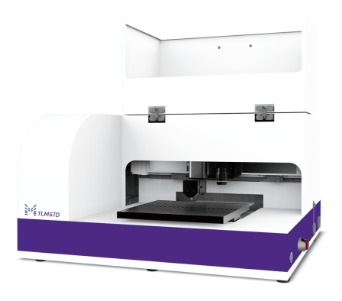
email:market@millennialsolar.com
The Millennial Solar TLM Contact Resistance Tester features contact resistivity testing capabilities, enabling rapid, flexible and precise testing.
Static test repeatability ≤ 1 per cent; dynamic test repeatability ≤ 3 per cent
l u Line resistance measurement accuracy up to 5 per cent or 0.1 Ω/cm
l u Seamless switching between contact resistivity and line resistance testing
l u Customised probes for measurement and analysis
Using the transmission line model method, the Millennial Solar TLM Contact Resistance Tester characterised the lateral uniformity of contact resistance in Ni/Cu-plated TOPCon cell samples—both those without LIF treatment and those with LIF introduced at different process nodes—and precisely determined the gradient of contact resistance distribution from the cell edge to the centre. This test provides key data support for how LIF technology significantly improves the uniformity of the metal/silicon contact interface.
Reference: Integration of laser-induced firing with Ni/Cu plating for TOPCon solar cell metallisation
Related Products


