


Non-contact IV tester

Quantum Efficiency Tester
PL/EL Integrated System
PV-Reflectumeter
3D Confocal Microscope
In-Line Four Point Probe Tester
Four Point Probe Tester
In-Line Thin Film Thickness Tester
Raman Spectrometer
FTIR Spectrometer
Spectrophotometer
Automatic Spectroscopic Ellipsometer
Contact Resistance Tester
Ultra depth of field 3D microscope
Auto Visual Tester
VMM PV Vision Measuring Machine
Solar Cell Horizontal Tensile Tester
Steady State Solar Simulator for Solar Cell
Solar Cell UV Aging Test Chamber
Solar Cell Comprehensive Tensile Tester
Visual Inspection Tester
Wet Leakage Current Tester
PV Module EL Tester
PV Module UV Preconditioning Chamber
Steady State Solar Simulator for PV Module
Current Continuous Monitor
Potential Induced Degradation Test
Bypass Diode Tester
LeTID Test System
Reverse Current Overload Tester
Impulse Voltage Tester
Hipot Insulation Tester
Ground Continuity Tester
Hipot Insulation Ground Tester
Damp Heat Test Chamber
Humidity Freeze Test
Thermal Cycle Test Chamber
Dynamic Mechanical Load Tester
Static Mechanical Load Tester
Hail Impact Tester
Robustness of Termination Tester
Module Breakage Tester
Cut Susceptibility Tester
Peel Shear Strength Tester
Universal Testing Machine (Single-arm)
Universal Testing Machine (Double-arm)
Glass Transmittance Tester
Acetic Acid Test Chamber
EVA Degree of Crosslinking Test System
Junction Box Comprehensive Tester
Drop ball tester
Semi-automatic scanning four-probe tester
Stylus Profilometer
Maximum Power Point Tracker
Perovskite Glass Transmittance Tester
Perovskite P1 Laser Scribing Multifunctional Testing Machine
Perovskite Online PL Tester
Perovskite Online Sheet Resistance Tester
Online Perovskite Film Thickness Tester
Perovskite Process Inspection Workstation
Portable EL Tester
Portable Thermal Imaging Tester
Solar Module Multi-Channel Testing System
PV Inverter Power Quality Tester
IV Tester
IVEL Cell Sorting Machine
Copper-Electrode n-TOPCon Solar Cell Reaches 24.3% Efficiency: LECO Process + Screen-Printed Copper Paste Enables Low-Cost Silver Replacement
Date : 31 August 2026Views : 1375
A copper-electrode n-TOPCon solar cell fabricated with screen-printed copper paste and the LECO process (laser-enhanced contact optimization) achieved 24.3% efficiency on the rear side of an n-type TOPCon solar cell, demonstrating a viable route for low-cost copper replacement of silver electrodes in photovoltaic cell metallization.
Copper-Electrode n-TOPCon Solar Cell: Why Replace Silver with Copper?
As n-type TOPCon solar cells become the mainstream crystalline-silicon technology, metal-induced recombination at the front boron emitter has become the main factor limiting efficiency gains, while double-sided silver-paste consumption keeps costs high.
Replacing expensive silver with abundant copper is attractive, yet copper tends to diffuse into silicon during high-temperature firing, forming recombination centers and causing leakage.
This has made reliable screen-printed fire-through copper contacts difficult to realize, a central challenge in developing the copper-electrode n-TOPCon solar cell.
The key issue is balancing low contact resistivity with minimal copper diffusion. This study combines a fire-through copper paste formulation with low-temperature firing and a subsequent LECO process step so that copper microcrystals form stably within the polysilicon layer, enabling good ohmic contact while suppressing recombination.
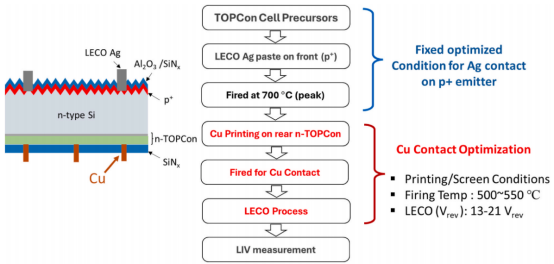
Figure 1: Cross-sectional schematic and process flow of the copper-contacted n-TOPCon cell.
Experimental Method: Screen-Printed Copper Paste and Two-Step Firing
The study fabricated cells using a standard industrial TOPCon process. n-type silicon wafers were textured and cleaned to form precursors: the front surface was a ~300 Ω/□ boron-diffused emitter passivated by Al₂O₃/SiNx, and the rear comprised the typical TOPCon stack (SiOx / n⁺ poly-Si / SiNx).
High-Temperature Front Silver Firing and Low-Temperature Rear Copper FiringA two-step firing strategy was used:
l The front side was screen-printed with silver paste and fired at ~700 °C to form electrodes.
l The rear side was printed with fire-through copper paste and fired at 500–550 °C by low-temperature firing to suppress copper diffusion into silicon.
l The cells underwent a two-step sequence: Ag high-temperature firing first, then Cu low-temperature firing.
LECO Process and CharacterizationAll cells then received the LECO process, with reverse bias adjusted for TOPCon contact resistance optimization.
Performance was evaluated by IV and EL imaging, contact resistivity was extracted by the transfer length method (TLM), and metal-induced recombination current density was analyzed at different metal coverage fractions.
Firing-Temperature Optimization for Copper Contacts
Firing temperature strongly affects copper-contact performance:
Temperature range | Contact status | Main observation | Performance impact |
<520 °C | Poor contact | Large dark areas in EL images | High series resistance, low FF |
530–535 °C | Optimal window | Contact resistivity drops below 10 mΩ·cm² | FF and efficiency peak |
>535 °C | Excessive Cu diffusion | TOPCon passivation degrades | Voc and pFF decline |
Thus, a clear trade-off exists between contact formation and passivation preservation, with the optimal firing window at 530–535 °C. The fire-through copper paste needs sufficient thermal budget to form contacts, yet excessive heat drives copper into the silicon bulk and degrades the copper-electrode n-TOPCon solar cell.
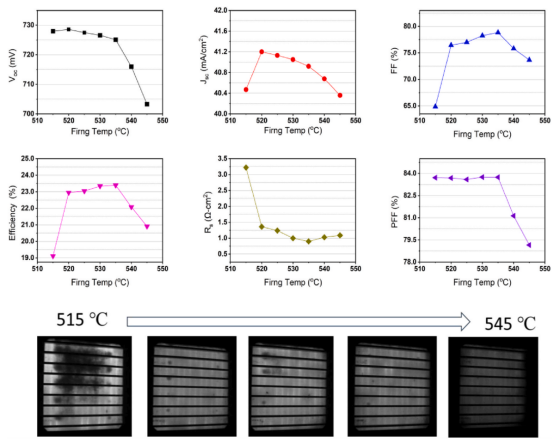
Figure 2: Measured performance and EL images of copper-contacted n-TOPCon cells fired at different peak temperatures.
LECO Process Optimization: Contact Resistivity from 300 to 10 mΩ·cm²
At the optimal firing temperature of 530 °C, the LECO process parameters were optimized:
· At low reverse bias (e.g., 13 V), Voc and pFF remained high, but series resistance was still large.
· As the bias increased to 17–19 V, contact resistivity decreased markedly and the fill factor peaked.
· At 21 V, device performance degraded, possibly because copper penetrated further into the polysilicon or even reached the silicon substrate, causing local shorting or Schottky effects.
TLM measurements showed that after the LECO process, contact resistivity fell from ~300 mΩ·cm² to ~10 mΩ·cm², confirming its decisive role in contact improvement.
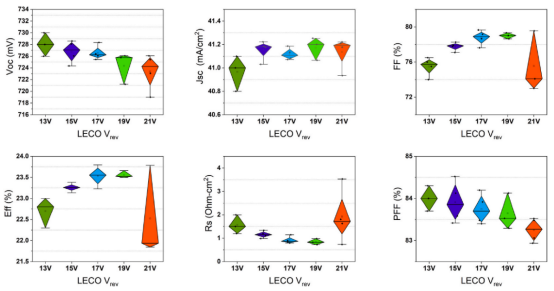
Figure 3: Performance parameters of copper-contacted n-TOPCon cells after LECO processing (reverse bias 10–21 V).
Performance Comparison: Copper vs. Silver Contacts
Comparing the Ag and Cu metallization systems gives the following conclusions:
Parameter | Copper contact | Silver contact | Note |
Maximum efficiency | 24.3% | 24.5% | Absolute efficiency gap ~0.2% |
Contact resistivity | ~10 mΩ·cm² | ~1 mΩ·cm² | Cu is about 10× higher than Ag |
Metal-induced recombination current density | Slightly lower | Slightly higher | Cu has an edge in interface recombination control |
Voc / pFF | Essentially equal | Essentially equal | Cu contact does not significantly damage passivation |
The table shows that copper contacts offer some advantage in interface recombination control, but their contact resistance is about ten times higher than silver; this can be compensated by increasing metal coverage.
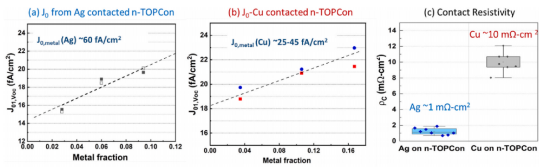
Figure 4: Metal contact fraction and measured J₀₁, Voc, and contact resistivity for Ag and Cu contacts on n-TOPCon.
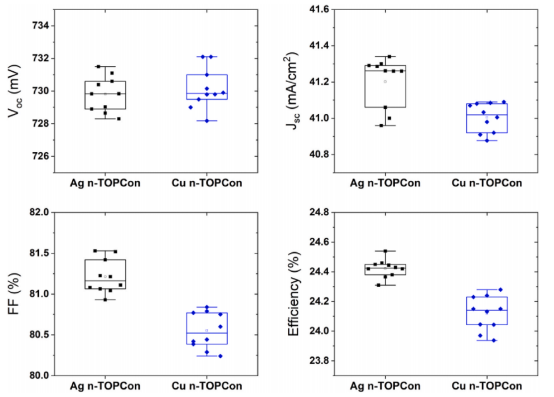
Figure 5: Performance comparison of Ag- and Cu-contacted n-TOPCon solar cells.

Figure 6: Performance comparison of the best n-TOPCon cells prepared with rear silver and copper metallization.
Microstructural Analysis of the Copper Contact Interface
STEM and EDX were used to examine the copper contact interface before and after LECO. Before treatment, a thick and non-uniform SiNx residue remained between the glass layer and polysilicon, leading to poor contact.
After the LECO process, copper colloid density on the polysilicon surface increased significantly, and more copper microcrystals formed in regions where SiNx was thin or absent.
These copper-rich microcrystals were confined within the polysilicon layer and did not reach the tunnel oxide, so passivation degradation or shunting was avoided. Local Joule heating during LECO promoted this structure and substantially reduced contact resistance.
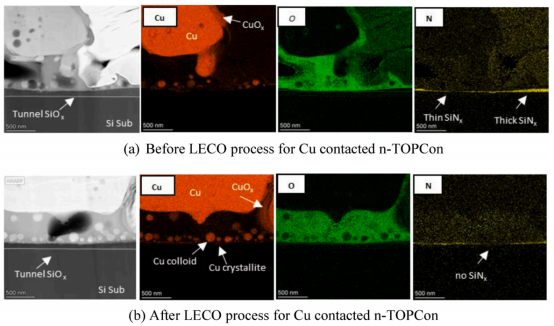
Figure 7: Microstructure and compositional images (STEM and EDX) of the copper-contacted n-TOPCon interface before and after LECO treatment.
Durability and Stability of Copper Contacts
Reliability testing shows that copper-contacted cells treated by the LECO process have good stability:
· After 1,000 hours of dry-heat treatment at 200 °C in nitrogen, Voc and pFF remained essentially unchanged (normalized values 1.004 and 1.005), with no significant copper diffusion or recombination degradation.
· In an 85 °C / 85% humidity-heat test, mini-modules based on these cells retained near-initial efficiency after 1,000 hours, indicating good module-level reliability.
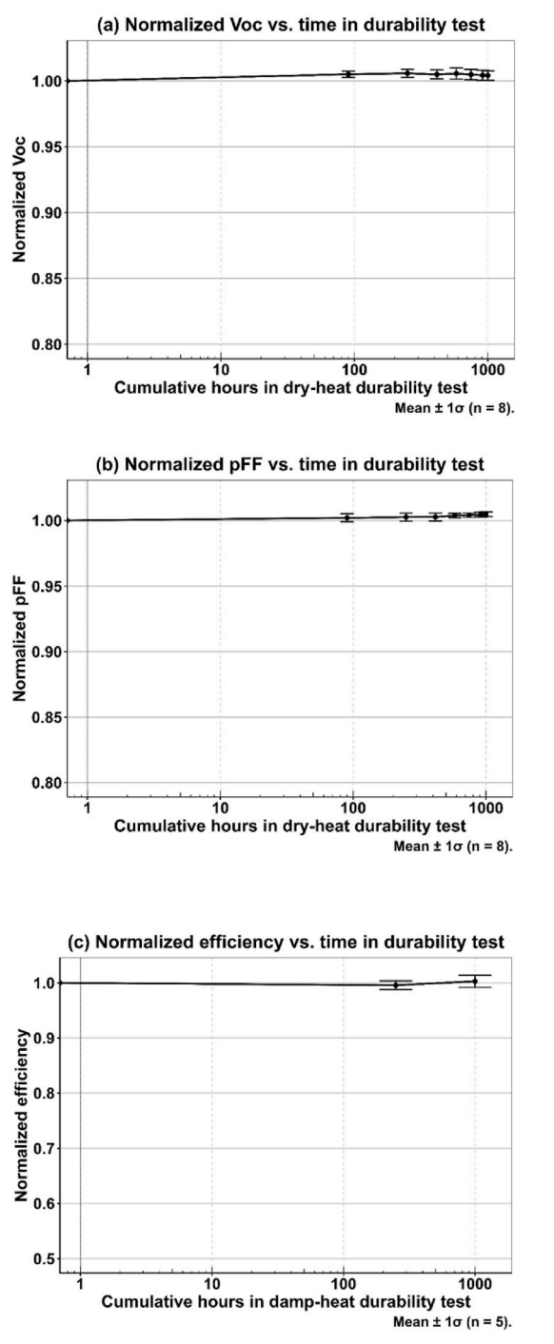
Figure 8: Stability of Voc and pFF under accelerated thermal stress (a, b) and efficiency stability of copper-contacted n-TOPCon mini-modules (c).
Conclusion
This work successfully fabricated a copper-electrode n-TOPCon solar cell using screen-printed copper paste on the rear side and silver on the front, reaching a maximum efficiency of 24.3%—only 0.2% absolute below the all-silver reference.
The copper contact’s contact resistivity is about ten times higher than silver’s and is the main reason for the efficiency gap; further improvement can be achieved by optimizing grid design, firing temperature, and LECO process conditions.
The cells and mini-modules showed excellent stability after 1,000 hours of dry-heat or damp-heat testing, providing a viable path to reduce silver consumption and realize low-cost photovoltaic cell metallization.
By supporting copper replacement of silver electrodes within a low-temperature firing window compatible with industrial lines, this work offers a practical alternative to silver-based metallization.
Frequently Asked Questions (FAQ)Q1: What is the screen-printed copper paste photovoltaic cell process?
The screen-printed copper paste photovoltaic cell process deposits copper-containing paste onto the cell surface through screen printing, followed by low-temperature firing to form metal electrodes.
Compared with silver paste, copper paste is lower in cost, but it must be combined with fire-through copper paste and the LECO process to obtain low contact resistivity and high stability.
Q2: What is the working principle of the LECO process in TOPCon solar cells?The LECO process in TOPCon solar cells relies on laser-enhanced contact optimization: localized laser heating and reverse bias break down insulating SiNx residues and induce copper microcrystals to form within the polysilicon layer, thereby lowering contact resistivity.
Q3: What is the efficiency improvement mechanism of copper-electrode n-TOPCon solar cells?The efficiency improvement mechanism of copper-electrode n-TOPCon solar cells includes using fire-through copper paste to reduce copper diffusion, firing in the optimal 530–535 °C window, and applying the LECO process at 17–19 V to reduce contact resistivity, ultimately enabling 24.3% cell efficiency.
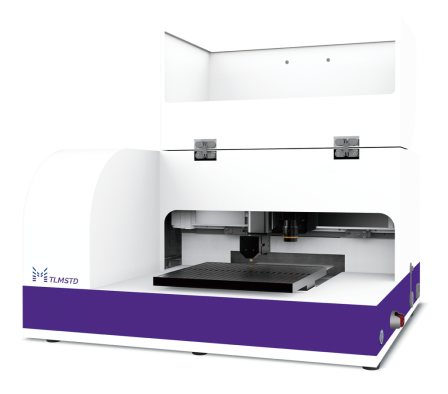
Millennial Solar TLM Contact Resistance Tester
Contact: 400 008 6690
The Millennial Solar TLM Contact Resistance Tester provides fast, flexible, and accurate contact-resistivity measurement.
l Static measurement repeatability ≤ 1%; dynamic measurement repeatability ≤ 3%
l Grid-line resistance accuracy up to 5% or 0.1 Ω/cm
l Switch freely between contact-resistivity and grid-line resistance tests
l Custom probes available for various measurement and analysis needs
Original reference: >24% screen printed Cu contacted n-TOPCon solar cells with successful implementation of LECO process
Related Products


