


Non-contact IV tester

Quantum Efficiency Tester
Accurate EQE, IQE and spectral response measurements—from localized spots to full cells.
The MNPVQE-1800T PRO is designed for photovoltaic research and production, providing accurate measurements of solar cell spectral response, external quantum efficiency (EQE/IPCE) and internal quantum efficiency (IQE). The MNPVQE-1800T PRO supports a wide range of photovoltaic devices, including crystalline silicon, multicrystalline silicon, amorphous silicon, microcrystalline silicon, CdTe, CIGS, CIS, Ge, dye-sensitized, organic/polymer, tandem, multijunction, quantum-well, quantum-dot, chalcogenide and perovskite solar cells.PL/EL Integrated System
PV-Reflectumeter
3D Confocal Microscope
In-Line Four Point Probe Tester
Four Point Probe Tester
In-Line Thin Film Thickness Tester
Raman Spectrometer
FTIR Spectrometer
Spectrophotometer
Automatic Spectroscopic Ellipsometer
Contact Resistance Tester
Ultra depth of field 3D microscope
Auto Visual Tester
VMM PV Vision Measuring Machine
Solar Cell Horizontal Tensile Tester
Steady State Solar Simulator for Solar Cell
Solar Cell UV Aging Test Chamber
Solar Cell Comprehensive Tensile Tester
Visual Inspection Tester
Wet Leakage Current Tester
PV Module EL Tester
PV Module UV Preconditioning Chamber
Steady State Solar Simulator for PV Module
Current Continuous Monitor
Potential Induced Degradation Test
Bypass Diode Tester
LeTID Test System
Reverse Current Overload Tester
Impulse Voltage Tester
Hipot Insulation Tester
Ground Continuity Tester
Hipot Insulation Ground Tester
Damp Heat Test Chamber
Humidity Freeze Test
Thermal Cycle Test Chamber
Dynamic Mechanical Load Tester
Static Mechanical Load Tester
Hail Impact Tester
Robustness of Termination Tester
Module Breakage Tester
Cut Susceptibility Tester
Peel Shear Strength Tester
Universal Testing Machine (Single-arm)
Universal Testing Machine (Double-arm)
Glass Transmittance Tester
Acetic Acid Test Chamber
EVA Degree of Crosslinking Test System
Junction Box Comprehensive Tester
Drop ball tester
Semi-automatic scanning four-probe tester
Stylus Profilometer
Maximum Power Point Tracker
Perovskite Glass Transmittance Tester
Perovskite P1 Laser Scribing Multifunctional Testing Machine
Perovskite Online PL Tester
Perovskite Online Sheet Resistance Tester
Online Perovskite Film Thickness Tester
Perovskite Process Inspection Workstation
Portable EL Tester
Portable Thermal Imaging Tester
Solar Module Multi-Channel Testing System
PV Inverter Power Quality Tester
IV Tester
IVEL Cell Sorting Machine
Low-Loss Singulation of TOPCon Half-Cells Using TLS and Al₂O₃ Edge Passivation
Date : 13 November 2026Views : 80
As TOPCon cell efficiencies continue to increase, newly exposed edges created during half-cell singulation introduce substantial carrier recombination and reduce efficiency. Edge recombination is particularly pronounced in large-format, high-performance cells and has become a key limitation on half-cell performance. Millennial Solar will soon introduce a new non-contact I-V testing solution to support further improvements in cell efficiency.
This study uses thermal laser separation (TLS) to split M10 TOPCon host cells from the front side, followed by passivated edge technology (PET). A 6 nm Al₂O₃ passivation layer is deposited on the half-cell edges by high-throughput plasma-enhanced atomic layer deposition (PE-ALD) and activated by annealing. With either the conventional Ag–Al paste process without LECO or an aluminum-free Ag paste process with laser-enhanced contact optimization (LECO), the optimized TLS cutting loss is only slightly above 0.1 percentage points. Al₂O₃ edge passivation recovers approximately 85% of the cutting-induced pseudo fill factor (pFF) loss, enabling nearly loss-free half-cell fabrication.
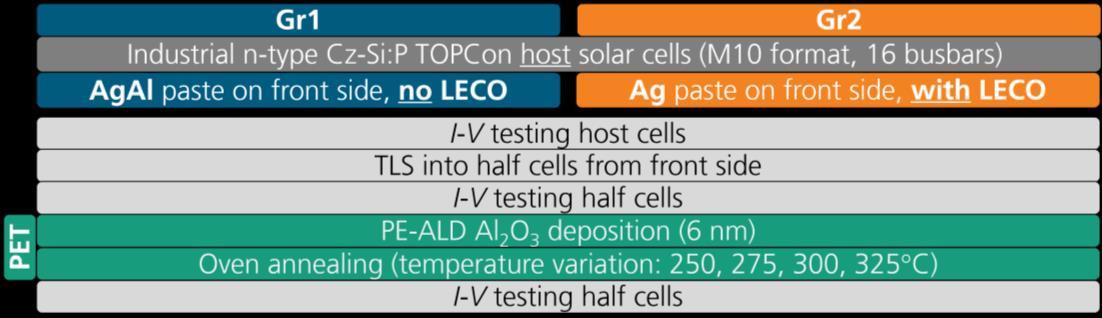
Schematic of the experimental process
Two groups were studied using industrial n-type Czochralski-grown silicon (Cz-Si) TOPCon host cells in the M10 pseudo-square format (182 mm × 182 mm), with 16 busbars.
Gr1 (conventional process): Ag–Al paste was used for the front-side fingers, without LECO.
Gr2 (alternative process): Aluminum-free Ag paste was used for the front-side fingers, followed by LECO. The front-side boron emitter was also optimized accordingly.
The I-V characteristics of the host cells were first measured. The cells were then separated into half-cells by front-side TLS and measured again. Next, the half-cells were stacked in a high-throughput PE-ALD prototype system, where a 6 nm Al₂O₃ layer was deposited on the cut edges. Each batch contained approximately 16,000 half-cells, with a processing time of about one hour. Finally, the cells were annealed at different peak temperatures in a forced-convection oven, followed by another I-V measurement.
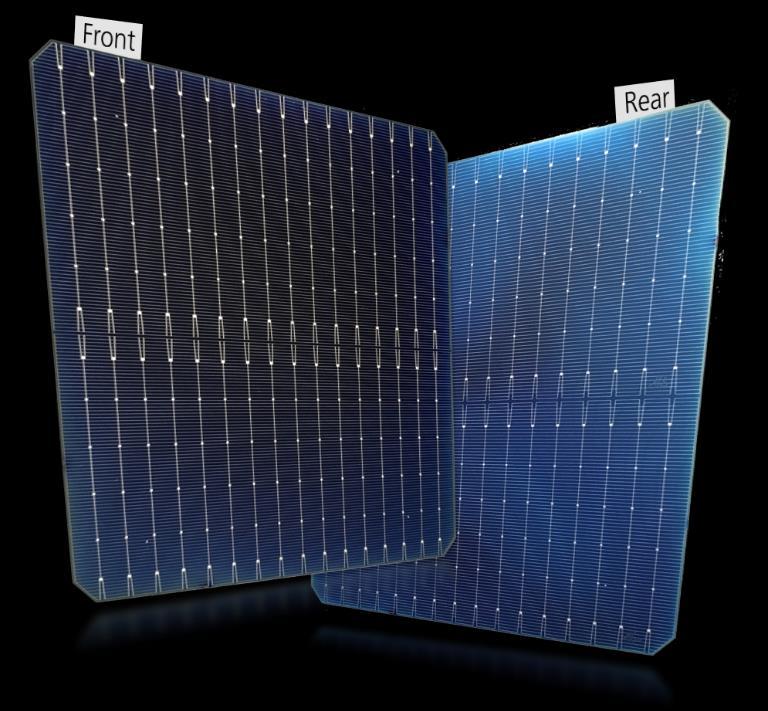
Example front- and rear-side photographs of the investigated M10 n-type Cz-Si TOPCon cells
The average host-cell efficiency was 24.2% for Gr1 and 24.8% for Gr2. With Ag paste and LECO, Gr2 achieved an average Voc 14 mV higher and an average pFF 0.9 percentage points higher, but its average series resistance (Rs) also increased by 0.17 Ω·cm².
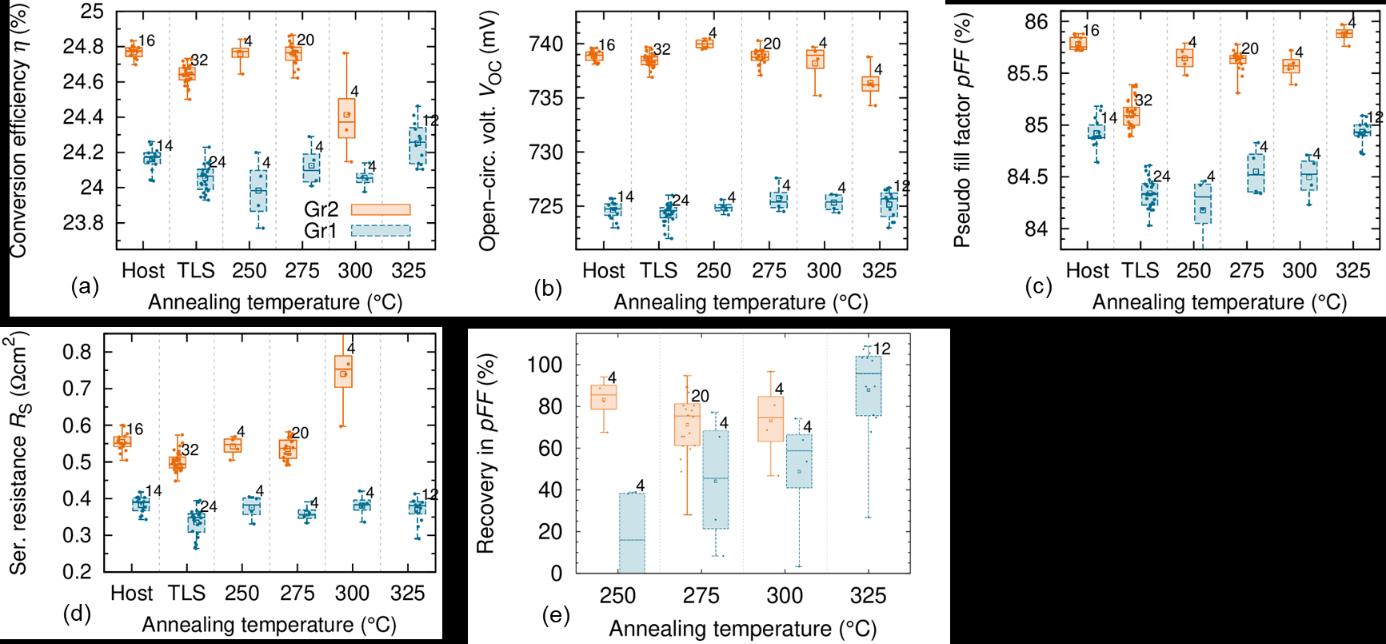
(a–d) I-V data of TOPCon cells in different states: (1) full host cells; (2) half-cells after TLS; and (3–6) half-cells after Al₂O₃ edge passivation and annealing at different peak temperatures. The average series resistance of Gr2 at an annealing temperature of 325°C was approximately 4 Ω·cm². (e) Recovery of cutting-induced pFF loss through Al₂O₃ edge passivation at different annealing temperatures.
After TLS cutting, the Voc loss was very small in both groups (an average change of only −0.4 mV). The main loss was in pFF, which decreased by 0.57 percentage points for Gr1 and 0.67 percentage points for Gr2. The corresponding absolute efficiency losses were 0.11 and 0.13 percentage points, respectively.
Following Al₂O₃ deposition and annealing at different temperatures, pFF recovered substantially in both groups.
Gr1: Rs was insensitive to annealing temperature and remained stable even at 325°C. The greatest pFF improvement occurred at 325°C, almost fully compensating for the cutting loss.
Gr2: At annealing temperatures of 300°C or above, Rs increased markedly and Voc began to decline. At 250°C and 275°C, however, the pFF improvement likewise almost compensated for the cutting loss. This indicates poorer thermal stability of the front-side contacts in Gr2, making it necessary to optimize the annealing temperature according to its processing history.
The recovery rate was calculated as the pFF gain from edge passivation divided by the pFF loss caused by cutting. Gr1 achieved an 88% recovery rate at 325°C, while Gr2 reached 83% at lower temperatures. Recovery above 100% was also observed for Gr1 at 325°C, possibly because annealing improved overall surface passivation.
Ultimately, Al₂O₃ edge passivation almost completely compensated for the initial efficiency losses, which were slightly greater than 0.1 percentage points in both groups.
Combining TLS with high-throughput PE-ALD Al₂O₃ edge passivation enables nearly loss-free cutting of TOPCon half-cells. For both the conventional Ag–Al paste route without LECO and the Ag paste route with LECO, Al₂O₃ edge passivation can recover approximately 85% of the cutting-induced pFF loss and almost fully compensate for the TLS-related efficiency loss of slightly more than 0.1 percentage points. These results demonstrate the potential of this approach for industrial-scale production of high-efficiency TOPCon half-cells.
Q1: What efficiency loss does TLS cause when cutting TOPCon cells into half-cells?
TLS caused absolute efficiency losses of 0.11 percentage points in Gr1 and 0.13 percentage points in Gr2, mainly due to reduced pseudo fill factor (pFF).
Q2: How effective is Al₂O₃ edge passivation in recovering cutting losses?After Al₂O₃ edge passivation and annealing, approximately 85% of the cutting-induced pFF loss was recovered, almost fully compensating for the efficiency loss.
Q3: Does the optimal annealing temperature differ between the two metallization routes?Yes. Gr1 remained stable up to 325°C, while Gr2 showed increased series resistance and reduced Voc at 300°C or above; 250–275°C gave favorable pFF recovery for Gr2.
E-mail: market@millennial.com
With years of experience in photovoltaic testing, Millennial Solar combines mass-production experience with advances in academic research to provide a millisecond-level, non-destructive testing solution for crystalline-silicon solar cells across production lines.
· Millisecond-level measurement: Eliminates time-consuming mechanical movements, matches high-speed production lines, and enables substantially higher throughput.
· Zero physical contact: Suitable for advanced structures such as ultra-thin wafers, busbar-free cells, and BC cells, with no physical damage and no consumables.
· Broad compatibility: PERC / TOPCon / HJT / BC and more.
· Five-dimensional data acquisition: I-V + EQE + SR + Re + PL.
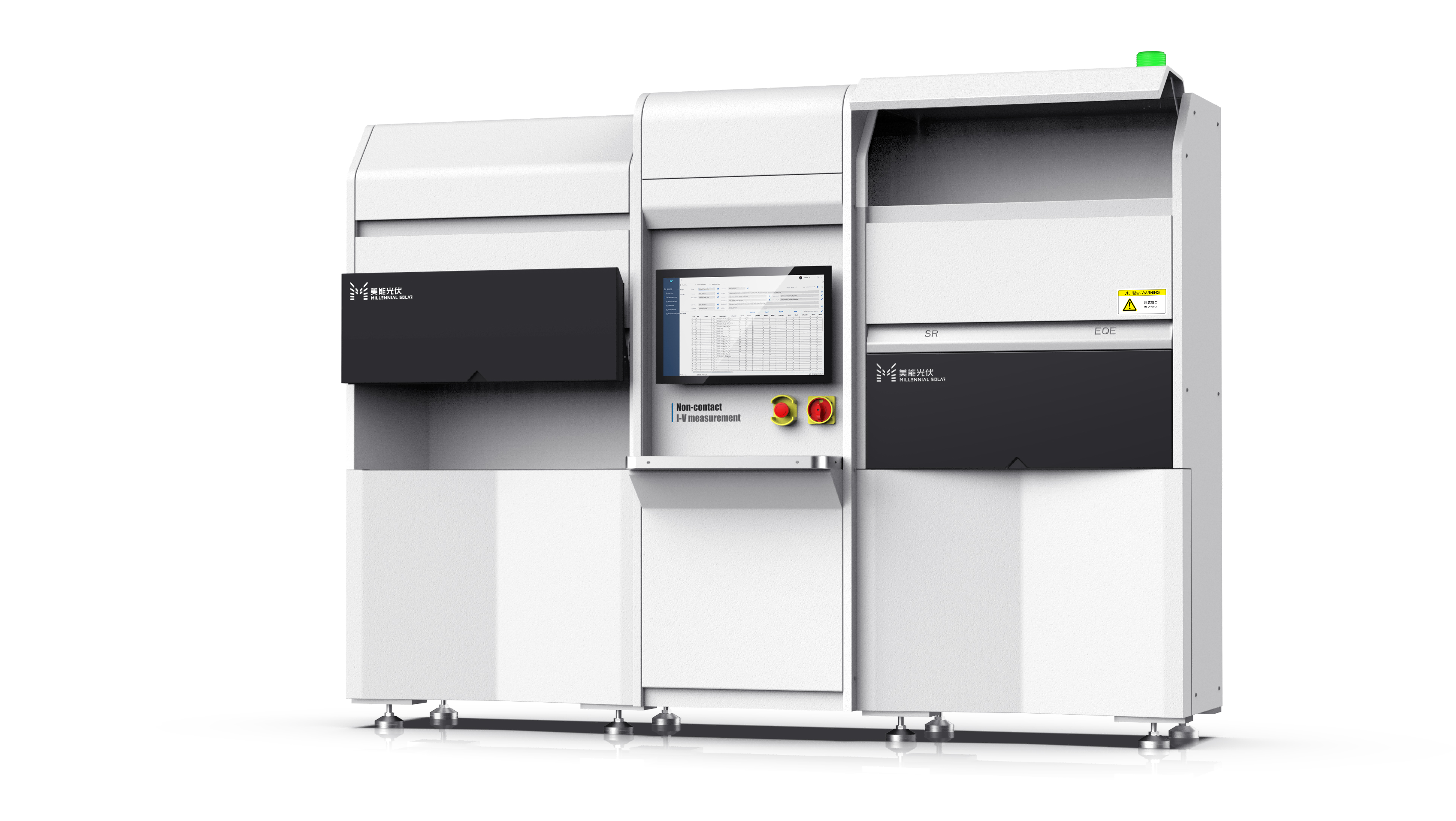
Millennial Solar Non-contact IV tester offers a non-contact approach to high-efficiency solar cell testing. Zero physical contact helps avoid microcrack and contamination risks associated with physical contact, while millisecond-level throughput is designed to match production-line takt time. High-precision measurement data provide a reliable basis for process optimization while reducing maintenance and consumable costs. This supports high-efficiency cell production without requiring the same trade-off between quality and testing efficiency.


