


Non-contact IV tester

Quantum Efficiency Tester
Accurate EQE, IQE and spectral response measurements—from localized spots to full cells.
The MNPVQE-1800T PRO is designed for photovoltaic research and production, providing accurate measurements of solar cell spectral response, external quantum efficiency (EQE/IPCE) and internal quantum efficiency (IQE). The MNPVQE-1800T PRO supports a wide range of photovoltaic devices, including crystalline silicon, multicrystalline silicon, amorphous silicon, microcrystalline silicon, CdTe, CIGS, CIS, Ge, dye-sensitized, organic/polymer, tandem, multijunction, quantum-well, quantum-dot, chalcogenide and perovskite solar cells.PL/EL Integrated System
PV-Reflectumeter
3D Confocal Microscope
In-Line Four Point Probe Tester
Four Point Probe Tester
In-Line Thin Film Thickness Tester
Raman Spectrometer
FTIR Spectrometer
Spectrophotometer
Automatic Spectroscopic Ellipsometer
Contact Resistance Tester
Ultra depth of field 3D microscope
Auto Visual Tester
VMM PV Vision Measuring Machine
Solar Cell Horizontal Tensile Tester
Steady State Solar Simulator for Solar Cell
Solar Cell UV Aging Test Chamber
Solar Cell Comprehensive Tensile Tester
Visual Inspection Tester
Wet Leakage Current Tester
PV Module EL Tester
PV Module UV Preconditioning Chamber
Steady State Solar Simulator for PV Module
Current Continuous Monitor
Potential Induced Degradation Test
Bypass Diode Tester
LeTID Test System
Reverse Current Overload Tester
Impulse Voltage Tester
Hipot Insulation Tester
Ground Continuity Tester
Hipot Insulation Ground Tester
Damp Heat Test Chamber
Humidity Freeze Test
Thermal Cycle Test Chamber
Dynamic Mechanical Load Tester
Static Mechanical Load Tester
Hail Impact Tester
Robustness of Termination Tester
Module Breakage Tester
Cut Susceptibility Tester
Peel Shear Strength Tester
Universal Testing Machine (Single-arm)
Universal Testing Machine (Double-arm)
Glass Transmittance Tester
Acetic Acid Test Chamber
EVA Degree of Crosslinking Test System
Junction Box Comprehensive Tester
Drop ball tester
Semi-automatic scanning four-probe tester
Stylus Profilometer
Maximum Power Point Tracker
Perovskite Glass Transmittance Tester
Perovskite P1 Laser Scribing Multifunctional Testing Machine
Perovskite Online PL Tester
Perovskite Online Sheet Resistance Tester
Online Perovskite Film Thickness Tester
Perovskite Process Inspection Workstation
Portable EL Tester
Portable Thermal Imaging Tester
Solar Module Multi-Channel Testing System
PV Inverter Power Quality Tester
IV Tester
IVEL Cell Sorting Machine
Nature: 27.96% Certified Efficiency in Single-Junction Perovskite Solar Cells and 34.71% Stabilized Output in Tandems Enabled by a Conjugated-Molecule Interface
Date : 27 November 2026Views : 70
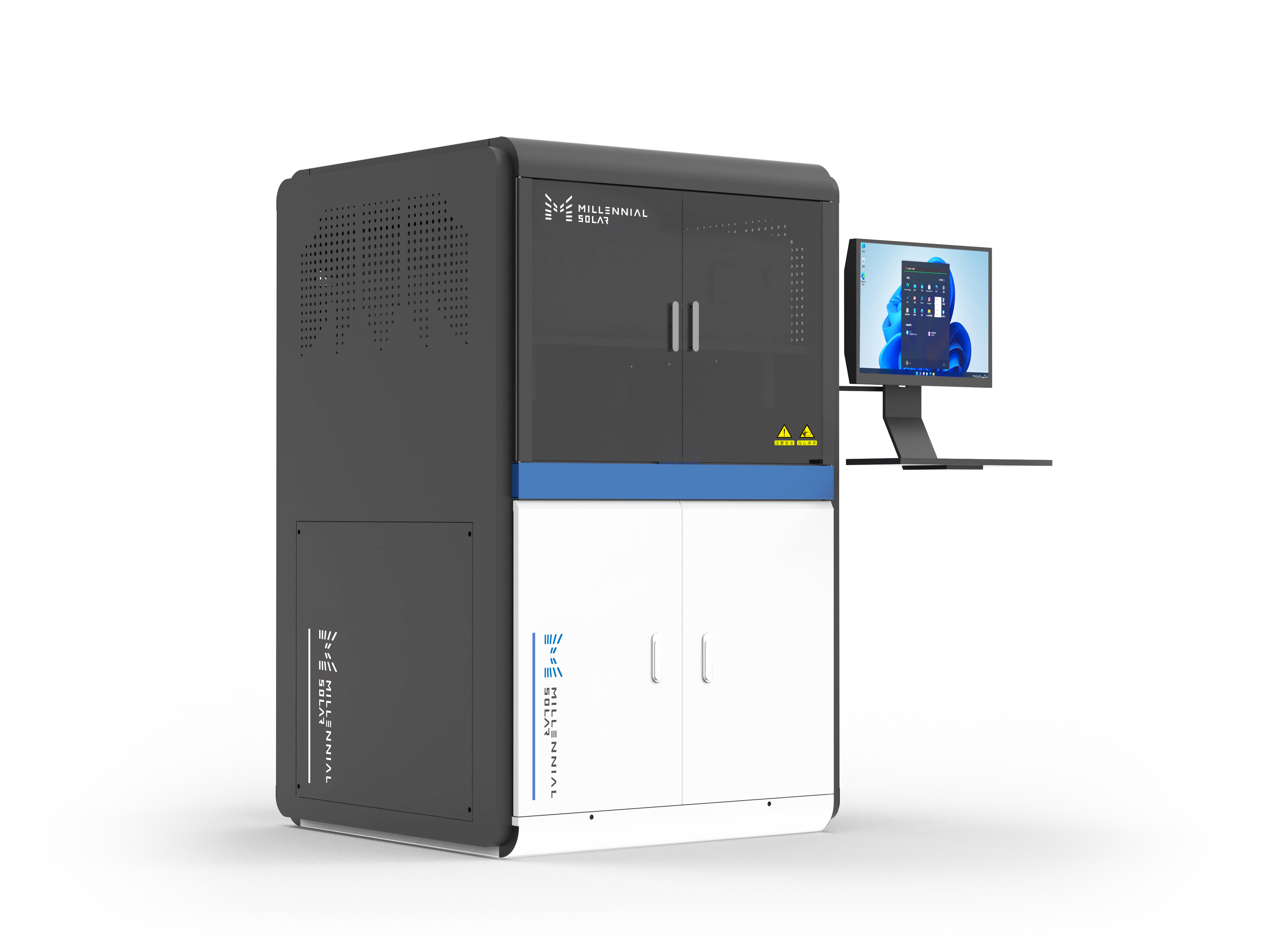
The efficiency of inverted perovskite solar cells (p-i-n PSCs) is limited by charge extraction at the interface between the perovskite absorber and the electron transport layer (ETL), as well as by nonradiative recombination losses. The Millennial Solar Maximum Power Point Tracker (MPPT) uses a Class 3A+ LED solar simulator as its aging light source. It supports multiple temperature-control modes and control of the testing atmosphere, enabling long-term stability testing.
C₆₀ is a commonly used electron-transport material in inverted perovskite solar cells. However, its chemical inertness and weak dipole interaction limit its ability to passivate interfacial defects. Ammonium-salt molecules such as PEAI are commonly introduced for surface modification to reduce interfacial defect density.
One limitation of these materials is that their non-conjugated alkyl spacer groups weaken electronic coupling between the organic molecules and the perovskite surface, creating an additional barrier to electron extraction. Although interfacial defects may be passivated, electron transport can be impeded.
The research team proposed a Band-Edge-Extended Heterointerface strategy. By designing fully conjugated formamidine molecules containing heteroatoms, the team sought to make interfacial passivation and electron transport work synergistically.
The research team designed three fully conjugated formamidine-based molecules for interface modification:
MeOTFI: Amino(5-methoxythiophen-2-yl)methaniminium iodide
TTFI: Amino(thieno[3,2-b]thiophen-2-yl)methaniminium iodide
BTFI: [2,2'-bithiophen]-5-carboximidamide hydroiodide
The conventional non-conjugated molecule PEAI was selected as the control.
Unlike PEAI, which connects the phenyl ring and ammonium group through a vinyl spacer, the three new molecules feature continuous π-conjugated structures. This enables stronger interactions between the organic molecular framework and the electronic states at the perovskite surface.
Density functional theory (DFT) calculations showed that MeOTFI, TTFI, and BTFI induce charge redistribution involving the Pb–I electronic states at the perovskite surface. The heteroatoms S or O participate in regulating the electronic structure, enabling hybridization between the molecular orbitals and the conduction-band states at the perovskite surface.
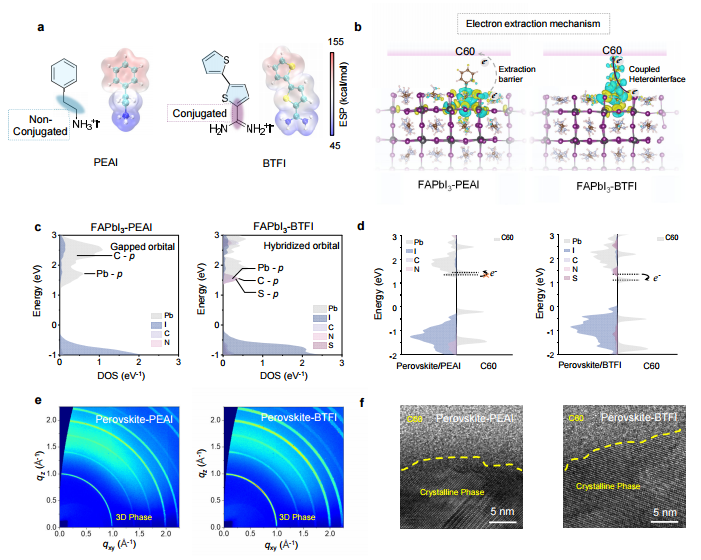
Fully conjugated formamidine molecules construct a coupled perovskite/electron-transport-layer interface. (a) Molecular structures and electrostatic potential distributions of PEAI and BTFI; (b) molecular adsorption configurations and charge-density differences on FAPbI₃; (c) projected density of states; (d) density of states at the perovskite/molecule/C₆₀ interface; (e) GIWAXS patterns; (f) cross-sectional HR-STEM images of the perovskite/C₆₀ interface.
On the BTFI-modified FAPbI₃ surface, the researchers observed more continuous electronic-state connectivity. After C₆₀ was introduced, energy-level alignment between the perovskite and C₆₀ improved at the BTFI-modified interface. The calculated peak-to-peak energy offset was 0.35 eV, which favors electron transfer from the perovskite to C₆₀. Structural analysis also showed that PEAI modification increased the average Pb–I bond length from 3.22 Å to 3.26 Å, whereas the average bond length after treatment with MeOTFI, TTFI, or BTFI was approximately 3.23 Å, close to that of the untreated sample.
To verify the effects of molecular modification, the research team used atomic force microscopy–infrared spectroscopy (AFM-IR), scanning electron microscopy (SEM), X-ray photoelectron spectroscopy (XPS), photoluminescence (PL), and space-charge-limited current (SCLC) measurements.
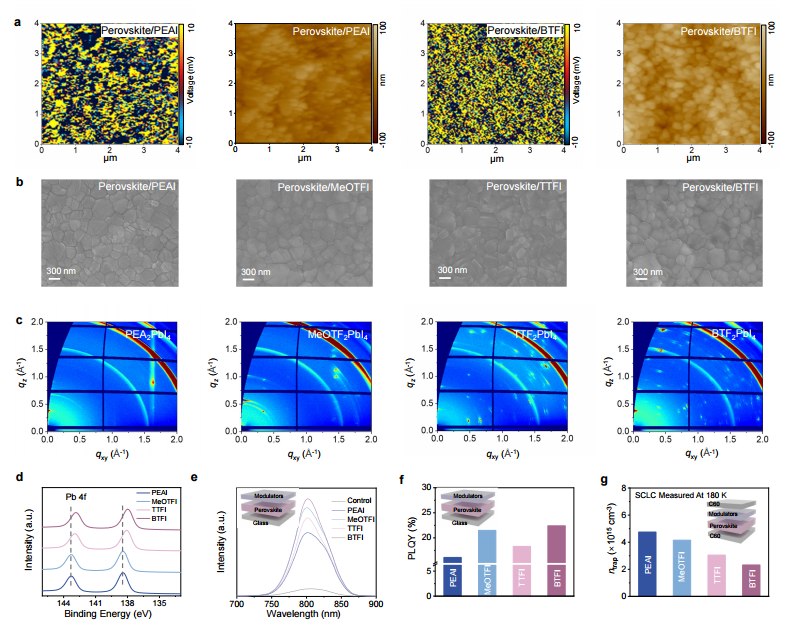
Characterization of the interface modified with conjugated formamidine molecules. (a) AFM-IR surface mapping; (b) SEM images after modification with different molecules; (c) two-dimensional perovskite structures formed in model systems; (d) Pb 4f XPS spectra; (e) PL spectra; (f) PLQY; (g) trap-state density.
AFM-IR results showed a more uniform infrared-signal distribution in the BTFI-treated film, indicating more uniform molecular coverage on the perovskite surface.
In XPS measurements, the binding energies of Pb 4f₇/₂ and Pb 4f₅/₂ in the BTFI-treated sample were 138.0 eV and 142.9 eV, respectively, lower than the corresponding values of 138.4 eV and 143.3 eV in the PEAI-treated sample. This indicates a change in the local chemical environment at the interface.
PL measurements showed higher emission intensity in the BTFI-treated film. Its photoluminescence quantum yield (PLQY) increased from 16.1% for the PEAI-treated sample to 22.4%.
In SCLC measurements conducted at 180 K, the trap-state density of the BTFI-treated sample decreased from 4.75 × 10¹⁵ cm⁻³ in the PEAI control to 2.32 × 10¹⁵ cm⁻³.
The researchers also used GIWAXS and cross-sectional high-resolution scanning transmission electron microscopy (HR-STEM) to examine the film structure. No obvious low-dimensional two-dimensional perovskite phase was detected under the actual device-fabrication conditions.
After reducing interfacial defects, the ability of electrons to transfer efficiently into C₆₀ is another key test of the strategy. The research team used low-energy inverse photoemission spectroscopy (LEIPS) and ultraviolet photoelectron spectroscopy (UPS) to analyze the interfacial energy levels.
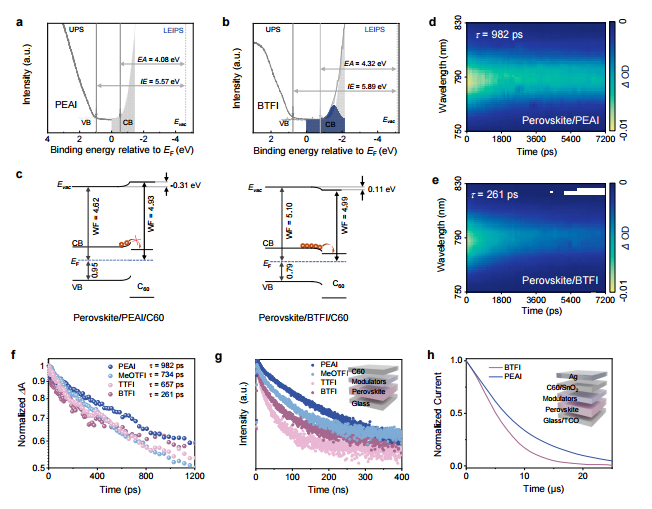
Energy-level alignment and carrier dynamics after conjugated-interface engineering. (a, b) UPS–LEIPS spectra; (c) band alignment of perovskite/PEAI/C₆₀ and perovskite/BTFI/C₆₀; (d, e) transient absorption spectra; (f) TAS decay curves; (g) TRPL curves; (h) transient photocurrent curves.
LEIPS results showed an additional low-energy shoulder in the conduction-band region of perovskites treated with MeOTFI, TTFI, and BTFI. This indicates that the conjugated molecules introduce new electronic-state contributions, consistent with the orbital-hybridization results predicted by DFT.
Combined UPS and LEIPS analyses showed an upward band bending of approximately 310 meV at the PEAI-modified perovskite/C₆₀ interface. In contrast, TTFI and BTFI treatments produced downward band bending of approximately 160 meV and 110 meV, respectively. This change helps establish an interfacial potential distribution more favorable for electron extraction.
Transient absorption spectroscopy (TAS) and time-resolved photoluminescence (TRPL) further confirmed changes in charge-transfer kinetics.
In the perovskite/modified-molecule/C₆₀ structure, the TAS bleach-recovery time after BTFI treatment decreased from 982 ps for the PEAI group to 261 ps, corresponding to an approximately 3.8-fold acceleration. The PL-quenching lifetime decreased from 73 ns to 44 ns.
Device-level transient photocurrent (TPC) measurements showed the same trend. At 83 K, the electron-extraction time (t₉₀) of the BTFI device decreased from 19.93 μs to 12.30 μs.
The study also used PeakForce tunneling atomic force microscopy (PFTUNA) to examine interfacial transport. At a bias of approximately 1 V, the current in the BTFI-treated sample was 5.2 times that of the PEAI-treated sample. Together, these characterization results support that conjugated molecules improve electronic coupling at the perovskite/C₆₀ interface and reduce resistance to electron extraction.
The research team applied BTFI to inverted perovskite solar cells with the following device architecture:
ITO/NiOₓ/4PADCB/PEAI/Perovskite/Interfacial Modulators/C₆₀/SnO₂/Ag.
Here, 4PADCB is a self-assembled hole-selective layer at the buried interface. PEAI improves the wettability of the self-assembled layer surface and suppresses defect formation during perovskite crystallization. BTFI modifies the interface between the perovskite absorber and C₆₀.
The BTFI device achieved a certified power conversion efficiency of 27.96%, an open-circuit voltage (Vₒc) of 1.195 V, and a certified stabilized output efficiency of 27.84%.
For comparison, the PEAI device had a reverse-scan efficiency of 26.57%. The improvement in the BTFI device was mainly associated with reduced interfacial transport losses and suppressed nonradiative recombination, which improved the fill factor and open-circuit voltage.
The strategy was also applied to a 1.68 eV wide-bandgap perovskite, Cs₀.₂₂FA₀.₇₈Pb(I₀.₈₅Br₀.₁₅)₃, to construct monolithic perovskite/silicon tandem solar cells.
The tandem device used a silicon heterojunction (SHJ) as the bottom cell, with BTFI employed to engineer the interface of the wide-bandgap perovskite top cell.
The tandem device achieved a certified reverse-scan efficiency of 34.74% and a certified stabilized output efficiency of 34.71%. The corresponding Vₒc, Jₛc, and FF were 2.009 V, 20.63 mA/cm², and 83.83%, respectively.
EQE measurements yielded integrated current densities of 21.08 mA/cm² for the top cell and 20.69 mA/cm² for the bottom cell, indicating good current matching between the two subcells.
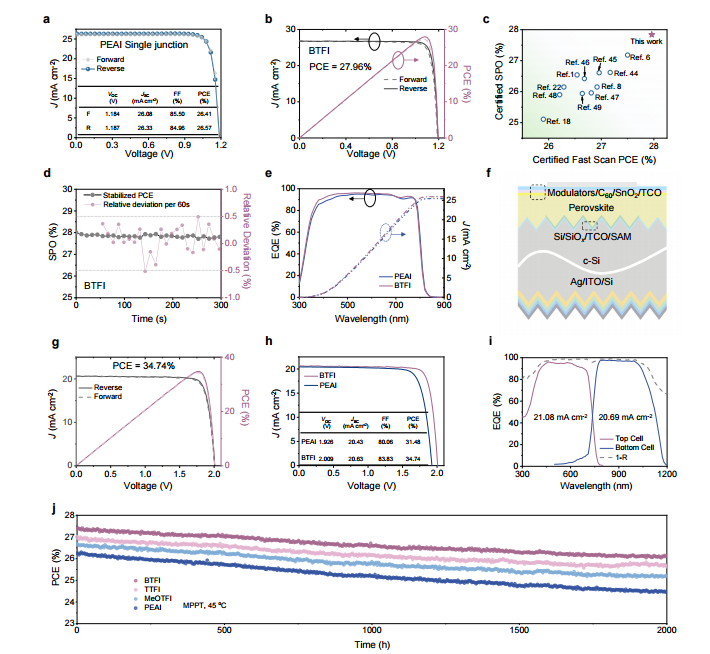
Performance of perovskite single-junction and perovskite/silicon tandem solar cells. (a, b) J–V curves of the single-junction devices; (c) comparison of certified efficiencies; (d) stabilized output of the single-junction device; (e) EQE spectra and integrated current densities; (f) tandem-device architecture; (g, h) J–V curves of the tandem device; (i) EQE spectra of the top and bottom cells; (j) 2,000-hour MPPT stability of devices with different interface modifiers.
In addition to efficiency, the research team evaluated the operational stability of BTFI-modified devices. Under continuous one-sun-equivalent illumination and maximum power point tracking (MPPT), the device temperature was maintained at approximately 45°C. After 2,000 hours of testing, the BTFI-treated single-junction device retained more than 95% of its initial efficiency, outperforming the PEAI control.
In damp-heat testing at 85°C and 85% relative humidity, the BTFI device retained more than 91% of its initial efficiency after 550 hours, compared with approximately 82% for the PEAI control. The researchers also evaluated thermally activated degradation through MPPT tests at different temperatures and Arrhenius analysis. The apparent activation energy of the BTFI device was 0.53 eV, higher than the 0.50 eV measured for the PEAI device.
This study used fully conjugated formamidine molecules to construct a band-edge-extended heterointerface, addressing the weak electronic coupling between conventional perovskite surface-passivation materials and the electron transport layer. BTFI improved interfacial coverage, defect-state density, energy-level alignment, and electron-extraction kinetics, and was validated in both single-junction perovskite cells and perovskite/silicon tandem cells. The characterization methods—including AFM-IR, XPS, PLQY, SCLC, UPS, LEIPS, TAS, and TPC—provided a chain of evidence spanning interfacial chemistry, electronic structure, and device-level charge transport. For the perovskite photovoltaic industry, the relationship between molecular interface design, film-crystallization control, carrier transport, and device stability remains an important research direction for developing high-efficiency devices.
It uses fully conjugated formamidine molecules, such as BTFI, to strengthen electronic coupling between the perovskite absorber and the C₆₀ electron transport layer while passivating interfacial defects.
Q2: What efficiencies did the BTFI-modified devices achieve?The BTFI-treated single-junction perovskite cell achieved 27.96% certified efficiency. The perovskite/silicon tandem cell achieved 34.74% certified reverse-scan efficiency and 34.71% certified stabilized output efficiency.
Q3: How stable was the BTFI-treated perovskite device?Under continuous one-sun-equivalent illumination and MPPT at approximately 45°C, the single-junction device retained more than 95% of its initial efficiency after 2,000 hours. It retained more than 91% after 550 hours of damp-heat testing at 85°C and 85% relative humidity.
E-mail: market@millennialsolar.com
The Millennial Solar perovskite MPPT tester uses a Class 3A+ LED solar simulator as its aging light source. Building on the previous generation, it offers an expanded spectral range of 300–1700 nm (AM0), an AAA spectral classification (AM0), and 24 independently adjustable channels. It supports research on perovskite solar cells, space photovoltaics, and tandem cells (2T/3T/4T).
▶ Light-source classification: AAA (AM0), with a spectral range of 300–1700 nm, suitable for space-photovoltaic testing.
▶ Independently controllable spectral bands: 24 adjustable channels (AM0) for matching the bandgaps of subcells in triple- and quadruple-junction tandem devices.
▶ Large-sample fixture: Supports tandem cells up to 210 × 105 mm. Gold-wire pressure contacts on the front and rear sides provide electrode connections.
▶ Environmental control: Semiconductor temperature control from 15°C to 100°C; testing is also supported in a moisture-free and oxygen-free nitrogen atmosphere.
Maximum Power Point Tracker (MPPT) is not only a performance-verification instrument but also an effective testing platform for research on perovskite and tandem solar cells.
Original research reference: Band-Edge-Extended Heterointerfaces for Perovskite Solar Cells and Tandems.
Disclaimer: Articles published by this account, whether original or reproduced, are intended solely for academic sharing and the dissemination of industry-related information. Unauthorized plagiarism, alteration, quotation, or reproduction that infringes the account’s rights is prohibited. The content is for reference only. If any copyright issue arises, please contact us for removal.
Related Products


