


Non-contact IV tester

Quantum Efficiency Tester
PL/EL Integrated System
PV-Reflectumeter
3D Confocal Microscope
In-Line Four Point Probe Tester
Four Point Probe Tester
In-Line Thin Film Thickness Tester
Raman Spectrometer
FTIR Spectrometer
Spectrophotometer
Automatic Spectroscopic Ellipsometer
Contact Resistance Tester
Ultra depth of field 3D microscope
Auto Visual Tester
VMM PV Vision Measuring Machine
Solar Cell Horizontal Tensile Tester
Steady State Solar Simulator for Solar Cell
Solar Cell UV Aging Test Chamber
Solar Cell Comprehensive Tensile Tester
Visual Inspection Tester
Wet Leakage Current Tester
PV Module EL Tester
PV Module UV Preconditioning Chamber
Steady State Solar Simulator for PV Module
Current Continuous Monitor
Potential Induced Degradation Test
Bypass Diode Tester
LeTID Test System
Reverse Current Overload Tester
Impulse Voltage Tester
Hipot Insulation Tester
Ground Continuity Tester
Hipot Insulation Ground Tester
Damp Heat Test Chamber
Humidity Freeze Test
Thermal Cycle Test Chamber
Dynamic Mechanical Load Tester
Static Mechanical Load Tester
Hail Impact Tester
Robustness of Termination Tester
Module Breakage Tester
Cut Susceptibility Tester
Peel Shear Strength Tester
Universal Testing Machine (Single-arm)
Universal Testing Machine (Double-arm)
Glass Transmittance Tester
Acetic Acid Test Chamber
EVA Degree of Crosslinking Test System
Junction Box Comprehensive Tester
Drop ball tester
Semi-automatic scanning four-probe tester
Stylus Profilometer
Maximum Power Point Tracker
Perovskite Glass Transmittance Tester
Perovskite P1 Laser Scribing Multifunctional Testing Machine
Perovskite Online PL Tester
Perovskite Online Sheet Resistance Tester
Online Perovskite Film Thickness Tester
Perovskite Process Inspection Workstation
Portable EL Tester
Portable Thermal Imaging Tester
Solar Module Multi-Channel Testing System
PV Inverter Power Quality Tester
IV Tester
IVEL Cell Sorting Machine
All-Perovskite Photovoltaic Cells: MPPT Analysis for Wearable Devices — 26.11% PCE with Verified Long-Term Stability
Date : 29 July 2026Views : 1750
All-perovskite photovoltaic cells achieve 26.11% PCE with MPPT-verified long-term stability. Learn how EVI₂ dual-function material powers wearable devices via flexible PVB technology.
Introduction
All-perovskite photovoltaic cells are transforming power solutions for portable wearable devices. Conventional photovoltaic power supply batteries suffer from poor integration and miniaturization — but all-perovskite photovoltaic cells overcome both by using perovskite simultaneously as the light-absorbing layer and cathode. This study introduces a dual-function material sharing strategy via ethyl violete diiodide (EVI₂), pushing all-perovskite photovoltaic cells to a record power conversion efficiency (PCE) of 26.11%. Rigorous maximum power point tracking (MPPT) — the gold-standard MPPT methodology for operational durability — validates exceptional long-term stability: 96.2% retention after 1,000 hours. The integrated all-perovskite photovoltaic battery (PVB) system, confirmed by maximum power point tracking analysis, delivers 24-hour continuous power to a wearable glucose monitor — proving that all-perovskite photovoltaic cells are transitioning from the lab to real-world portable wearable device applications.
What Are All-Perovskite Photovoltaic Cells?
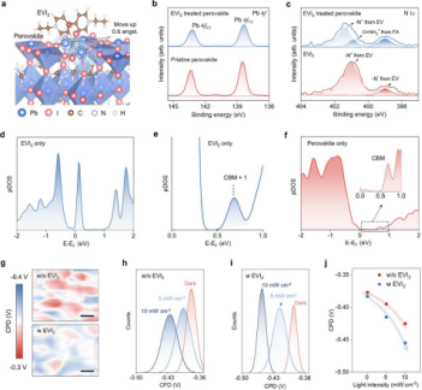
Interaction Between EVI₂ and Perovskite
All-perovskite photovoltaic cells are perovskite solar cells (PSCs) where every functional layer, from light absorption to charge storage, leverages perovskite materials. Unlike silicon-based photovoltaics requiring rigid wafers processed at ~1,000°C, perovskite solar cells can be solution-processed at low temperatures on flexible substrates such as PEN and PET films. This dual-function architecture — absorbing sunlight and storing electrochemical energy within a single material platform — eliminates the integration complexity that has historically prevented photovoltaic power supply batteries from powering portable wearable devices.
Perovskite Solar Cell Efficiency: 26.11% PCE
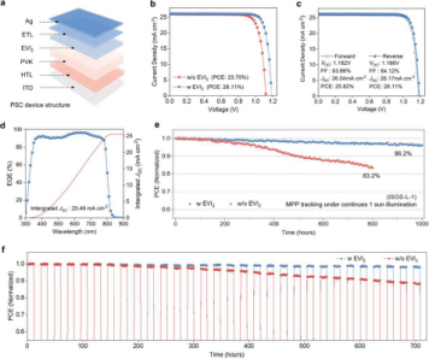
Photovoltaic Performance of Perovskite Solar Cells (PSCs)
The power conversion efficiency (PCE) of perovskite solar cells has surged from 3.8% (2009) to a certified 26.7% (2024). In this study, the champion all-perovskite photovoltaic cell achieved 26.11% PCE — among the highest reported for single-junction perovskite solar cells. Key metrics: short-circuit current density 26.17 mA cm⁻², open-circuit voltage 1.186 V, and fill factor 84.12%, with negligible hysteresis (<1.1%).
XPS and DFT calculations reveal that EVI₂ increases electron density at Pb atoms on the perovskite surface and induces a favorable conduction band minimum shift, facilitating rapid interfacial charge extraction. The p-i-n structured device employs C₆₀ as the electron transport layer and p-type organic small molecules as the hole transport layer.
Non-Radiative Recombination SuppressionEVI₂ forms a surface modification layer rather than altering the bulk structure. KPFM confirms uniform surface potential distribution. Key improvements: PL lifetime doubled from 223.5 ns to 457.4 ns, and trap filling limit voltage (defect density proxy) reduced from 0.56 V to 0.31 V — directly suppressing non-radiative recombination.
MPPT Analysis: Long-Term Stability Verification
Long-term stability is the critical barrier to commercial perovskite solar cells. This study employs maximum power point tracking (MPPT) — the gold standard for operational stability assessment — using AAA-grade LED solar simulators with independently controllable spectral bands (300–400, 400–750, and 750–1200 nm). MPPT continuously tracks peak power output under sustained illumination, simulating real-world deployment far more accurately than dark storage tests.
ISOS-L Protocol Stability ResultsProtocol | Conditions | EVI₂-Modified PSC | Unmodified PSC |
ISOS-L-1 | 1-sun continuous, 1,000 h | 96.2% retention | 83.2% (800 h) |
ISOS-L-3 | Enhanced environmental stress, 1,000 h | 93.7% retention | 76.2% |
Light-switching | 12 h light/12 h dark, 30 cycles, 720 h | 2% loss | 11% loss |
These maximum power point tracking metrics confirm that all-perovskite photovoltaic cells meet the long-term stability requirements of practical portable electronic devices. The <2% degradation under light-switching is especially relevant for wearable devices transitioning between sunlight and indoor environments.
All-Perovskite PVB: Integrated Energy Conversion + Storage
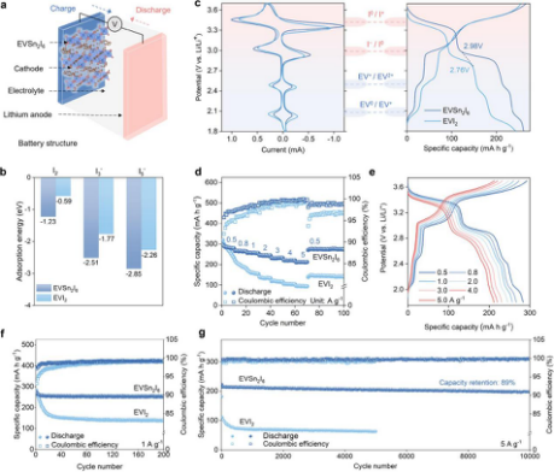
Electrochemical Performance of Rechargeable Batteries
A perovskite micro-module (23.60% efficiency, Voc = 4.41 V, four series-connected sub-cells) was integrated with an EVSnI₆ cathode battery to form an all-perovskite integrated photovoltaic battery (PVB). The EVSnI₆ cathode, with a one-dimensional organic-inorganic hybrid structure, enables multi-electron reversible redox reactions (EV⁰/EV⁺/EV²⁺ and I⁻/I⁰/I⁺) at 2.98 V average voltage. Electrochemical performance:
l 296.1 mAh g⁻¹ at 0.5 A g⁻¹; 212.4 mAh g⁻¹ at 5 A g⁻¹
l 89% capacity retention after 10,000 cycles at 5 A g⁻¹ (0.0011% decay per cycle)
The rigid all-perovskite PVB achieved 18.54% overall energy conversion efficiency over 100 photovoltaic charge-discharge cycles. The flexible PVB on PEN substrate reached 17.62% efficiency, maintaining performance after 1,000 bending cycles (8 mm radius) across a temperature range of -20°C to 40°C.
Flexible Perovskite for Wearable Electronics
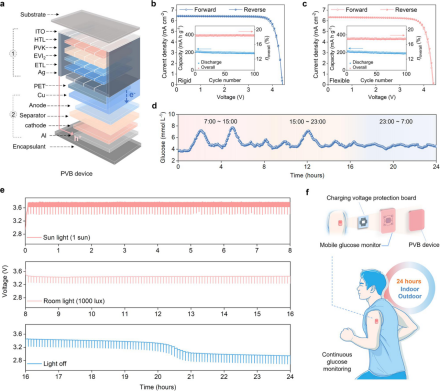
Performance of All-Perovskite Photovoltaic Power Battery (PVB)
The flexible all-perovskite photovoltaic cells, integrated with an intelligent charging protection board, delivered 24-hour uninterrupted power to a commercial continuous glucose monitor — operating stably under sunlight, indoor lighting, and darkness. This marks a milestone for perovskite solar cells in wearable devices: any portable electronic device requiring autonomous power — medical patches, fitness trackers, environmental sensors — can leverage the cordless power supply enabled by lightweight flexible photovoltaic harvesting with integrated storage on a single thin-film platform.
FAQQ: What efficiency do all-perovskite photovoltaic cells achieve for portable wearable devices?
A: All-perovskite photovoltaic cells in this study achieved 26.11% PCE, with the flexible all-perovskite photovoltaic battery delivering 17.62% overall energy conversion efficiency — sufficient for powering wearable electronics like continuous glucose monitors.
Q: How does MPPT analysis validate perovskite solar cell long-term stability?A: Maximum power point tracking (MPPT) continuously monitors peak power under sustained illumination, providing long-term stability data that dark storage tests cannot. MPPT analysis confirmed 96.2% PCE retention after 1,000 hours (ISOS-L-1) and only 2% degradation across 30 light-dark cycles for EVI₂-modified perovskite solar cells.
Q: What role does EVI₂ play in high-efficiency perovskite solar cells?A: EVI₂ (ethyl violete diiodide) is a dual-function material — it forms a surface modification layer suppressing non-radiative recombination (PL lifetime doubled, defect density halved) in perovskite solar cells, while also serving as the structural template for the EVSnI₆ cathode in the integrated perovskite photovoltaic battery.
Q: Can flexible perovskite photovoltaic batteries power wearable medical devices?A: Yes. The flexible PVB demonstrated 24-hour uninterrupted power to a continuous glucose monitor across a temperature range from -20°C to 40°C and maintained performance after 1,000 bending cycles — validating all-perovskite photovoltaic cells as a cordless power supply for next-generation portable electronic devices.
Millennial Perovskite Maximum Power Point Tracking Test MPPT
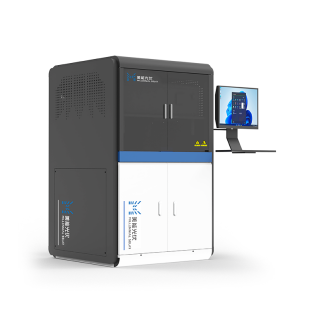
The Perovskite Maximum Power Point Tracking Test MPPT utilizes A+AA+ grade LED solar simulators as aging light sources. With its advanced technology and multifunctional design, it provides robust support for perovskite solar cell research.
▶ Light Source Rating: A+AA+, Spectral Matching Grade A+, Uniformity Grade A, Long-Term Stability Grade A+
▶ Effective Spot Size: ≥250*250mm (customizable)
▶ Adjustable Irradiance: 0.2-1.5 sun, adjustable in 0.1 sun increments
▶ Independently Controllable Power Bands: 300-400 nm / 400-750 nm / 750-1200 nm
Millennial Perovskite Maximum Power Point Tracking (MPPT) Testing is not only a performance verification tool but also provides robust support for perovskite solar cell (PSC) research.
Related Products


