


Non-contact IV tester

Quantum Efficiency Tester
PL/EL Integrated System
PV-Reflectumeter
3D Confocal Microscope
In-Line Four Point Probe Tester
Four Point Probe Tester
In-Line Thin Film Thickness Tester
Raman Spectrometer
FTIR Spectrometer
Spectrophotometer
Automatic Spectroscopic Ellipsometer
Contact Resistance Tester
Ultra depth of field 3D microscope
Auto Visual Tester
VMM PV Vision Measuring Machine
Solar Cell Horizontal Tensile Tester
Steady State Solar Simulator for Solar Cell
Solar Cell UV Aging Test Chamber
Solar Cell Comprehensive Tensile Tester
Visual Inspection Tester
Wet Leakage Current Tester
PV Module EL Tester
PV Module UV Preconditioning Chamber
Steady State Solar Simulator for PV Module
Current Continuous Monitor
Potential Induced Degradation Test
Bypass Diode Tester
LeTID Test System
Reverse Current Overload Tester
Impulse Voltage Tester
Hipot Insulation Tester
Ground Continuity Tester
Hipot Insulation Ground Tester
Damp Heat Test Chamber
Humidity Freeze Test
Thermal Cycle Test Chamber
Dynamic Mechanical Load Tester
Static Mechanical Load Tester
Hail Impact Tester
Robustness of Termination Tester
Module Breakage Tester
Cut Susceptibility Tester
Peel Shear Strength Tester
Universal Testing Machine (Single-arm)
Universal Testing Machine (Double-arm)
Glass Transmittance Tester
Acetic Acid Test Chamber
EVA Degree of Crosslinking Test System
Junction Box Comprehensive Tester
Drop ball tester
Semi-automatic scanning four-probe tester
Stylus Profilometer
Maximum Power Point Tracker
Perovskite Glass Transmittance Tester
Perovskite P1 Laser Scribing Multifunctional Testing Machine
Perovskite Online PL Tester
Perovskite Online Sheet Resistance Tester
Online Perovskite Film Thickness Tester
Perovskite Process Inspection Workstation
Portable EL Tester
Portable Thermal Imaging Tester
Solar Module Multi-Channel Testing System
PV Inverter Power Quality Tester
IV Tester
IVEL Cell Sorting Machine
Copper Paste for PERC Solar Cells: Performance & Reliability
Date : 31 July 2026Views : 2720
Crystalline silicon silicon wafer solar cells occupy about 97% of the global market share, and reducing silver consumption has become critical to meet future production and cost targets. Copper paste has become an ideal alternative to silver due to its low cost, abundant reserves, and similar resistivity, but it suffers from oxidation susceptibility, copper diffusion to silicon, and reduced minority carrier lifetime. In this study, we investigate how optimizing copper paste properties can reduce degradation of copper metallization cells and improve the reliability of PERC solar cells. By applying screen-printed copper paste to PERC solar cells, we demonstrate that copper paste can achieve competitive efficiency while maintaining long-term reliability for PERC solar cells.
Research Methodologyof CopperPaste for PERC Solar CellsSelective Emitter PERC Solar Cell Preparation
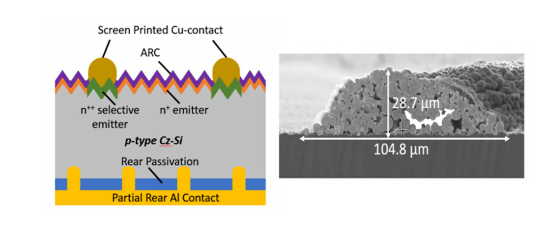
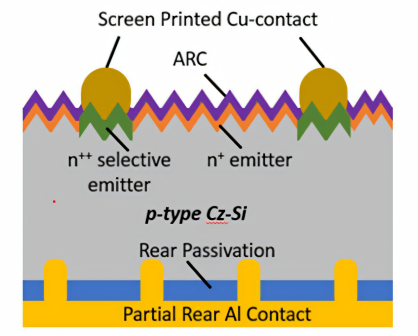
Schematic diagram of selective emitter PERC cell
Selective emitter PERC solar cells were prepared on monocrystalline p-type silicon wafers of M6 size (166 mm × 166 mm). The front-side grid lines were screen-printed using copper paste, and the back-side was aluminum (Al) contact with localized contact openings. This screen printing approach enables cost-effective copper metallization for PERC solar cells.
Copper metallization was performed in two steps. First, aluminum is printed on the backside of the silicon wafer, dried and sintered at ~751°C, followed by front-side grid printing with copper paste and sintering at ~630°C. A reference cell with front-side silver printing was prepared using the same silicon wafers and a co-sintering sintering temperature of 751°C for comparison with copper paste PERC solar cells.
Copper Paste Characteristics and SEM/EDS Analysis
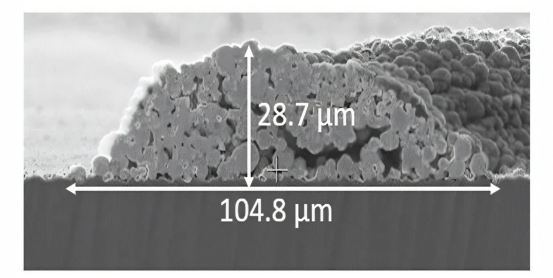
Scanning electron microscope image of a cross-section of a copper finger strip
The copper paste was optimized for a peak sintering temperature of ~630°C and a resistivity of ~2-3 × 10⁻⁵ Ω-cm. The cross-section of the copper paste finger strip was analyzed by SEM (scanning electron microscopy) and EDS (energy dispersive X-ray spectroscopy). It was found that the width of the copper paste finger strip was ~100 μm, the height was 28.7 μm, and the aspect ratio was 0.27.
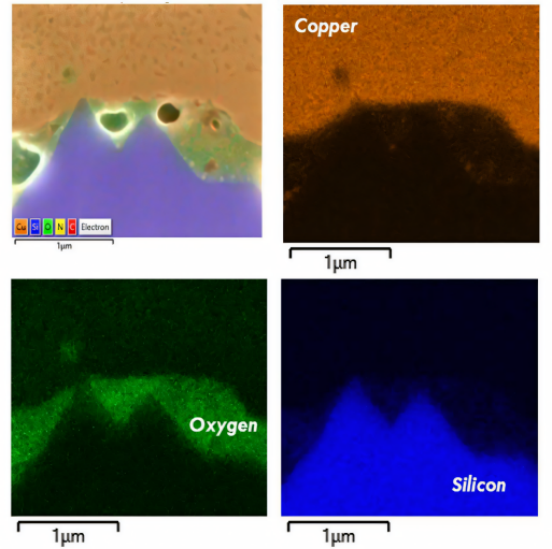
EDS analysis of different versions of copper pastes
The initial version of copper paste has a thick oxide layer between copper and silicon wafer. This thick oxide layer increases the series resistance of the PERC solar cell and hinders carrier transmission, leading to lower efficiency. Newer versions of copper paste have a thinner oxide layer that facilitates carrier transport while still acting as a barrier against copper diffusion into silicon, ensuring the PERC solar cell maintains good reliability after 1500 hours of damp heat testing.
Electrical Performance Analysis of Copper Metallization
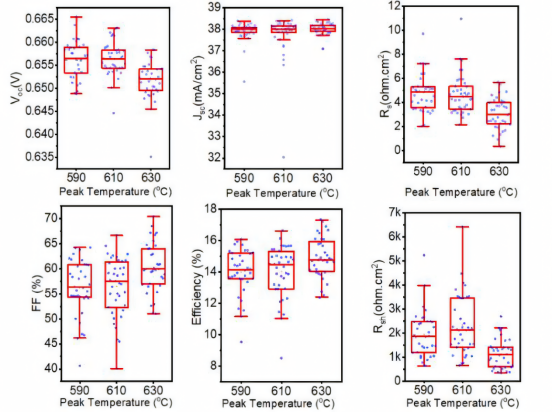
Distribution of IV parameters for a group of 100 PERC cells at different peak sintering temperatures
Sintering Temperature Effects on PERC Solar Cell Efficiency100 PERC solar cells with copper paste copper metallization were divided into three groups, each corresponding to a different peak sintering temperature: 590°C, 610°C, and 630°C.
l Voc: There is a slight tendency for Voc to increase as the sintering temperature increases, suggesting higher sintering temperature may help increase the open-circuit voltage of PERC solar cells.
l Jsc: Jsc does not change significantly at different sintering temperatures, indicating sintering temperature has a small effect on short-circuit current density of copper paste cells.
l Fill Factor (FF): FF is highest at a sintering temperature of 630°C, indicating that optimized sintering temperature can significantly increase the fill factor of PERC solar cells, thus improving overall efficiency.
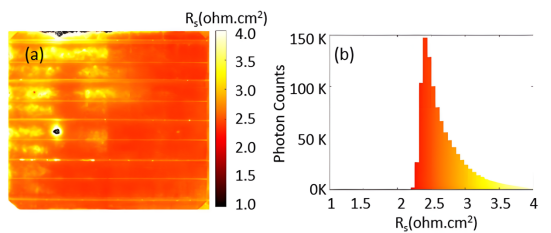
Series Resistance Distribution of Copper Metallized M6 Size Cells
Efficiency at different sintering temperatures for copper paste PERC solar cells:
· 590°C: Efficiency is lower than 19.25%.
· 610°C: Efficiency improved but still lower than at 630°C sintering temperature.
· 630°C: The highest efficiency of 19.25% for copper paste PERC solar cells.
Series Resistance Distribution in Copper Metallization Cells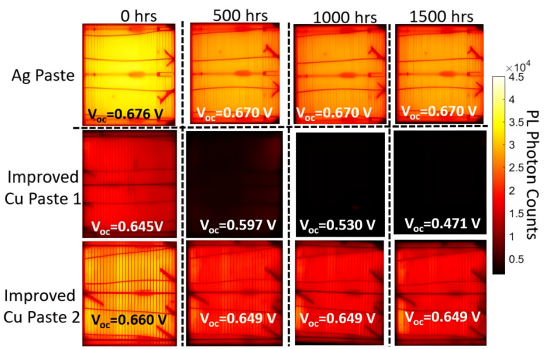
PL images before and after accelerated testing (85°C/85% humidity hot and humid environment)
Series resistance (Rs) color coding shows series resistance values across the PERC solar cell. Darker colors indicate higher series resistance. Series resistance is an important parameter affecting the fill factor and overall efficiency of copper paste PERC solar cells. Higher series resistance increases voltage drop, reducing power output.
Color coding quickly identifies areas with higher series resistance in copper paste cells. These areas may be due to uneven copper paste finger strips, uneven oxide layers, or other copper metallization defects.
Reliability Testing of Copper Paste PERC Solar CellsDamp Heat Test Results — PL Image Analysis
Damp heat testing was conducted for 1500 hours at 85°C and 85% humidity. PL images were observed every 500 hours to monitor copper paste PERC solar cell reliability:
l Initial state: Before the damp heat test, PL images showed brighter overall glow, indicating good initial performance of copper paste cells.
l Performance degradation: As damp heat test time increases, PL images show gradually decreasing luminous intensity, especially in cracked areas of PERC solar cells.
l Improvement effect: After improving copper paste properties, PL images show significant reduction in performance degradation, confirming optimized copper paste improves reliability of PERC solar cells.
DLIT Analysis After Damp Heat Test
Image observed by DLIT after damp heat test
The PERC solar cell underwent 500 hours of damp heat testing at 85°C/85% humidity, followed by DLIT testing at reverse bias  . DLIT image bright spots indicate bypass diode locations — defective areas causing current to bypass its normal path, degrading PERC solar cell performance. DLIT images show visible bypass diodes after damp heat testing, indicating degradation at the Cu/Si interface of copper paste cells.
SEM and EDS Analysis of Copper Paste Contacts
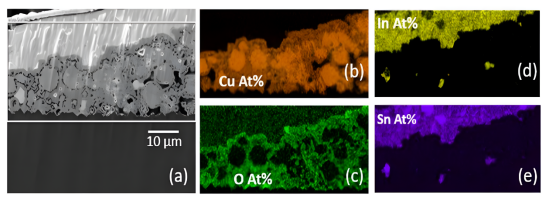
SEM and EDS analysis of copper contacts after ultrasonic welding
Cross-sectional SEM images show the bonding of copper paste contacts to solder. EDS analysis provides chemical composition information of the soldered area, where distribution of copper (Cu), tin (Sn) and indium (In) can be observed. Uniform elemental distribution in SEM/EDS results indicates good mixing during soldering of copper paste contacts, with no obvious copper diffusion or elemental segregation.
Frequently Asked QuestionsQ: What is the optimal sintering temperature for copper paste on PERC solar cells?A: The optimal peak sintering temperature for copper paste on PERC solar cells is 630°C sintering temperature, which achieves the highest efficiency of 19.25% and the best fill factor. At 630°C sintering temperature, the copper paste forms optimal contact with the silicon wafer while maintaining a protective oxide layer against copper diffusion.
Q: How does copper paste compare to silver paste for PERC solar cells?A: Copper paste performance on PERC cells demonstrates that copper paste is a viable cost-effective alternative to silver. Screen-printed copper paste achieves 19.25% efficiency on PERC solar cells, with copper metallization offering similar resistivity at significantly lower material cost.
Q: What reliability tests were performed on copper paste PERC solar cells?A: Damp heat reliability testing 1500 hours was conducted at 85°C/85% humidity conditions. PL image and DLIT analysis confirmed that optimized copper paste PERC solar cells maintain good performance after 1500-hour damp heat testing, demonstrating excellent reliability for screen-printed copper metallization.
Q: How is copper diffusion into silicon prevented in copper paste PERC solar cells?A: The oxide layer between copper paste and the silicon wafer acts as a barrier against copper diffusion into silicon. Newer versions of copper paste maintain a thin but sufficient oxide layer that prevents copper diffusion into silicon while facilitating carrier transport, ensuring PERC solar cell reliability.
Q: What efficiency can screen-printed copper paste achieve on selective emitter PERC solar cells?A: Screen-printed copper metallization on selective emitter PERC solar cells achieves cell efficiency 19.25% at the optimal 630°C sintering temperature. This selective emitter PERC architecture combined with optimized copper paste demonstrates strong potential for cost-effective PV production.
Conclusion
The optimized copper paste achieves a PERC solar cell efficiency of 19.25% at a sintering temperature of 630°C, and the PERC solar cell maintains good performance after 1500 hours of damp heat testing at 85°C/85% humidity. These results show that copper paste has great potential for copper metallization to reduce PV production costs while meeting high efficiency and reliability requirements for PERC solar cells. The SEM/EDS and DLIT analysis confirms that the oxide layer effectively prevents copper diffusion, making screen-printed copper paste a proven solution for next-generation PERC solar cells.
Millennial Online Four Probe Square Resistance Meter
email:market@millennialsolar.com
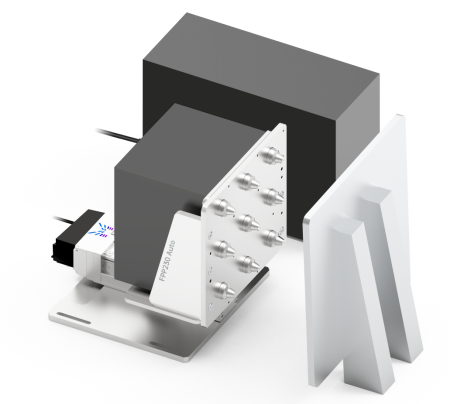
Millennial Online Square Resistance Tester is an online four-probe square resistance tester specially designed for PV process monitoring, which can quickly and automatically scan the maximum 230mm×230mm samples to obtain the square resistance/resistivity distribution information of different positions of the samples.
l Maximum sample meets 230mm×230mm
l Measurement range: 1mΩ~100MΩ
l Measurement points support 5-point and 9-point measurement, simultaneous testing of 5 points meets ≤ 5 seconds, simultaneous testing of 9 points meets ≤ 10 seconds
l Measurement accuracy: to ensure that the accuracy of the same model of measurement of the different testing instruments between the test error of ± 1%.
Evaluate the square resistance and resistivity distribution of batteries using the Millennial Online Four Probe Square Resistance Tester. The device performs a fast, automated scan to obtain information on the square resistance/resistivity distribution of the sample at different locations. With this automated and non-destructive testing technology, we are able to monitor the cell manufacturing process in real time to ensure consistent performance and reliability of each cell.
Related Products


