


Non-contact IV tester

Quantum Efficiency Tester
PL/EL Integrated System
PV-Reflectumeter
3D Confocal Microscope
In-Line Four Point Probe Tester
Four Point Probe Tester
In-Line Thin Film Thickness Tester
Raman Spectrometer
FTIR Spectrometer
Spectrophotometer
Automatic Spectroscopic Ellipsometer
Contact Resistance Tester
Ultra depth of field 3D microscope
Auto Visual Tester
VMM PV Vision Measuring Machine
Solar Cell Horizontal Tensile Tester
Steady State Solar Simulator for Solar Cell
Solar Cell UV Aging Test Chamber
Solar Cell Comprehensive Tensile Tester
Visual Inspection Tester
Wet Leakage Current Tester
PV Module EL Tester
PV Module UV Preconditioning Chamber
Steady State Solar Simulator for PV Module
Current Continuous Monitor
Potential Induced Degradation Test
Bypass Diode Tester
LeTID Test System
Reverse Current Overload Tester
Impulse Voltage Tester
Hipot Insulation Tester
Ground Continuity Tester
Hipot Insulation Ground Tester
Damp Heat Test Chamber
Humidity Freeze Test
Thermal Cycle Test Chamber
Dynamic Mechanical Load Tester
Static Mechanical Load Tester
Hail Impact Tester
Robustness of Termination Tester
Module Breakage Tester
Cut Susceptibility Tester
Peel Shear Strength Tester
Universal Testing Machine (Single-arm)
Universal Testing Machine (Double-arm)
Glass Transmittance Tester
Acetic Acid Test Chamber
EVA Degree of Crosslinking Test System
Junction Box Comprehensive Tester
Drop ball tester
Semi-automatic scanning four-probe tester
Stylus Profilometer
Maximum Power Point Tracker
Perovskite Glass Transmittance Tester
Perovskite P1 Laser Scribing Multifunctional Testing Machine
Perovskite Online PL Tester
Perovskite Online Sheet Resistance Tester
Online Perovskite Film Thickness Tester
Perovskite Process Inspection Workstation
Portable EL Tester
Portable Thermal Imaging Tester
Solar Module Multi-Channel Testing System
PV Inverter Power Quality Tester
IV Tester
IVEL Cell Sorting Machine
TOPCon Silver-Reduction Strategy: Aluminum-Free Silver Paste and Backside Copper Paste Replacement
Date : 24 August 2026Views : 1485
As PV capacity scales toward the terawatt level, silver use has become a critical bottleneck, and TOPCon silver reduction is the core proposition for overcoming it. In 2023, PV silver reached 16.2% of global demand; TOPCon's double-sided silver grid intensifies pressure.
Breaking the solar cell metallization material system is essential, so the strategy is now a strategic priority for TOPCon silver reduction. It is the foundation of durable silver-consumption reduction.
In empirical electrode material optimization, the Millennial Solar TLM tester reliably extracts contact resistivity and gridline resistance. This study proposes an industrialization-oriented TOPCon silver-reduction metallization scheme: front-side aluminum-free silver paste replaces aluminum-containing paste, while a 'silver + copper' copper paste overprint is added on the back.
Copper assumes the main conductive function, cutting silver consumption from ~15 to below 9 mg/Wp (40%) while preserving efficiency—a viable low silver consumption, metallization scheme.
Why TOPCon Silver Reduction Matters
TOPCon silver reduction addresses the largest material cost and supply risk in high-efficiency PV. Combining an aluminum-free silver paste front with a copper paste overprint back, this metallization scheme achieves a 40% silver-consumption reduction while preserving efficiency, as verified below.
Solar cell metallization is shifting from silver-intensive to silver-light; through electrode material optimization and contact resistivity measurement, the strategy proves low silver consumption and high efficiency can coexist in one metallization scheme.
Technical Route: A Differentiated Front-and-Back Silver-Reduction Strategy
This study uses stepwise validation toward integrating front-and-back silver-reduction schemes on one cell. The differentiated solar cell metallization design is the core feature versus traditional aluminum-containing processes and a key link in the TOPCon silver-reduction route, defining this metallization scheme.
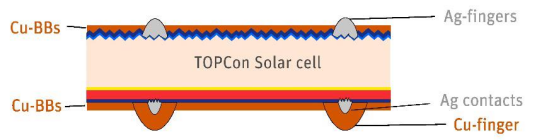
Figure 1. Cross-sectional schematic of a Cu-TOPCon cell with silver-reduction design on both front and back sides. This structure underpins TOPCon silver reduction.
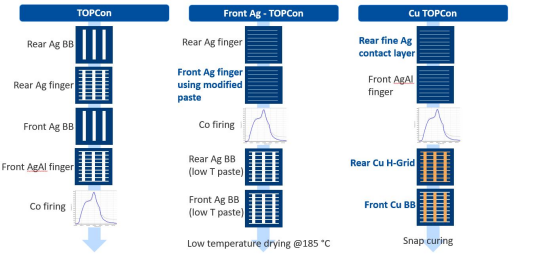
Figure 2. Comparison of the printing process flows with the TOPCon reference process, supporting TOPCon silver reduction.
From a process view, TOPCon silver reduction needs only incremental changes to existing screen-printing lines; the front aluminum-free silver paste and back copper paste overprint are validated separately, de-risking the metallization scheme.
Front-Side Strategy: Aluminum-Free Silver Paste Replacing Aluminum-Containing PasteThe front-side strategy uses aluminum-free silver paste to replace aluminum-containing paste, leveraging higher conductivity to reduce silver paste consumption.
Through 'fine grid first, then busbar' printing, high-temperature sintering forms a quality boron contact within this metallization scheme; the busbar is later printed with low-temperature copper paste—the front-side pillar of TOPCon silver reduction and a direct contributor to silver-consumption reduction.
Back-Side Strategy: Copper Paste Overprint for Silver-Layer ReplacementThe back-side strategy adopts a copper paste overprint structure: an ultra-thin silver layer ensures ohmic contact with n⁺ polysilicon, then a copper layer assumes main conduction. Copprint nano-copper paste cures at 300°C; its wide particle distribution and anti-oxidation formula ensure conductivity.
The overprint leaves silver for ohmic contact only, moving copper paste conductivity to the main body—the back-side pillar of TOPCon silver reduction that drives silver-consumption reduction at the cell level.
Experimental Results: Electrical Verification of the Silver-Reduction Scheme
To verify the TOPCon silver-reduction scheme, this section examines the two metallization schemes—front aluminum-free silver paste and back copper paste overprint—around specific contact resistance, series resistance, fill factor, open-circuit voltage, short-circuit current, and ohmic contact quality.

Figure 3. Paste consumption, extracted resistance values, and effective bulk resistivity, quantifying TOPCon silver reduction.
Electrical Performance of the Front-Side Aluminum-Free Silver PasteFront-side tests show aluminum-free silver paste keeps series resistance comparable to reference despite 40% lower silver paste consumption.
Wider fine grids slightly lower short-circuit current, but open-circuit voltage and fill factor gains confirm reduced metal-induced recombination. specific contact resistance dropped 1.8→1.3 mΩ·cm² and bulk resistivity 32%, raising silver efficiency—confirming the front-side gain and supporting silver-consumption reduction.
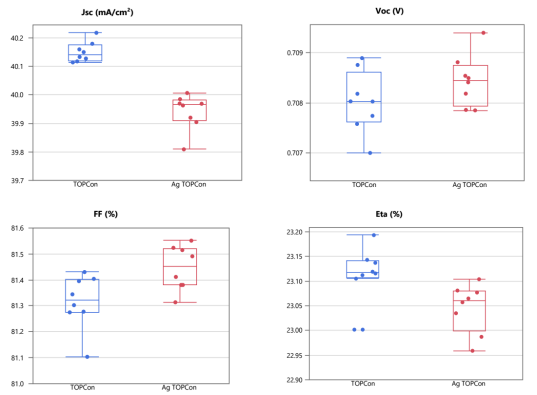
Figure 4. IV parameters of TOPCon cells with reference vs. new aluminum-free silver paste, informing TOPCon silver reduction.
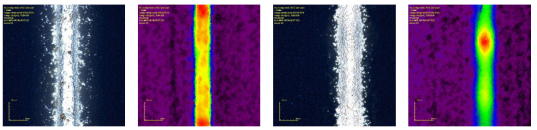
Figure 5. Laser scanning microscope images of fine grids printed with the two front-side pastes, relevant to TOPCon silver reduction.
Conductive Substitution Effect of the Back-Side Copper Paste OverprintIn the back-side experiment, the copper paste overprint cell matched the all-silver reference efficiency. Optical loss slightly lowered short-circuit current, but reduced contact area raised open-circuit voltage; fill factor was fully preserved, proving copper paste conductivity suffices. silver consumption fell >two-thirds—confirming TOPCon silver reduction on the back with clear silver-consumption reduction.
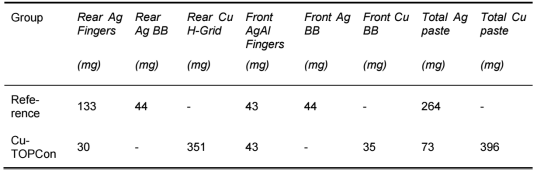
Figure 6. Wet paste consumption per printing step in the second experiment, key to TOPCon silver reduction.
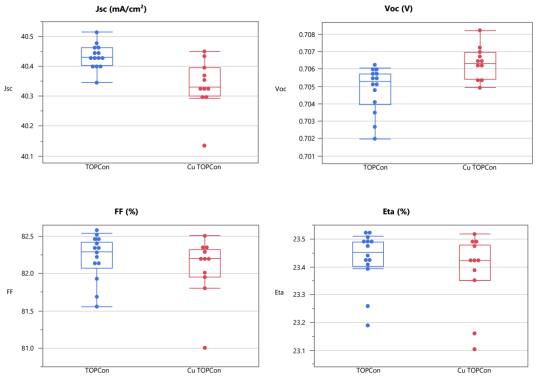
Figure 7. IV parameters of back-side silver-reduction cells, confirming TOPCon silver reduction.
Together, front and back data confirm TOPCon silver reduction is electrically equivalent to all-silver.
aluminum-free silver paste improves specific contact resistance; the overprint matches silver in copper paste conductivity and fill factor, validating the metallization scheme and the silver-consumption reduction achieved on both sides.
Industrialization Potential: Silver Consumption Reduced from 15 to 9 mg/Wp
Based on results, an M10 TOPCon cell's silver paste consumption drops from ~125 to 73 mg/cell; the silver-consumption-reduction path is clear.
l Front: 60→45 mg (aluminum-free silver paste fine grid).
l Back: 65→≤28 mg (silver contact layer + copper paste overprint busbar).
At 24.5% efficiency, silver consumption drops 15→9 mg/Wp (40% silver-consumption reduction); silver paste consumption falls in parallel.
Adding 94–132 mg/cell copper paste and one curing step is economical under high silver prices; the scheme fits existing screen-printing lines with no major retrofit—a producible metallization scheme delivering silver-consumption reduction.
Key Outcomes of the Silver-Reduction PathwayThe case for TOPCon silver reduction rests on three outcomes: silver consumption falls 15→9 mg/Wp; aluminum-free silver paste and copper paste overprint hold 24.5% efficiency, validating the metallization scheme that needs no new screen-printing lines, making silver-consumption reduction immediately deployable.
Silver-Consumption Reduction: 15 to 9 mg/Wp, a 40% DropThe headline of TOPCon silver reduction is a 40% silver-consumption reduction (15→9 mg/Wp) from the combined metallization scheme: aluminum-free silver paste front + copper paste overprint back.
Achievable on existing screen-printing lines with no new capital, it saves 52 mg/cell (125→73) and proves TOPCon silver reduction is ready to scale through sustained silver-consumption reduction.
FAQ: Core Questions About TOPCon Silver ReductionQ1. How can TOPCon cells reduce silver paste consumption?
Reducing silver use uses two paths: front aluminum-free silver paste cuts front silver paste consumption ~40% while keeping specific contact resistance; back copper paste overprint lets copper conduct and silver handle ohmic contact, cutting back silver use >two-thirds. Combined, TOPCon silver reduction lowers overall silver consumption from ~15 to 9 mg/Wp.
Q2. What are the advantages of aluminum-free silver paste over aluminum-containing paste?Versus aluminum-containing paste, the front paste has higher conductivity and stable series resistance under finer grids; no aluminum lowers metal-induced recombination, raising open-circuit voltage and fill factor. specific contact resistance dropped 1.8→1.3 mΩ·cm² (bulk −32%) at ~40% lower silver paste consumption—a cornerstone of TOPCon silver reduction and a driver of silver-consumption reduction.
Q3. Is the back-side copper-paste-replacing-silver scheme reliable?After adopting the copper paste overprint, the thin silver layer handles ohmic contact with n⁺ polysilicon and copper handles main conduction. fill factor matched all-silver and efficiency showed no decay; copper paste conductivity equals silver and ohmic contact meets spec. Long-term reliability (PID, thermal, humidity) needs production validation, but the functional substitution confirms the overprint enables TOPCon silver reduction.
Millennial Solar TLM Contact Resistance Tester
In verifying the TOPCon silver-reduction scheme, the electrode material optimization stage relies on precise measurement.
The Millennial Solar TLM tester extracts key parameters and supports evaluating both the aluminum-free silver paste and copper paste overprint approaches within this metallization scheme.
email:market@millennialsolar.com
The contact resistivity testing of the Millennial Solar TLM enables fast, flexible, precise detection:
l Static test repeatability ≤1%, dynamic ≤3%
l Line resistance accuracy up to 5% or 0.1 Ω/cm
l Free switching between contact and line resistance testing
l Customizable probe heads for analysis
Through specific contact resistance data and interface evaluation (gridline resistance and contact resistivity) from the Millennial Solar TLM, key evidence supports the front paste in lowering contact resistivity and improving metallization efficiency, and validates the thin silver layer in the copper paste overprint—a reliable base for a low silver consumption, metallization scheme.
Original reference for TOPCon silver reduction: TOPCon Solar Cells With Al-Free Ag and Cu Metallization.
Related Products


