


Non-contact IV tester

Quantum Efficiency Tester
PL/EL Integrated System
PV-Reflectumeter
3D Confocal Microscope
In-Line Four Point Probe Tester
Four Point Probe Tester
In-Line Thin Film Thickness Tester
Raman Spectrometer
FTIR Spectrometer
Spectrophotometer
Automatic Spectroscopic Ellipsometer
Contact Resistance Tester
Ultra depth of field 3D microscope
Auto Visual Tester
VMM PV Vision Measuring Machine
Solar Cell Horizontal Tensile Tester
Steady State Solar Simulator for Solar Cell
Solar Cell UV Aging Test Chamber
Solar Cell Comprehensive Tensile Tester
Visual Inspection Tester
Wet Leakage Current Tester
PV Module EL Tester
PV Module UV Preconditioning Chamber
Steady State Solar Simulator for PV Module
Current Continuous Monitor
Potential Induced Degradation Test
Bypass Diode Tester
LeTID Test System
Reverse Current Overload Tester
Impulse Voltage Tester
Hipot Insulation Tester
Ground Continuity Tester
Hipot Insulation Ground Tester
Damp Heat Test Chamber
Humidity Freeze Test
Thermal Cycle Test Chamber
Dynamic Mechanical Load Tester
Static Mechanical Load Tester
Hail Impact Tester
Robustness of Termination Tester
Module Breakage Tester
Cut Susceptibility Tester
Peel Shear Strength Tester
Universal Testing Machine (Single-arm)
Universal Testing Machine (Double-arm)
Glass Transmittance Tester
Acetic Acid Test Chamber
EVA Degree of Crosslinking Test System
Junction Box Comprehensive Tester
Drop ball tester
Semi-automatic scanning four-probe tester
Stylus Profilometer
Maximum Power Point Tracker
Perovskite Glass Transmittance Tester
Perovskite P1 Laser Scribing Multifunctional Testing Machine
Perovskite Online PL Tester
Perovskite Online Sheet Resistance Tester
Online Perovskite Film Thickness Tester
Perovskite Process Inspection Workstation
Portable EL Tester
Portable Thermal Imaging Tester
Solar Module Multi-Channel Testing System
PV Inverter Power Quality Tester
IV Tester
IVEL Cell Sorting Machine
Bifacial PV Module (bPVP) Technology: Global Comparison of 842 Key Parameters, Analysis of Production Technology and Regional Differences
Date : 16 September 2025Views : 2710
Bifacial photovoltaic modules (bPVP) are rapidly capturing the global PV market due to novel cell designs enabling rear-side light capture. This paper conducts a comprehensive analysis of all technical specifications for 499 bPVP models from 236 global manufacturers, covering mainstream production technologies (PERC, TOPCon, HJT, etc.) with varying efficiencies. It establishes optimal values (highest or lowest) and median values for 16 key parameters. Millennial QE Quantum Efficiency Tester precisely quantifies the contribution of rear-side light utilization. By quantifying parameter variability through confidence intervals, it enhances the accuracy of module performance comparisons. Results indicate that heterojunction technology (HJT) delivers the optimal bPVP parameters.
Data Acquisition and Processing Workflow
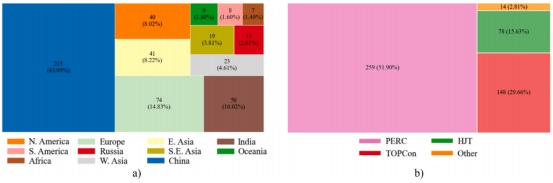
Bifacial PV Module Analysis Quantitative Metrics:a) Model distribution by country classification;b) Model distribution by production technology classification
Data Collection
Sample Scope: Collected 842 bPVP models from 236 manufacturers across 39 countries by Q1/2025;
Selection Criteria: 499 models included in final analysis (requiring complete parameters), covering PERC / TOPCon / HJT / Other (ABC / HPBC) technologies;
Uniform Test Conditions: Front parameters measured under STC (Standard Test Conditions); total bPVP parameters measured under BSTC (Bifacial Standard Test Conditions);
Key Assumption: VOC and Vmp exhibit no difference between BSTC and STC conditions.
Data Processing
Components categorized by 11 regions:
Production technology distribution: PERC 54%, TOPCon 30%, HJT 12%, Others (HPBC/ABC) 4%
Statistical Methods: Box-and-whisker plots visualize parameter distributions; median and confidence intervals calculated for 16 parameters with 95% confidence intervals;
Correlation Analysis: Pearson's correlation coefficient evaluates parameter associations with maximum power output.
Results Analysis
Efficiency (η)
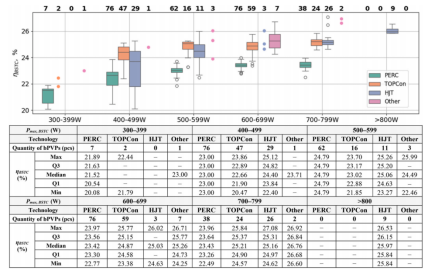
Distribution of ηBSTC for Bifacial PV Panels Grouped by Maximum Power
Global Comparison: Europe's bPVP ηBSTC median is highest (24.40%), while Russia's is lowest (21.68%).
Technology Differences: HJT and ABC/HPBC (“Other” category) exhibit ηBSTC values 1.69%-2.24% higher than PERC, with the highest recorded at 27.08% (3Sun HJT modules in Italy).
Power Correlation: ηBSTC positively correlates with Pmax (HJT technology r=0.697). High-power modules (>800W) generally exceed 24% efficiency.
Temperature Coefficients (kP, kV, kI)
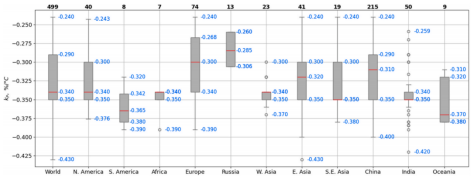
Maximum Power Temperature Coefficient kp of Bifacial PV Panels by Production Region
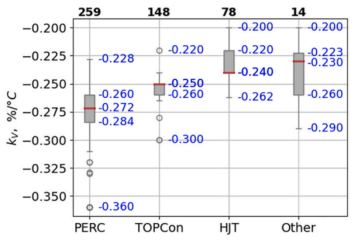
Variation in Open-Circuit Voltage Temperature Coefficient kV of Bifacial PV Panels Across Different Production Technologies
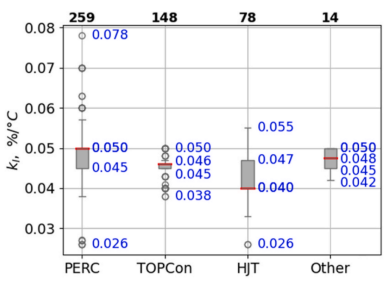
Distribution of Short-Circuit Current Temperature Coefficient kI for Bifacial PV Panels Grouped by Maximum Power
Power Temperature Coefficient (kp): Russian products exhibit the optimal median kp (-0.285%/°C), with HJT technology demonstrating outstanding performance (median -0.26%/°C).
Voltage Temperature Coefficient (kV): HJT achieves a median kV of -0.24%/°C, outperforming PERC (-0.27%/°C).
Current Temperature Coefficient (kI): PERC technology exhibits the highest kI (0.05%/°C), but HJT demonstrates superior stability in modules exceeding 800W.
Bifacial Performance and Reliability
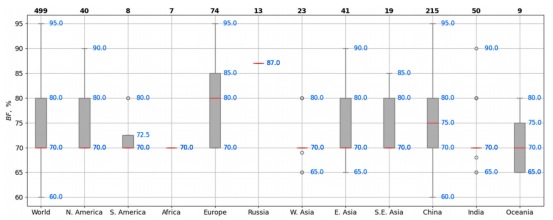
Bifacial Factor BF by Production Region
Bifacial Factor BF:
HJT Technology Leads (Median BF 85%, Optimal BF 95%)
European/Chinese Module Median BF Exceeds 80%
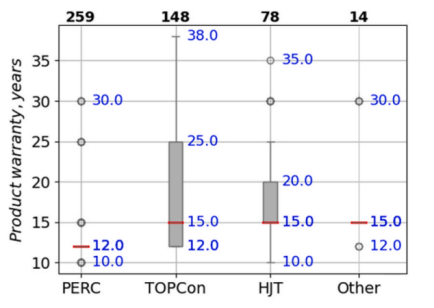
Variation in Warranty Periods for Bifacial PV Panels Across Different Manufacturing Technologies
Guaranteed Performance (GP): HJT modules exhibit the lowest 25-year degradation rate (median 89.93%)
Median Lifespan: 30 years (HJT/TOPCon reach 35–38 years)
Warranty Period: HJT median 15 years (PERC only 12 years)
Technical Comparison Conclusions
HJT leads in 6 parameters (ηBSTC/kP/BF/warranty, etc.), while TOPCon excels in sq/voltage coefficient;
PERC only achieves optimal kI (current temperature coefficient) at 0.055%/°C.
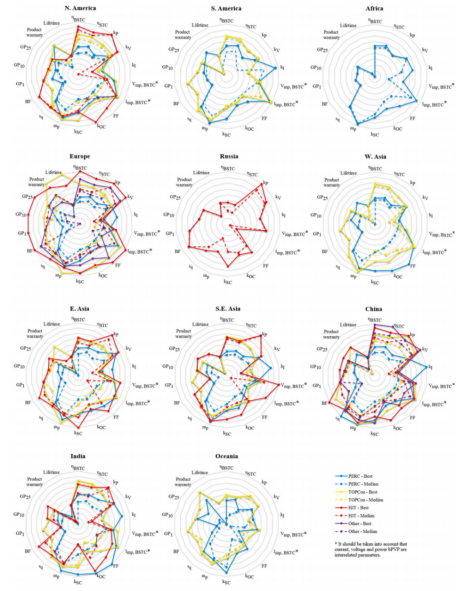
Comparison of Optimal and Median Parameters for Bifacial PV Modules Across Regions
Regional Manufacturing Differences
China accounts for 62% (309/499 models), yet Europe offers the longest module warranty (median 12 years);
Russia produces only HJT modules, but achieves BF values of 87% (world's highest).
Bifacial photovoltaic modules (bPVP) have become a core growth driver in the global PV market, with continuous improvements in technological maturity and application scale. HJT technology's advantages in core parameters like efficiency and temperature stability position it as the future mainstream direction. Meanwhile, regionalized supply patterns and differentiated competition based on specialized technologies will propel the industry toward diversification. Selecting suitable modules requires consideration of application scenarios (e.g., albedo, temperature range).
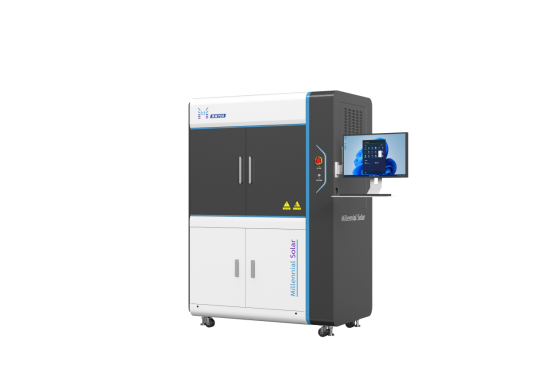
Millennial QE Quantum Efficiency Tester
email:market@millennialsolar.com
The Millennial QE Quantum Efficiency Tester measures the spectral response of solar cells and diagnoses areas of low spectral response through quantum efficiency analysis. It offers universal compatibility, a broad spectral measurement range, testing accuracy, and traceability.
Compatible with all solar cell types to meet diverse testing requirements
Spectral range extends from 300-2500nm with specialized customization options
Dual light source structure (xenon lamp + halogen lamp) ensures stable illumination
The Millennial QE Quantum Efficiency Tester delivers comprehensive underlying diagnostic capabilities for photovoltaic module research, revealing the fundamental physical mechanisms behind performance differences in photovoltaic technologies (such as PERC, TOPCon, HJT, HBC, etc.) regarding photovoltaic conversion efficiency and bifacial power generation capabilities.


