


Non-contact IV tester

Quantum Efficiency Tester
PL/EL Integrated System
PV-Reflectumeter
3D Confocal Microscope
In-Line Four Point Probe Tester
Four Point Probe Tester
In-Line Thin Film Thickness Tester
Raman Spectrometer
FTIR Spectrometer
Spectrophotometer
Automatic Spectroscopic Ellipsometer
Contact Resistance Tester
Ultra depth of field 3D microscope
Auto Visual Tester
VMM PV Vision Measuring Machine
Solar Cell Horizontal Tensile Tester
Steady State Solar Simulator for Solar Cell
Solar Cell UV Aging Test Chamber
Solar Cell Comprehensive Tensile Tester
Visual Inspection Tester
Wet Leakage Current Tester
PV Module EL Tester
PV Module UV Preconditioning Chamber
Steady State Solar Simulator for PV Module
Current Continuous Monitor
Potential Induced Degradation Test
Bypass Diode Tester
LeTID Test System
Reverse Current Overload Tester
Impulse Voltage Tester
Hipot Insulation Tester
Ground Continuity Tester
Hipot Insulation Ground Tester
Damp Heat Test Chamber
Humidity Freeze Test
Thermal Cycle Test Chamber
Dynamic Mechanical Load Tester
Static Mechanical Load Tester
Hail Impact Tester
Robustness of Termination Tester
Module Breakage Tester
Cut Susceptibility Tester
Peel Shear Strength Tester
Universal Testing Machine (Single-arm)
Universal Testing Machine (Double-arm)
Glass Transmittance Tester
Acetic Acid Test Chamber
EVA Degree of Crosslinking Test System
Junction Box Comprehensive Tester
Drop ball tester
Semi-automatic scanning four-probe tester
Stylus Profilometer
Maximum Power Point Tracker
Perovskite Glass Transmittance Tester
Perovskite P1 Laser Scribing Multifunctional Testing Machine
Perovskite Online PL Tester
Perovskite Online Sheet Resistance Tester
Online Perovskite Film Thickness Tester
Perovskite Process Inspection Workstation
Portable EL Tester
Portable Thermal Imaging Tester
Solar Module Multi-Channel Testing System
PV Inverter Power Quality Tester
IV Tester
IVEL Cell Sorting Machine
Post-Etching Passivation Technology (PET) for Metallisations: Reducing Silicon Solar Cell Cutting Losses and Enhancing Module Efficiency
Date : 28 September 2025Views : 2505
The cutting process of silicon-based solar cells (e.g., shingled or half-cell modules) exposes highly reactive cut edges, inducing carrier recombination and reducing power-free-from-failure (pFF). Traditional solutions require modifying pre-metallization processes, which exhibit low industrial compatibility and high costs. This paper proposes a post-metallization edge passivation technology (PET) that achieves efficient edge passivation through precise control of AlOₓ film thickness (7/14 nm) via thermal atomic layer deposition (ALD) combined with low-temperature annealing. This technology integrates Millennial online film thickness tester for real-time monitoring, ensuring consistent passivation layer thickness to optimize long-term stability. Ultimately, it enables double-sided PERC shingled cells to achieve a high power density output of 23.5 mW/cm².
PET Technology and Cell Characterization
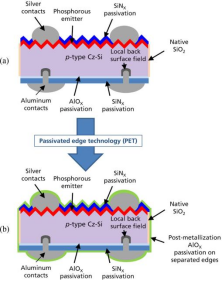
(a): Cross-section schematic of double-sided pSPEER solar cell (b): Cross-section of cell after PET treatment
pSPEER® Technology Principle
Edge Passivation Mechanism: Native SiO₂ at cut edges → Full Al₂O₃ encapsulation (7/14 nm) inhibits recombination
ALD Process Advantages:
Conformal deposition → Three-dimensional edge coverage
High negative fixed charge density (~10¹³ cm⁻²) → Field-effect carrier repulsion
Light transmittance >98% (d<15 nm, OPTOS optical simulation)
Battery Preparation Process
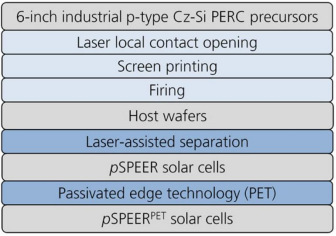
pSPEER® Battery Preparation Process Flow
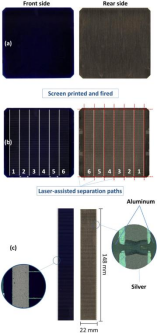
(a) Industrial 6-inch PERC precursor; (b) Metallized wafer capable of separating 6 cells; (c) Laser-separated cells (22×148 mm)
Substrate: Industrial 6-inch Ga-doped p-type Cz-Si PERC precursor.
Metallization: Screen-printing silver main grid, aluminum backfield, and front silver grid; rapid sintering.
Cutting: TLS (laser thermal cracking) or LSMC (laser scribing + mechanical cracking)
PET Processing: ALD deposition of AlOₓ → Hot plate annealing
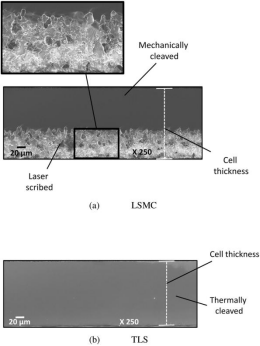
(a) LSMC separation edge (1/3 area rough); (b) TLS separation edge (entirely smooth)
Edge Passivation Experiment
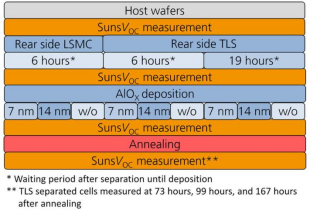
Experimental Workflow for PET's Impact on Separated Cells
Experimental Design:
Procedure: SunsVOC measurement (host wafer → dicing state → deposition state → annealing state).
Control group: No AlOₓ coating, annealing only.
SunsVOC and IV characteristic characterization
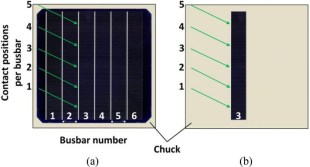
(a) SunsVOC measurement contact point on the wafer; (b) Measurement at the same location on the separated cell
Evaluate the impact of separation and passivation processes on cell performance via SunsVOC measurements. Measurements conducted under 1000 W/m² illumination, focusing on pFF and open-circuit voltage (VOC) variations. Measurements taken at identical locations before and after separation to eliminate local inhomogeneities. IV testing performed on both front and back sides under standard conditions, considering specified area current density in busbar-free regions.
PET Experimental Protocol
Compare the effects of LSMC and TLS separation processes on pFF. Deposit AlOₓ (7 nm or 14 nm thickness) 6 hours or 19 hours after TLS separation to investigate the impact of dwell time on passivation effectiveness. Set annealing temperature to <225°C. Measure minority carrier lifetime τeff via QSSPC.
Passivation Layer Performance Validation
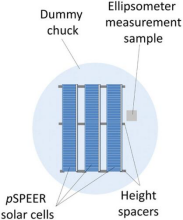
Schematic of Cell Stacking During AlOₓ Deposition Process
AlOₓ Deposition Process
Separated cells (LSMC/TLS process) exposed to air for 6–19 hours, forming native SiO₂ during exposure;
Reactor loading: Cells placed face-up with height spacers between them;
Thickness verification: Real-time thickness monitoring via in-line film thickness gauge, targeting d1=7 nm and d2=14 nm.
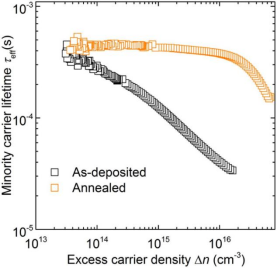
Carrier Lifetime After AlOₓ Deposition/Annealing
Following AlOₓ annealing, τeff=432 μs (Δn=10¹⁵ cm⁻³), corresponding to Seff=22 cm/s, indicating the current process achieves low edge recombination rates.
SunsVOC Results
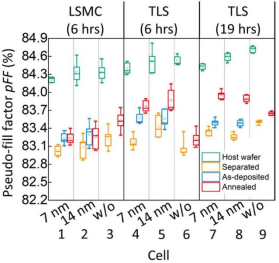
pFF Changes Measured by SunsVOC
PET Effect: Both LSMC and TLS separation resulted in a pFF decrease of −1.2%.
After AlOₓ deposition,
the TLS-separated cell showed a pFF increase of +0.4%, further rising to +0.7% after annealing;
the LSMC-separated cell only improved by +0.3%.
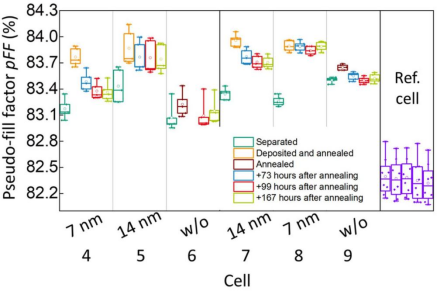
Stability of pFF after PET (14 nm AlOₓ with no decay)
Stability: The 14 nm AlOₓ passivation layer exhibits long-term stability (pFF stable for 167 hours), likely due to the growth of a dense oxide layer.
IV Test Performance
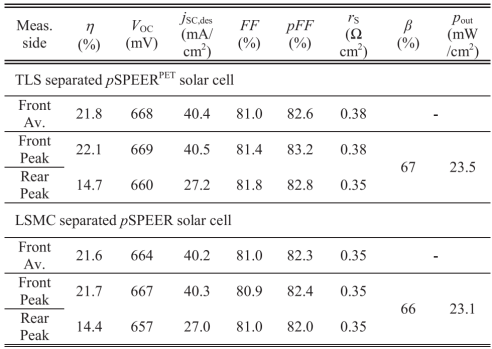
Comparison of IV Performance Between TLS+PET and LSMC Cells
Optimal TLS+PET Cell: Front-side efficiency ηf = 22.1%, output power density pout = 23.5 mW/cm² (including 10% back-side irradiation).
Compared to LSMC unpassivated cells: Δpout = +0.4 mW/cm².
The proposed post-metallization passivated edge technology (PET) effectively suppresses edge recombination in shingled solar cells through low-temperature ALD deposition of aluminum oxide followed by annealing. Combining TLS separation with PET processing increases pFF by +0.7%, achieving cell efficiency of 22.1% and power density of 23.5 mW/cm². The 14 nm AlOₓ passivation layer demonstrates long-term stability. The PET technology requires no modification to pre-treatment processes, making it suitable for industrial production and providing a viable solution for enhancing the efficiency of small-sized solar cells.
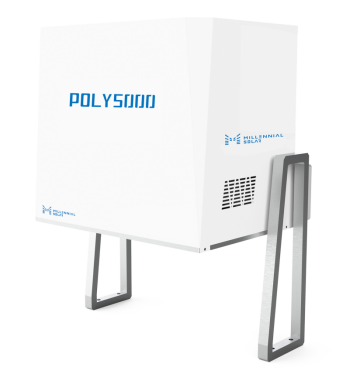
Millennial Online Film Thickness Tester
email:market@millennialsolar.com
The POLY5000 is an online film thickness tester specifically designed for photovoltaic process monitoring. It performs rapid, automated 5-point simultaneous scanning of samples to monitor the thickness and optical constants of various films on industrial production lines. It delivers fast and accurate measurements of film thickness, optical constants, and other parameters, with customizable measurement dimensions based on customer sample sizes.
✔ Film thickness measurement range: 20nm–2000nm
✔ Rapid, automated 5-point simultaneous scanning
✔ Non-contact, non-destructive measurement with zero breakage rate
✔ 24/7 automated, non-stop calibration to ensure production efficiency
The Millennial Online Film Thickness Tester empowers users to optimize film thickness characteristics by enabling real-time monitoring of AlOₓ layer thickness during deposition and verifying thickness's impact on stability.
Related Products


