


Non-contact IV tester

Quantum Efficiency Tester
PL/EL Integrated System
PV-Reflectumeter
3D Confocal Microscope
In-Line Four Point Probe Tester
Four Point Probe Tester
In-Line Thin Film Thickness Tester
Raman Spectrometer
FTIR Spectrometer
Spectrophotometer
Automatic Spectroscopic Ellipsometer
Contact Resistance Tester
Ultra depth of field 3D microscope
Auto Visual Tester
VMM PV Vision Measuring Machine
Solar Cell Horizontal Tensile Tester
Steady State Solar Simulator for Solar Cell
Solar Cell UV Aging Test Chamber
Solar Cell Comprehensive Tensile Tester
Visual Inspection Tester
Wet Leakage Current Tester
PV Module EL Tester
PV Module UV Preconditioning Chamber
Steady State Solar Simulator for PV Module
Current Continuous Monitor
Potential Induced Degradation Test
Bypass Diode Tester
LeTID Test System
Reverse Current Overload Tester
Impulse Voltage Tester
Hipot Insulation Tester
Ground Continuity Tester
Hipot Insulation Ground Tester
Damp Heat Test Chamber
Humidity Freeze Test
Thermal Cycle Test Chamber
Dynamic Mechanical Load Tester
Static Mechanical Load Tester
Hail Impact Tester
Robustness of Termination Tester
Module Breakage Tester
Cut Susceptibility Tester
Peel Shear Strength Tester
Universal Testing Machine (Single-arm)
Universal Testing Machine (Double-arm)
Glass Transmittance Tester
Acetic Acid Test Chamber
EVA Degree of Crosslinking Test System
Junction Box Comprehensive Tester
Drop ball tester
Semi-automatic scanning four-probe tester
Stylus Profilometer
Maximum Power Point Tracker
Perovskite Glass Transmittance Tester
Perovskite P1 Laser Scribing Multifunctional Testing Machine
Perovskite Online PL Tester
Perovskite Online Sheet Resistance Tester
Online Perovskite Film Thickness Tester
Perovskite Process Inspection Workstation
Portable EL Tester
Portable Thermal Imaging Tester
Solar Module Multi-Channel Testing System
PV Inverter Power Quality Tester
IV Tester
IVEL Cell Sorting Machine
Fraunhofer ISE's Latest Research: 33.1% Efficiency Achieved in Fully Textured Perovskite/Silicon Tandem Cells via Two-Step Hybrid Evaporation + PDAI Interface Layer
Date : 25 February 2026Views : 2255
Perovskite/silicon tandem cells represent a key direction in photovoltaics. However, existing high-performance tandem cells predominantly employ solution-processed perovskite, requiring customized silicon substrate cells (e.g., polishing, pyramid sizing adaptation) that are incompatible with industrially mainstream >1μm random pyramid-textured silicon. Whilst full-textured perovskite/silicon tandem cells offer low cost and superior light management, they face challenges in perovskite/C₆₀ interface passivation. This study employs a hybrid two-step perovskite deposition method compatible with industrially textured silicon. By introducing PDAI treatment to the perovskite surface, it overcomes the key bottleneck of fully textured cells (pyramid height > 1μm), achieving a certified efficiency of 33.1% (VOC=2.01V) and producing high-performance fully textured perovskite/silicon tandem solar cells with outstanding outdoor stability.
The Millennial platform's perovskite tandem cell PL tester enables rapid, precise perovskite film quality assessment through light-intensity-dependent PL power-law relationships. PDAI treatment simultaneously reduces interfacial recombination losses via field-effect passivation and enhances electron concentration in the all-perovskite absorber layer to minimize carrier transport losses.
Core Mechanism: Electron Accumulation from Interface to Bulk Phase
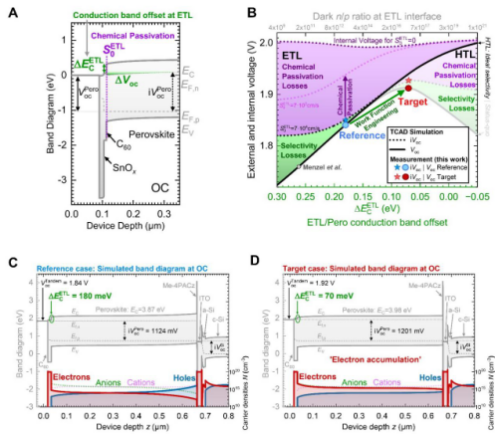
Simulation-Based Strategy to Overcome Non-radiative Recombination and Transport Losses at the Perovskite Carrier Transport Layer Interface
An experimentally validated perovskite/silicon tandem cell model, through photovoltaic cell simulation, clarified the optimization direction for the perovskite/C₆₀ interface. Interface performance is primarily determined by two parameters: chemical passivation quality and band alignment characteristics. By introducing PDAI molecules with high dipole moments to treat the perovskite surface, we successfully implemented work function engineering:
Reducing interface recombination: PDAI interacts with the perovskite surface (using a hybrid two-step method in this study to form an organic-rich surface termination), forming a positive dipole (negative pole toward C₆₀, positive pole toward perovskite). This effectively lowers ΔEC,ETL (from 180 meV to 70 meV), causing substantial electron accumulation at the interface. This significantly suppresses interfacial recombination, thereby enhancing the VOC.
Enhanced bulk conductivity: Due to the intrinsic properties of perovskite materials, this interfacial electron accumulation effect extends throughout the perovskite absorber layer, increasing the bulk electron concentration by nearly 40-fold. According to the formula σ = q * n * μ, the conductivity (σ) consequently increases substantially, significantly reducing series resistance and transport losses, becoming the primary driver for FF enhancement.
Data analysis indicates that under 1-sun illumination at open-circuit voltage (OC) and maximum power point (MPP) conditions, the target cell maintains a high n/p ratio; Perovskite iVOC increased from 1.12 V to 1.20 V (S₀, ETL both at 7×10⁴ cm/s), while the external circuit VOC of the tandem cell rose from 1.84 V to 1.92 V; The average electron concentration in the perovskite bulk phase increased from 1×10¹⁴ cm⁻³ (reference) to 4×10¹⁵ cm⁻³ (target), significantly enhancing electron transport efficiency toward ETL.
Interaction between PDAI and the perovskite surface

Energy Dynamics and Surface Chemical Properties
PDAI was introduced at the perovskite/C₆₀ interface via wet chemical spin coating (scalable to dip coating). XPS confirmed the presence of PDAI molecules, while UPS indicated PDAI-induced surface dipole formation. DFT calculations verified that PDAI interacts with the organic-rich surface to form a positive dipole. This discrepancy indicates that perovskite surface termination characteristics and molecule-surface interactions are key factors determining dipole orientation, critically influencing the effectiveness of passivation molecules.
Surface Passivation Effect and Enhanced Conductivity

Passivation Effect and Conductivity Influence
To validate PDAI's surface passivation effect and conductivity enhancement on perovskites, the study reached core conclusions through multiple precise characterization methods:
Hyperspectral photoluminescence (PL) imaging: Without C₆₀, the reference perovskite exhibited an average built-in open-circuit voltage (iVOC) of 1.23 V with a standard deviation of 38 mV. After PDAI treatment, iVOC increased to 1.25 V (a 20 mV rise), with the standard deviation decreasing to 26 mV, indicating mild chemical passivation. After C₆₀ deposition, the passivated PDAI-stacked iV_OC remained at 1.23 V (while the reference sample dropped to 1.15 V). AM-KPFM further confirmed more uniform contact potential distribution.
TRPL/TA Spectra: Demonstrated that PDAI treatment effectively suppressed interfacial recombination and shallow trap states, prolonging carrier lifetime.
Suns-VOC & Suns-PL imaging: Crucially demonstrated that the FF improvement primarily stems from reduced transport losses (pFF-FF difference decreased from 6% to 3%), rather than enhancements in selectivity or recombination (iFF and iVOC-VOC differences showed minimal variation).
THz/SCLC measurements: Exclude the dominant role of mobility (μ) changes, confirming increased electron concentration (n) as the fundamental cause of enhanced conductivity.
Cell Performance and Stability
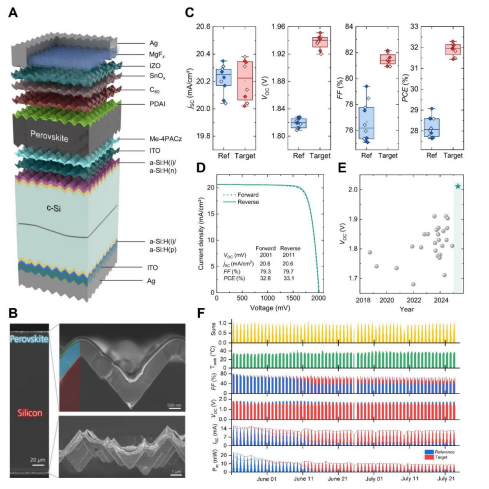
Performance and Stability of Perovskite/Silicon Tandem Solar Cells
After applying the PDAI strategy to fully textured tandem cells:
Efficiency: The peak efficiency increased from 29.1% to 32.3%, ultimately reaching 33.1% (VOC=2.01 V) by optimizing current matching through perovskite bandgap adjustment.
Reproducibility: The strategy demonstrated excellent reproducibility across multiple international laboratories (KAUST, Fraunhofer ISE).
Stability: During outdoor testing along the Red Sea coast, PDAI cells exhibited exceptionally stable current output, whereas reference cells showed continuous current decay. BACE measurements revealed that PDAI treatment reduced mobile ion concentration by approximately two-thirds, effectively suppressing ion migration—a key factor in enhanced stability. Humidity-temperature stability testing (85°C/85% RH, 1000h) further confirmed this improved stability.
This study elucidates a previously overlooked mechanism: field-effect passivation at the interface profoundly modulates the electronic transport properties of the perovskite bulk phase. PDAI treatment simultaneously reduces interfacial recombination and bulk transport losses, thereby overcoming the core challenges of VOC and FF in fully textured tandem cells. This enables performance comparable to more complex planar structures. Crucially, this approach is fully compatible with industrial textured silicon wafers, paving the way for commercial mass production of perovskite/silicon tandem cells. Future work may further focus on optimizing the quality of perovskite bulk phase prepared via the mixing method to achieve higher performance breakthroughs.
Millennial Da Platform Perovskite Tandem Solar Cell PL Tester
The Millennial Da Platform Perovskite Tandem Solar Cell PL Tester systematically addresses core challenges in solar cell production—including speed, yield, cost, process optimization, and stability—through non-contact operation, high precision, and real-time feedback. Integrated with AI deep learning, it enables fully automated defect detection and process feedback.
email:market@millennialsolar.com
High-Precision PL Imaging: Utilizes line-scan laser with imaging accuracy <75μm/pixel (customizable)
Supports 16-bit Color/Grayscale: Simultaneously displays bright areas (e.g., defect-free zones) and low-brightness regions (e.g., defect dark spots)
High-Speed In-Line PL Defect Detection: Detection speed ≤2 seconds, false negative rate <0.1%; false positive rate <0.3%
AI defect recognition classification training: Enables fully automated defect identification and process feedback
Using the Millennial PL tester for perovskite tandem cells, the photoluminescence (PL) characteristics and carrier dynamics-related PL decay behavior of perovskite films before and after PDAI treatment were monitored. This systematically investigated the surface passivation effects and conductivity enhancement mechanisms of PDAI on fully textured perovskite/ silicon tandem cells, providing technical support for interface optimization and film quality assessment in high-performance fully textured perovskite/silicon tandem cells.
Related Solutions

Perovskite & Organic Photovoltaic
Optimizing perovskite compositions and architectures for high-efficiency solar cells.
View Details


