


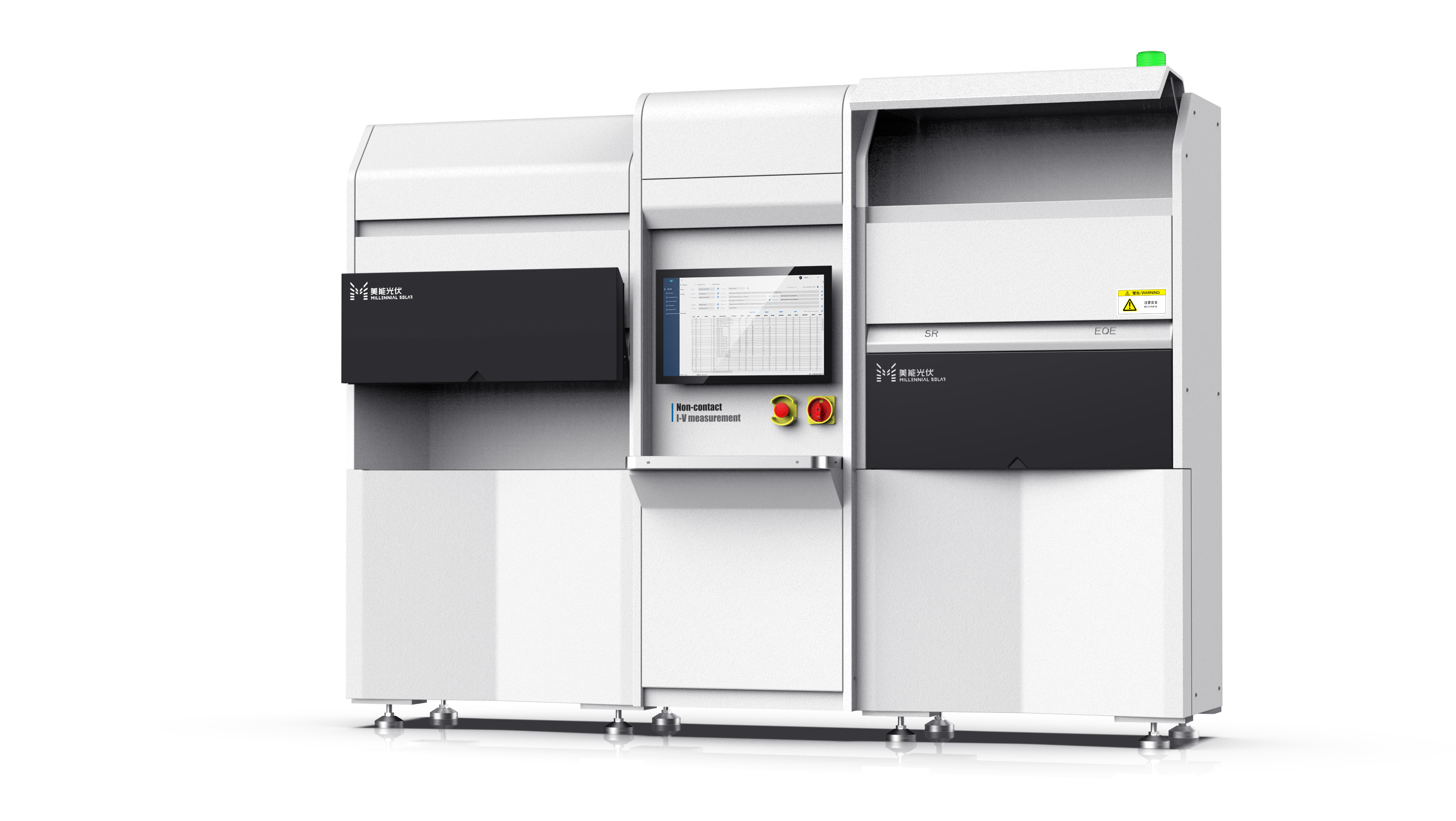
Non-contact IV tester

Quantum Efficiency Tester
PL/EL Integrated System
PV-Reflectumeter
3D Confocal Microscope
In-Line Four Point Probe Tester
Four Point Probe Tester
In-Line Thin Film Thickness Tester
Raman Spectrometer
FTIR Spectrometer
Spectrophotometer
Automatic Spectroscopic Ellipsometer
Contact Resistance Tester
Ultra depth of field 3D microscope
Auto Visual Tester
VMM PV Vision Measuring Machine
Solar Cell Horizontal Tensile Tester
Steady State Solar Simulator for Solar Cell
Solar Cell UV Aging Test Chamber
Solar Cell Comprehensive Tensile Tester
Visual Inspection Tester
Wet Leakage Current Tester
PV Module EL Tester
PV Module UV Preconditioning Chamber
Steady State Solar Simulator for PV Module
Current Continuous Monitor
Potential Induced Degradation Test
Bypass Diode Tester
LeTID Test System
Reverse Current Overload Tester
Impulse Voltage Tester
Hipot Insulation Tester
Ground Continuity Tester
Hipot Insulation Ground Tester
Damp Heat Test Chamber
Humidity Freeze Test
Thermal Cycle Test Chamber
Dynamic Mechanical Load Tester
Static Mechanical Load Tester
Hail Impact Tester
Robustness of Termination Tester
Module Breakage Tester
Cut Susceptibility Tester
Peel Shear Strength Tester
Universal Testing Machine (Single-arm)
Universal Testing Machine (Double-arm)
Glass Transmittance Tester
Acetic Acid Test Chamber
EVA Degree of Crosslinking Test System
Junction Box Comprehensive Tester
Drop ball tester
Semi-automatic scanning four-probe tester
Stylus Profilometer
Maximum Power Point Tracker
Perovskite Glass Transmittance Tester
Perovskite P1 Laser Scribing Multifunctional Testing Machine
Perovskite Online PL Tester
Perovskite Online Sheet Resistance Tester
Online Perovskite Film Thickness Tester
Perovskite Process Inspection Workstation
Portable EL Tester
Portable Thermal Imaging Tester
Solar Module Multi-Channel Testing System
PV Inverter Power Quality Tester
IV Tester
IVEL Cell Sorting Machine
Temperature-Dependent Degradation and LeTID Kinetics in n-Type BC Solar Cells
Date : 30 September 2026Views : 60
Interdigitated back-contact (IBC) solar cells place both polarities of metal contacts on the rear side, eliminating front-side grid shading and allowing the optical advantages of surface texturing and anti-reflection coatings to be fully utilized. Combined with passivation and contact engineering, n-type IBC cells can achieve high open-circuit voltage and current density. However, this architecture also has inherent sensitivities: photogenerated minority carriers must travel laterally through the base region before being collected by the interdigitated rear emitters, making device performance highly dependent on bulk lifetime and rear-side passivation quality. Once rear-interface recombination or contact leakage is thermally activated, the dark saturation current density J0 can increase significantly, resulting in a loss of Voc. Millennial Solar Non-contact IV Tester provides non-destructive, consumable-free, millisecond-level measurement for BC and busbar-free cells, with simultaneous acquisition of multiple parameters including IV, EQE, and PL.
This is the focus of the present study: for n-type IBC cells, illuminated J-V measurements from 25–85°C, LeTID stress tests under one sun at 45–85°C for up to 960 minutes, and dark IV analysis over the same temperature range were conducted within the same thermal environment, allowing the three sets of evidence to be considered together.
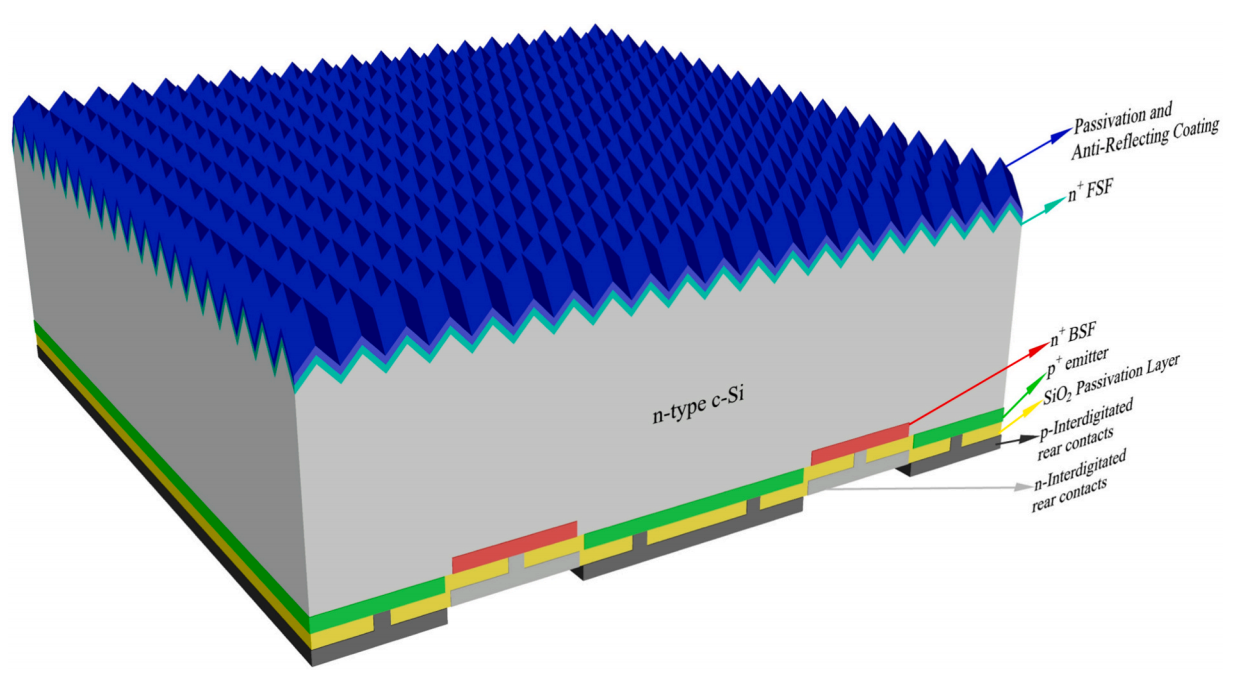
Cross-sectional schematic of the n-type IBC solar cell: rear interdigitated p+ emitter and n+ BSF contacts,
with front-side texturing and an anti-reflection coating (ARC).
The experimental cells had an area of 258.3 cm² and a silicon wafer thickness of 151 ± 6 μm. The rear interdigitated pitch was approximately 480 μm, while the emitter and BSF fingers were approximately 250 μm and 90 μm wide, respectively. Illuminated measurements were performed under AM1.5G at 100 mW/cm². At each temperature point, five scans were averaged after thermal stabilization. LeTID stress measurements were performed directly at the stress temperature without intermediate cooling, with data recorded at exponentially spaced intervals of 1, 2, 4, 8, … minutes. Each parameter was normalized to its initial value to distinguish intrinsic degradation kinetics from instantaneous temperature-coefficient effects.
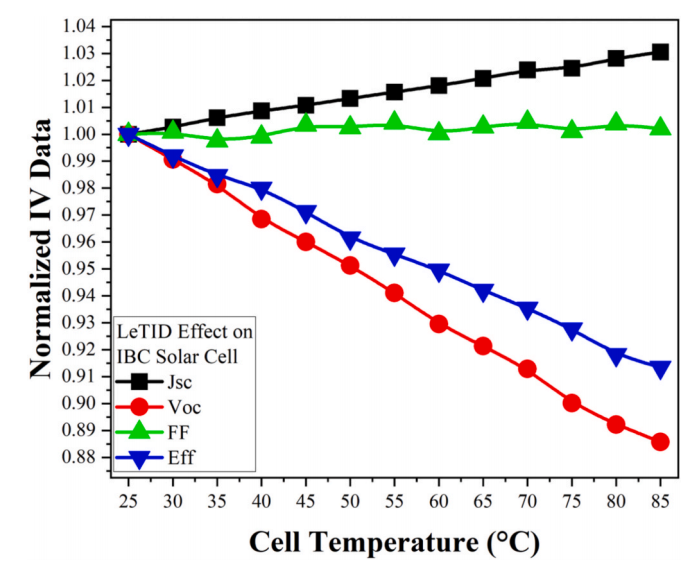
Normalized thermal evolution of four parameters relative to their respective values at 25°C
At 25°C, the cell exhibited a Jsc of approximately 38.6 mA/cm², a Voc of approximately 0.743 V, an FF of approximately 79%, and an efficiency of approximately 22.7%. When the temperature increased to 85°C, Jsc increased by only about 3% (+0.0203 mA·cm⁻²·K⁻¹, approximately +0.05%/K), while Voc decreased linearly at −1.4 mV/K (approximately −0.2%/°C). Efficiency decreased by approximately 9%, while FF remained nearly unchanged.
The small increase in current results from bandgap narrowing: according to the Varshni relationship, the absorption edge shifts toward longer wavelengths, slightly increasing photogeneration. The more rapid voltage degradation originates from the exponential increase of J0(T), governed by the intrinsic carrier concentration and recombination activity. Because Voc is proportional to ln(Jsc/J0), even a moderate increase in J0 can produce a measurable voltage loss. This temperature coefficient falls within the commonly observed range of −1.3 to −1.6 mV/K for high-quality crystalline-silicon devices, indicating a recombination-limited rather than resistance- or transport-limited behavior. The normalized trends are also clear: at 85°C, Voc decreased by about 15% relative to 25°C, efficiency decreased by about 9%, FF remained within ±1%, and Jsc increased by about 3%.
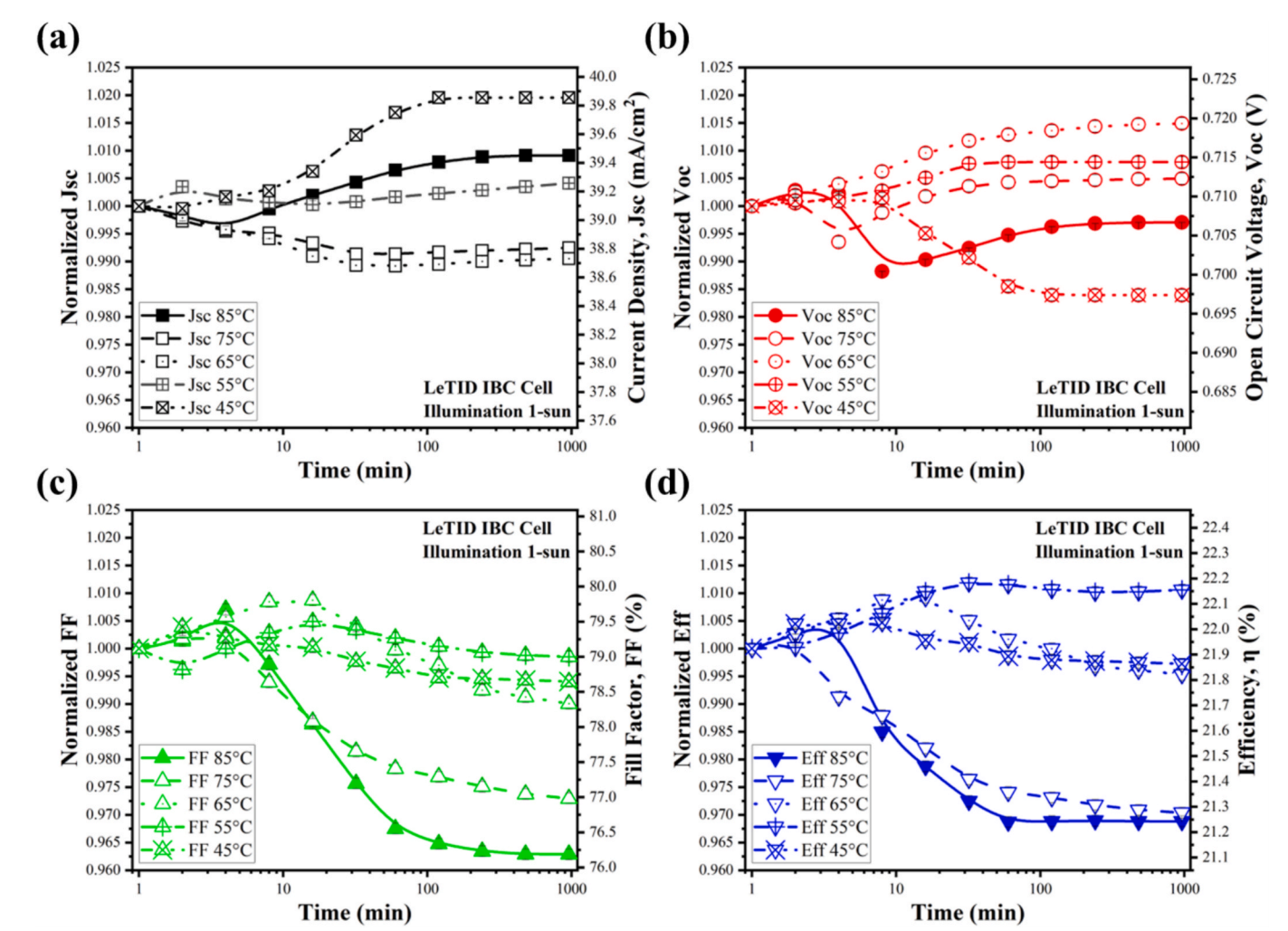
LeTID degradation kinetics.
Steady-state measurements answer the question of “how much does heat affect performance,” while LeTID stress testing addresses “how does performance change with time.” At 85°C, Voc dropped rapidly during the first 10–30 minutes and then gradually approached a quasi-saturated level. Degradation was much slower at lower temperatures. After 960 minutes, Voc decreased to approximately 0.69 V, while Jsc remained within ±2% and FF fluctuated only slightly. No regeneration was observed within the experimental window.
Because measurements were performed at the stress temperature after thermal stabilization, the early voltage drop should be attributed to rapid activation of defect states rather than transient thermal equilibration. The stability of Jsc indicates that photogeneration and short-circuit extraction were not significantly affected, suggesting that the dominant loss was not generation-limited. The authors also noted a limitation: without a dark-annealing control experiment, the contribution of purely thermal effects cannot be completely excluded.
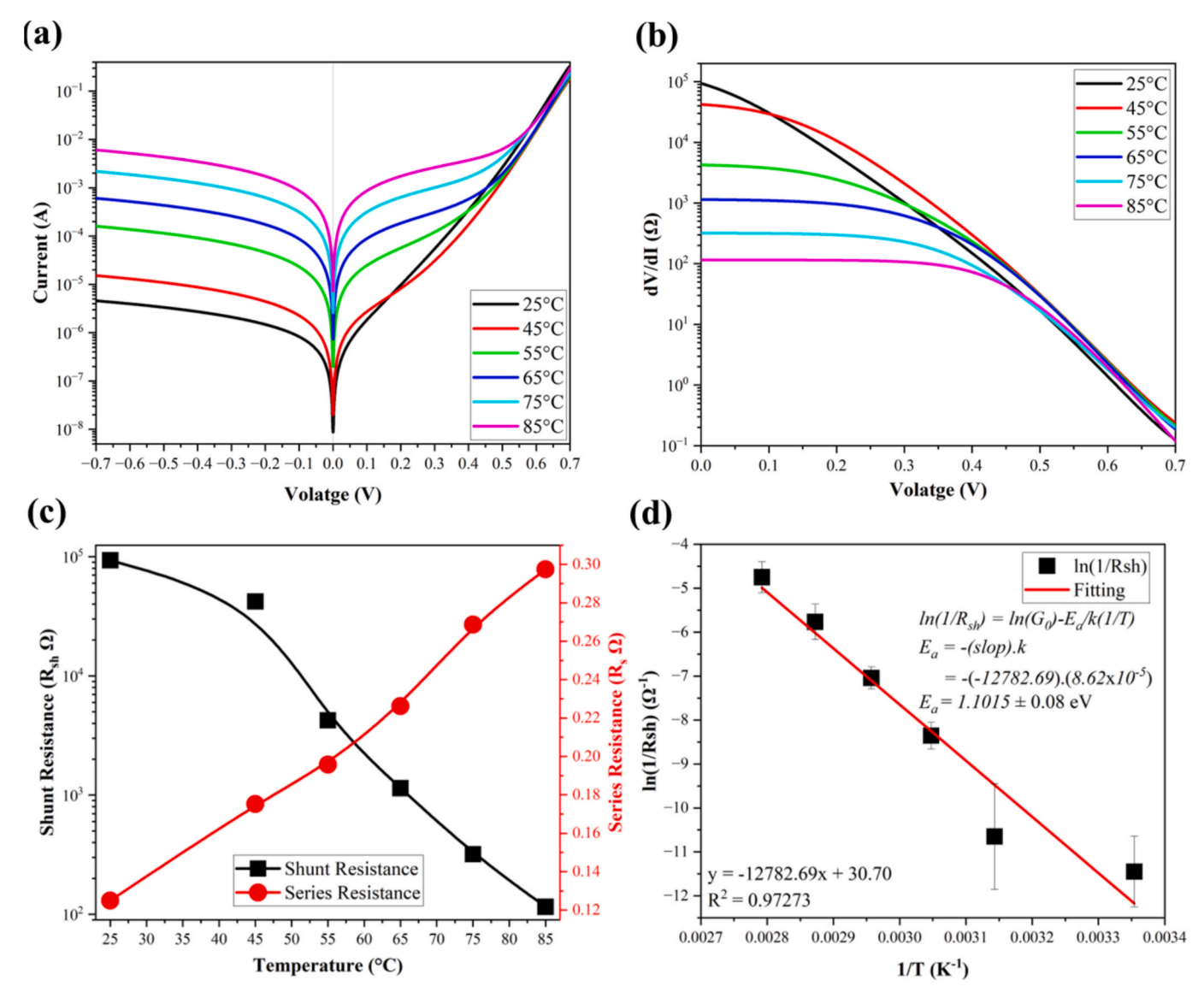
Dark-state electrical characteristics and leakage pathways: (a) dark J-V curves, (b) differential resistance, (c) extracted shunt and series resistance, and (d) Arrhenius analysis of shunt conductance, yielding Ea ≈ 1.10 eV.
Dark I-V measurements approach the same issue from a different perspective. Forward current increased significantly with temperature. The low-bias slope showed a clear decrease in shunt resistance, while the high-current region changed much less. This indicates that thermally induced resistance evolution was dominated by leakage activation rather than series-resistance degradation. The ideality factor remained at 1.05–1.25, indicating that diffusion recombination was dominant, with a possible contribution from Shockley–Read–Hall (SRH) recombination at higher temperatures.
Arrhenius analysis of shunt conductance showed good linearity between ln(1/Rsh) and 1/T (R² = 0.97), with an activation energy of 1.10 ± 0.08 eV. This is comparable to the silicon bandgap (approximately 1.12 eV) and falls within the LeTID range reported in the literature (0.8–1.2 eV). An activation energy on the order of the bandgap is often associated with defect-assisted conduction through deep-level defects, but a contribution from the intrinsic carrier concentration cannot be ruled out. Therefore, the result supports thermally activated leakage behavior but does not identify a specific defect species.
The three lines of evidence can be described within a phenomenological framework:
J0(t, T) = J0,intr(T) + A·Ndef(t, T)
Where a thermally activated defect contribution that evolves with time and temperature is superimposed on the intrinsic saturation current. The resulting voltage loss can then be expressed as:
Voc = (nkT/q)·ln(Jsc/(J0 + 1))
Recombination enhancement and leakage activation occur within the same framework, linking the steady-state temperature coefficient, LeTID kinetics, and dark-state leakage evolution without assigning a specific defect identity. For outdoor operation, cell temperatures in modules under high irradiance are commonly in the 50–65°C range. Based on a temperature coefficient of −1.4 mV/K, operation at 60°C corresponds to an approximately 49 mV voltage loss relative to 25°C. Temperature-accelerated LeTID can further add time-dependent losses on top of this effect.
These extrapolations apply only to the cells tested in this study. For back-contact TOPCon and back-contact HJT cells, the findings serve only as qualitative references: degradation magnitude, activation energy, and regeneration kinetics depend on the respective passivating-contact architecture, interface quality, hydrogen distribution, and thermal stability, and require dedicated comparative studies. For high-efficiency back-contact devices operating in warm climates, voltage robustness and long-term energy yield ultimately depend on the stability of rear-side passivation and effective defect management.
Q1: How does temperature affect the performance of n-type IBC solar cells?
As temperature increases from 25°C to 85°C, Voc decreases by approximately 1.4 mV/K, while Jsc increases only slightly. The efficiency decreases by about 9%, whereas FF remains nearly unchanged.
Q2: How does LeTID affect n-type IBC solar cells?
Under one-sun LeTID stress, Voc shows a rapid initial decline, particularly at 85°C, followed by a slower approach toward quasi-saturation. After 960 minutes, Voc decreased to approximately 0.69 V, while Jsc remained within ±2%.
Q3: What causes the temperature-dependent electrical degradation?
Dark I–V analysis indicates that temperature-induced degradation is mainly associated with thermally activated leakage, rather than series-resistance degradation. The extracted shunt-conductance activation energy was 1.10 ± 0.08 eV, supporting thermally activated leakage behavior.
Contact: market@millennialsolar.com
With years of experience in photovoltaic testing, Millennial Solar combines mass-production experience with advances in academic research to provide a millisecond-level, non-destructive testing solution for crystalline-silicon solar cells across production lines.
· Millisecond-level measurement: Eliminates time-consuming mechanical movements, matches high-speed production lines, and enables substantially higher throughput.
· Zero physical contact: Suitable for advanced structures such as ultra-thin wafers, busbar-free cells, and BC cells, with no physical damage and no consumables.
· Broad compatibility: PERC / TOPCon / HJT / BC and more.
· Five-dimensional data acquisition: IV + EQE + SR + Re + PL.
Millennial Solar Non-contact IV Tester offers a non-contact approach to high-efficiency solar cell testing. Zero physical contact helps avoid microcrack and contamination risks associated with physical contact, while millisecond-level throughput is designed to match production-line takt time. High-precision measurement data provide a reliable basis for process optimization while reducing maintenance and consumable costs. This supports high-efficiency cell production without requiring the same trade-off between quality and testing efficiency.
Original reference: Temperature-dependent voltage degradation and LeTID kinetics in n-type interdigitated back contact (IBC) solar cells
*Statement: Original and reprinted articles published by this account are intended for academic sharing and the dissemination of industry-related information. Without authorization, copying, alteration, citation, or reproduction that infringes upon the relevant rights of this account is prohibited. The content is for reference only. If there is a copyright issue, please contact our company for removal.


