


Non-contact IV tester

Quantum Efficiency Tester
PL/EL Integrated System
PV-Reflectumeter
3D Confocal Microscope
In-Line Four Point Probe Tester
Four Point Probe Tester
In-Line Thin Film Thickness Tester
Raman Spectrometer
FTIR Spectrometer
Spectrophotometer
Automatic Spectroscopic Ellipsometer
Contact Resistance Tester
Ultra depth of field 3D microscope
Auto Visual Tester
VMM PV Vision Measuring Machine
Solar Cell Horizontal Tensile Tester
Steady State Solar Simulator for Solar Cell
Solar Cell UV Aging Test Chamber
Solar Cell Comprehensive Tensile Tester
Visual Inspection Tester
Wet Leakage Current Tester
PV Module EL Tester
PV Module UV Preconditioning Chamber
Steady State Solar Simulator for PV Module
Current Continuous Monitor
Potential Induced Degradation Test
Bypass Diode Tester
LeTID Test System
Reverse Current Overload Tester
Impulse Voltage Tester
Hipot Insulation Tester
Ground Continuity Tester
Hipot Insulation Ground Tester
Damp Heat Test Chamber
Humidity Freeze Test
Thermal Cycle Test Chamber
Dynamic Mechanical Load Tester
Static Mechanical Load Tester
Hail Impact Tester
Robustness of Termination Tester
Module Breakage Tester
Cut Susceptibility Tester
Peel Shear Strength Tester
Universal Testing Machine (Single-arm)
Universal Testing Machine (Double-arm)
Glass Transmittance Tester
Acetic Acid Test Chamber
EVA Degree of Crosslinking Test System
Junction Box Comprehensive Tester
Drop ball tester
Semi-automatic scanning four-probe tester
Stylus Profilometer
Maximum Power Point Tracker
Perovskite Glass Transmittance Tester
Perovskite P1 Laser Scribing Multifunctional Testing Machine
Perovskite Online PL Tester
Perovskite Online Sheet Resistance Tester
Online Perovskite Film Thickness Tester
Perovskite Process Inspection Workstation
Portable EL Tester
Portable Thermal Imaging Tester
Solar Module Multi-Channel Testing System
PV Inverter Power Quality Tester
IV Tester
IVEL Cell Sorting Machine
Low-Temperature Silver-Coated Copper Paste Epoxy Curing System: Electrical Performance Optimization for HJT Solar Cells
Date : 14 August 2026Views : 1815
HJT solar cells have become a research hotspot owing to their simple process, high efficiency, and low temperature coefficient. In HJT cell manufacturing, the electrical properties and curing process of the low-temperature silver-coated copper paste directly affect the photovoltaic conversion efficiency and production throughput of the cell.
Because the ITO layer on the HJT cell surface is easily damaged above 200°C, the entire production process must be controlled below 200°C, requiring the silver-coated copper paste to cure rapidly at low temperatures (typically drying at 150°C for 3 min and curing at 200°C for 6 min).
With its low cost and conductivity approaching that of pure silver paste, silver-coated copper paste has become a key material for improving efficiency and reducing cost in HJT cells. In actual production, silver-coated copper conductive paste is printed onto the silicon wafer surface via screen printing to form the metallized gridline electrodes of the cell.
This study adopted the controlled variable method to systematically investigate the effects of different epoxy curing systems on the electrical properties of the low-temperature silver-coated copper paste. In the experiments, epoxy resins and curing agents were selected to form different curing system combinations, which act as the metallization framework in the electronic paste and directly affect the conductivity and adhesion of the paste.
The choice of curing system directly determines the curing quality of the low-temperature silver-coated copper paste. A Millennial Solar 3D confocal microscope was used to scan the cured gridline electrodes of the silver-copper paste, enabling an intuitive comparison of the curing performance of different conductive pastes.
1. Effect of Epoxy Resin on the Electrical Properties of Silver-Coated Copper Paste1.1 Experimental Methods
Five types of epoxy resin were selected for the experiments: hydrogenated bisphenol A epoxy resin, bisphenol A epoxy resin, trifunctional epoxy resin, tetrafunctional epoxy resin, and phenolic-modified epoxy resin, used to construct different curing systems.
The paste had a solid content of 92.6% and a silver content of 30%. By adjusting the resin addition amount (1.2%, 1.0%, 0.8%) and the corresponding curing agent content (80%), the volume resistivity, contact resistivity, and adhesion were measured. Combined with 3D microscopy observation of the curing morphology, the optimal main resin for the curing systems was identified.
1.2 Experimental Results and AnalysisTable 1: Summary of experimental data of silver-coated copper paste with different main resins
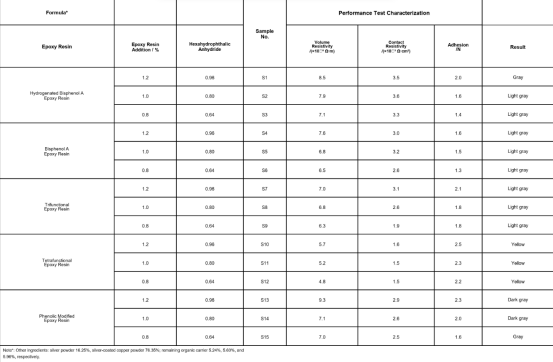
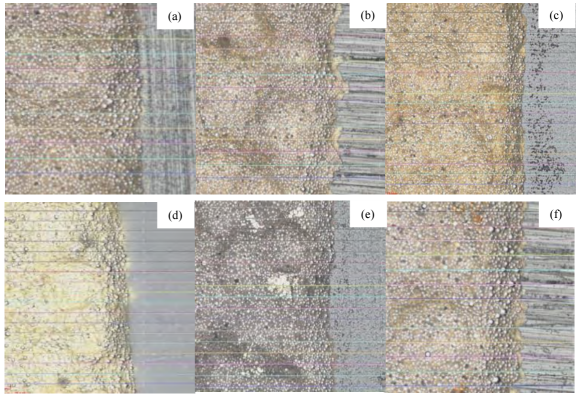
Figure 1: 3D images of cured silver-coated copper conductive paste samples (a–f correspond to different epoxy resin systems)
As the epoxy resin addition amount decreased, both the volume resistivity and the contact resistivity showed a downward trend. For example, in the bisphenol A epoxy resin system, the volume resistivity decreased from 7.6×10⁻⁸ Ω·m to 6.5×10⁻⁸ Ω·m; for the tetrafunctional epoxy resin, it decreased from 5.7×10⁻⁸ Ω·m to 4.8×10⁻⁸ Ω·m.
This indicates that a lower resin content helps improve the continuity of the conductive pathways, thereby enhancing the electrical properties of the curing system.
Effect of Resin Typel Electrical properties: The tetrafunctional epoxy resin performed best, with the lowest volume resistivity (4.8×10⁻⁸ Ω·m) and the lowest contact resistivity (1.5×10⁻³ Ω·cm²). The hydrogenated bisphenol A epoxy resin exhibited inferior electrical properties because it contains no benzene ring and has low reactivity.
l Adhesion: The tetrafunctional epoxy resin exhibited the highest adhesion (2.2 N), followed by the trifunctional resin (1.8 N), while the bisphenol A resin was the lowest (1.3 N). The higher the functionality, the greater the crosslinking density and the stronger the adhesion.
l Curing morphology: After curing, the paste with the tetrafunctional epoxy resin appeared bright yellow with a distinct metallic luster, indicating complete curing; the pastes with the hydrogenated bisphenol A and phenolic-modified resins appeared grayish, indicating a lower degree of curing.
2. Effect of Curing Agents on the Electrical Properties of Silver-Coated Copper Paste2.1 Experimental Methods
Based on the preferred tetrafunctional epoxy resin (TT400), five latent curing agents were studied: dicyandiamide (DICY), 2-ethyl-4-methylimidazole (EM124), hexahydrophthalic anhydride (HHPA), boron trifluoride monoethylamine complex (BF₃-MEA), and sebacic dihydrazide (SPH), to construct various low-temperature curing systems.
By adjusting the curing agent addition ratio and testing the electrical properties and adhesion, the optimal curing system formulation for the low-temperature silver-coated copper paste was identified.
2.2 Experimental Results and AnalysisTable 2: Summary of experimental data of silver-coated copper paste with different curing agents
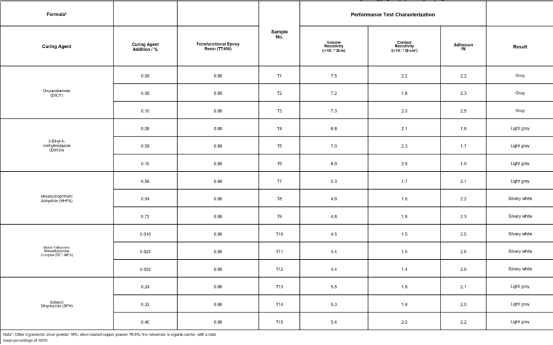
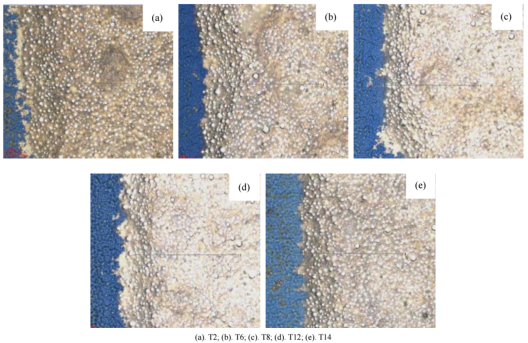
Figure 2: 3D images of cured silver-coated copper conductive paste under different curing agent systems (a–e correspond to samples T2/T6/T8/T12/T14)
l The boron trifluoride monoethylamine complex performed best, with the lowest volume resistivity (4.4×10⁻⁸ Ω·m) and the lowest contact resistivity (1.4×10⁻³ Ω·cm²).
l Hexahydrophthalic anhydride ranked second, while dicyandiamide exhibited the poorest electrical properties.
l The boron trifluoride monoethylamine complex has a low curing onset temperature (approximately 120°C) and high reactivity, making it suitable for rapid curing processes and enabling complete curing of the silver-coated copper paste at low temperatures.
Comparison of AdhesionThe boron trifluoride monoethylamine complex exhibited the highest adhesion (2.6 N), followed by dicyandiamide, HHPA, and SPH, while the imidazole-type agent was the lowest. Appropriately increasing the curing agent content can enhance adhesion, but excessive amounts tend to stabilize the effect. This curing system offers the best overall performance.
Observation of Curing Morphologyl After curing with the boron trifluoride monoethylamine complex, the paste appeared bright silver-white with a high degree of metallization;
l The sample cured with dicyandiamide appeared dark gray, indicating poor curing;
l The sample cured with hexahydrophthalic anhydride appeared silver-white, indicating good curing.
3. Optimal Epoxy Curing System and Process Validation
This study systematically evaluated the effects of different curing systems on the performance of the low-temperature silver-coated copper paste for HJT solar cells. The results show that the tetrafunctional epoxy resin, owing to its high reactivity and high crosslinking density, outperforms other resins in both electrical properties and adhesion, making it the best choice as the main resin in the epoxy curing system. Among the curing agents, the boron trifluoride monoethylamine complex exhibited the best low-temperature rapid curing characteristics.
The curing system combining the tetrafunctional epoxy resin TT400 with the boron trifluoride monoethylamine complex enables complete curing of the silver-coated copper paste under process conditions of 200°C/6 min, achieving a low volume resistivity (4.4×10⁻⁸ Ω·m), low contact resistivity (1.4×10⁻³ Ω·cm²), and high adhesion (2.6 N), providing a feasible epoxy curing system solution for the development of high-performance, low-cost conductive pastes for HJT cells.
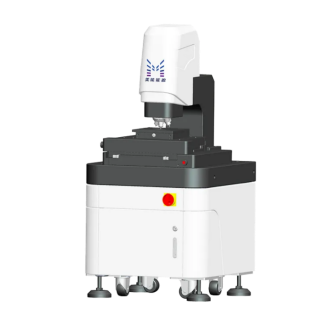
Measurement Instrument: Millennial Solar 3D Confocal Microscope
email:market@millennialsolar.com
The Millennial Solar 3D Confocal Microscope ME-PT3000 is a precision instrument for 3D measurement of the surfaces of various precision components and materials. It can handle diverse measurement scenarios and rapidly and efficiently complete accurate measurement of submicron-level morphology and surface roughness. This instrument is widely used in the characterization of the curing morphology of silver-coated copper conductive paste for HJT solar cells, and is a key characterization tool for studying the influence of epoxy curing systems on the electrical properties of silver-coated copper paste.
Product Featuresl Precise and reliable 3D measurement with real-time confocal microscopic imaging
l Ultra-high confocal lens with Z-axis display resolution up to 1 nm
l Maximum total magnification of 198x–39,966x for accurate measurement of submicron-level morphology
l Fully automatic grating and textured-surface measurement with rapid data generation
l Comprehensive feedback for cleaning, texturing, and screen printing processes
With its in-situ observation and 3D imaging capabilities, the Millennial Solar 3D Confocal Microscope provides characterization support for precision measurement, facilitating precise control of surface roughness and performance analysis. It has become an important optical measurement tool driving technological upgrades across multiple fields, and is also a key curing-morphology analysis instrument in the R&D of silver-coated copper paste for HJT solar cells.
Related Products


