


Non-contact IV tester

Quantum Efficiency Tester
PL/EL Integrated System
PV-Reflectumeter
3D Confocal Microscope
In-Line Four Point Probe Tester
Four Point Probe Tester
In-Line Thin Film Thickness Tester
Raman Spectrometer
FTIR Spectrometer
Spectrophotometer
Automatic Spectroscopic Ellipsometer
Contact Resistance Tester
Ultra depth of field 3D microscope
Auto Visual Tester
VMM PV Vision Measuring Machine
Solar Cell Horizontal Tensile Tester
Steady State Solar Simulator for Solar Cell
Solar Cell UV Aging Test Chamber
Solar Cell Comprehensive Tensile Tester
Visual Inspection Tester
Wet Leakage Current Tester
PV Module EL Tester
PV Module UV Preconditioning Chamber
Steady State Solar Simulator for PV Module
Current Continuous Monitor
Potential Induced Degradation Test
Bypass Diode Tester
LeTID Test System
Reverse Current Overload Tester
Impulse Voltage Tester
Hipot Insulation Tester
Ground Continuity Tester
Hipot Insulation Ground Tester
Damp Heat Test Chamber
Humidity Freeze Test
Thermal Cycle Test Chamber
Dynamic Mechanical Load Tester
Static Mechanical Load Tester
Hail Impact Tester
Robustness of Termination Tester
Module Breakage Tester
Cut Susceptibility Tester
Peel Shear Strength Tester
Universal Testing Machine (Single-arm)
Universal Testing Machine (Double-arm)
Glass Transmittance Tester
Acetic Acid Test Chamber
EVA Degree of Crosslinking Test System
Junction Box Comprehensive Tester
Drop ball tester
Semi-automatic scanning four-probe tester
Stylus Profilometer
Maximum Power Point Tracker
Perovskite Glass Transmittance Tester
Perovskite P1 Laser Scribing Multifunctional Testing Machine
Perovskite Online PL Tester
Perovskite Online Sheet Resistance Tester
Online Perovskite Film Thickness Tester
Perovskite Process Inspection Workstation
Portable EL Tester
Portable Thermal Imaging Tester
Solar Module Multi-Channel Testing System
PV Inverter Power Quality Tester
IV Tester
IVEL Cell Sorting Machine
Silver-Free BC Cells Approach 26% Efficiency: Bipolar Screen-Printed Aluminum Contacts Based on Passivated Contacts
Date : 8 September 2026Views : 125
As the photovoltaic industry moves toward terawatt-scale manufacturing, reducing metallization costs and decreasing reliance on silver has become one of the key issues in the development of high-efficiency crystalline silicon solar cell technology. Particularly in back-contact (BC) cell systems, while efficiency continues to break records, the costs and supply chain pressures resulting from silver paste consumption are becoming increasingly pronounced. The Millennial Solar TLM Contact Resistance Tester is a high-precision analytical instrument specifically designed to extract key electrical parameters for solar cell electrode optimization. It features two testing functions for contact resistivity and line resistance, providing reliable quantitative data for electrode material optimization and process improvements in high-efficiency structures such as TOPCon cells.
This study focuses on silver-free metallization solutions for TBC silicon solar cells and proposes a new approach: replacing traditional silver electrodes with screen-printed aluminum (Al) electrodes to achieve a low-cost, highly compatible metallization path for back-contact cells, with efficiency potential approaching 26%.
The back-contact (BC) structure completely eliminates front-side shading losses by relocating all metal electrodes to the back of the cell, making it a key technological direction for achieving high-efficiency crystalline silicon solar cells.
Among the various BC approaches:
· HBC (heterojunction back-contact) has achieved an efficiency of 27.09%
· TBC (passivated contact back-contact) has reached an efficiency of 27.03%
· HIBC has further set a new record at 27.81% efficiency
However, despite its excellent efficiency performance, TBC technology still faces two major challenges:
· High process complexity
· High silver (metallization) consumption, resulting in significant cost pressures
Therefore, developing alternative metallization solutions to replace silver has become a key breakthrough in advancing TBC toward industrialization.
Among the many candidate materials, both copper (Cu) and aluminum (Al) are considered potential alternatives, but their approaches differ significantly:
· Cu: Excellent electrical conductivity, but requires a barrier layer and electroplating processes, resulting in a complex system
· Al: Does not require a complex electroplating system and is directly compatible with screen printing and sintering processes
Aluminum has already been widely adopted in PERC and Al-BSF cells, offering:
·Low cost
·Abundant resources
·Mature manufacturing processes (screen printing + sintering)
However, in TBC systems, the challenges lie in:
·How to control the interfacial reaction between Al and poly-Si
·How to simultaneously achieve low contact resistance and low recombination loss
This study focuses precisely on these key issues.
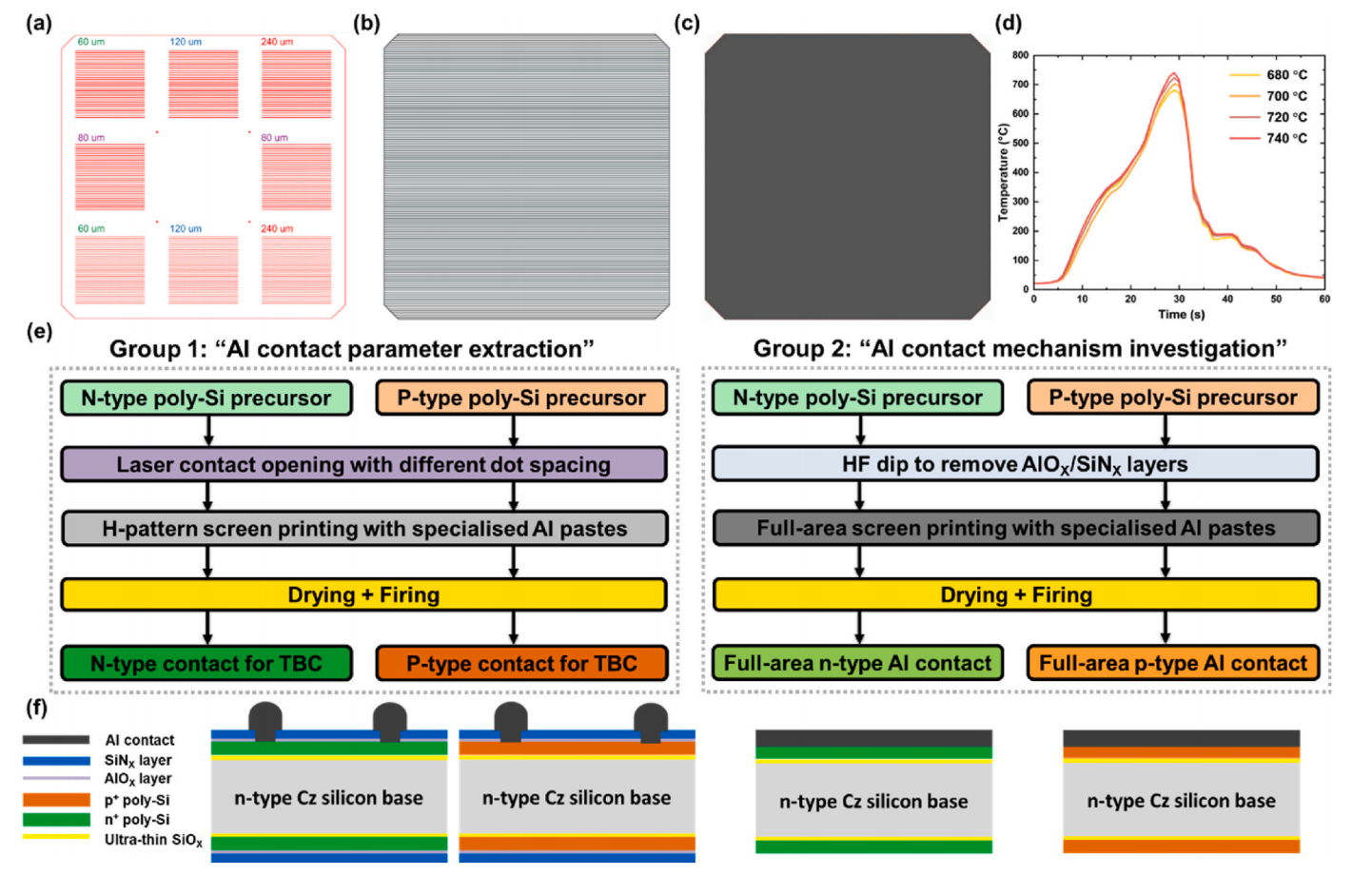
Schematic Diagram of the TBC Solar Cell Aluminum Metallization Process Flow and Structure
The research team proposed a bipolar (n-type/p-type) Al contact engineering strategy to replace the traditional silver metallization structure.
The core approach includes:
·Use of a specialized Al paste system (optimized Al-Si alloy particles and glass system)
·Controlling the intensity of interfacial reactions through the sintering process
·Achieving low-resistance contacts on both sides of n-poly and p-poly
·Suppressing excessive Al-Si alloying and deep etching
The key objective of this approach is:
To achieve a mass-producible low-silver or even silver-free metallization system without compromising the poly-Si/SiOx passivated contact structure.
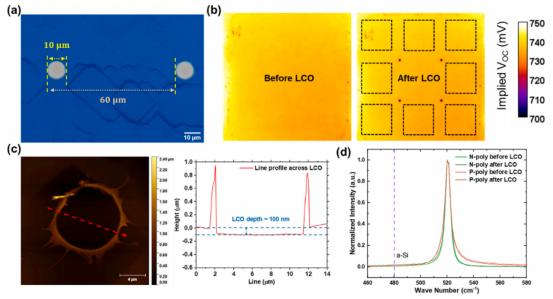
Femtosecond UV Laser LCO Process and Characterization of Its Impact on the Passivation Structure
For the construction of localized contact structures, this study employed 257 nm femtosecond UV laser LCO (Laser Contact Opening) technology.
Its advantages include:
·Deep-ultraviolet high-photon energy (approximately 4.8 eV)
·Extremely shallow absorption depth, enabling selective removal of AlOx/SiNx
·Virtually no damage to the underlying poly-Si/SiOx passivation layer
Experimental results show that:
· iVOC levels show virtually no decrease after LCO
· No significant amorphous silicon signal was observed in the Raman spectrum
· Passivation quality remains stable
This demonstrates that the process can achieve precise interface engineering capable of “opening a window without damaging the passivation layer.”
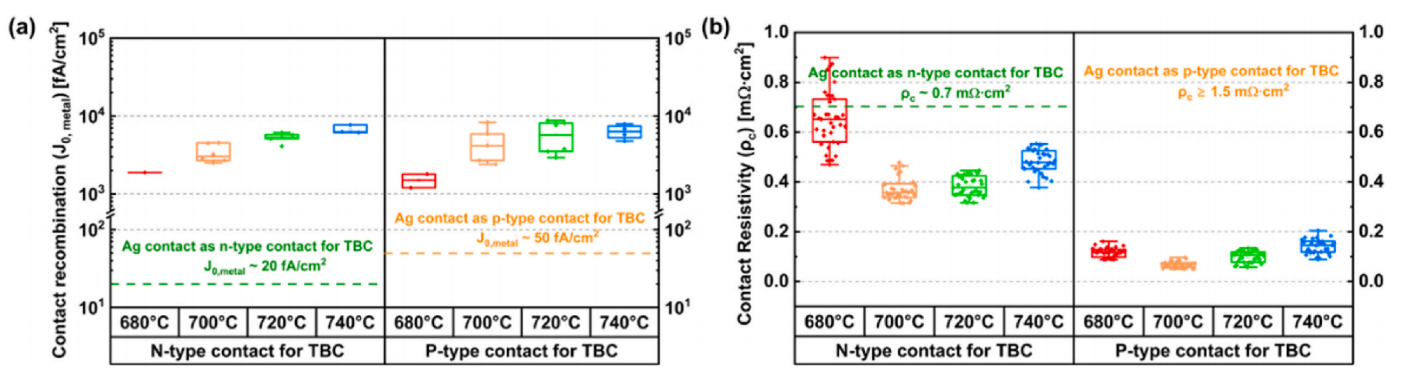
Comparison of Electrical Properties of Al Contacts Under Different Sintering Conditions
A systematic comparison of n-type and p-type poly-Si revealed that the optimal sintering condition is 700°C
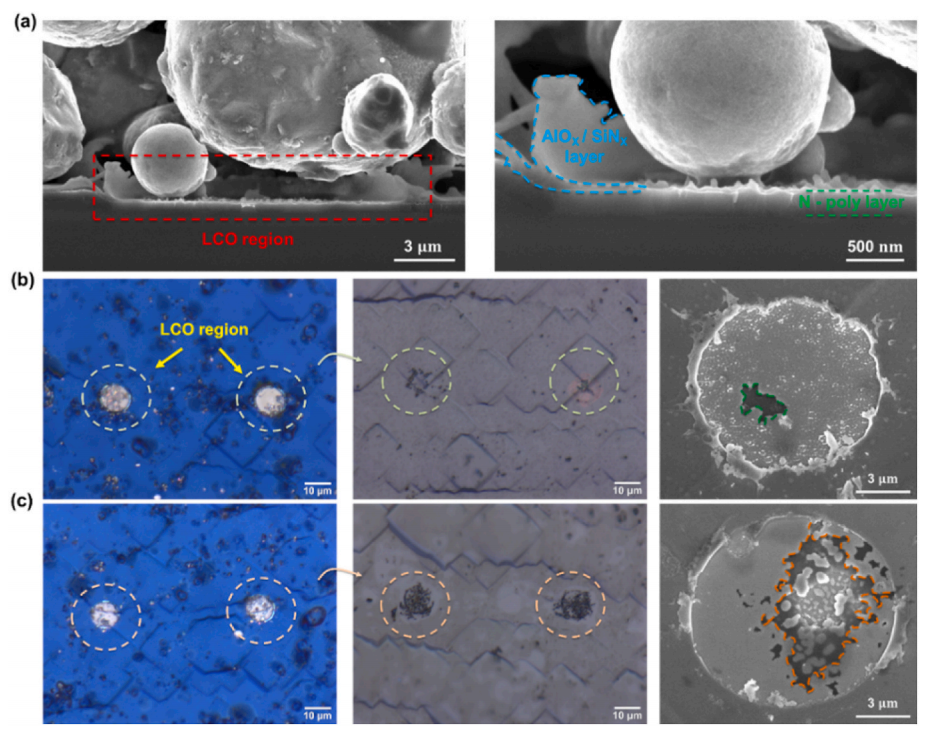
Analysis of Local Al Contact Structures and Interface Topography
Under these conditions:
·n-type contact: J0,metal ≈ 2,500 fA/cm²
·p-type contact: J₀,metal ≈ 2,400 fA/cm²
Contact resistivity:
·n-type: 0.3 mΩ·cm²
·p-type: 0.1 mΩ·cm²
Further observations revealed:
·Too low a temperature → Insufficient contact formation (resistance increases)
·Too high a temperature → Enhanced interfacial reactions (increased recombination)
Of particular note:
·Interface reactions in p-type poly-Si are significantly more intense
·n-type interface reactions are more localized and more controllable
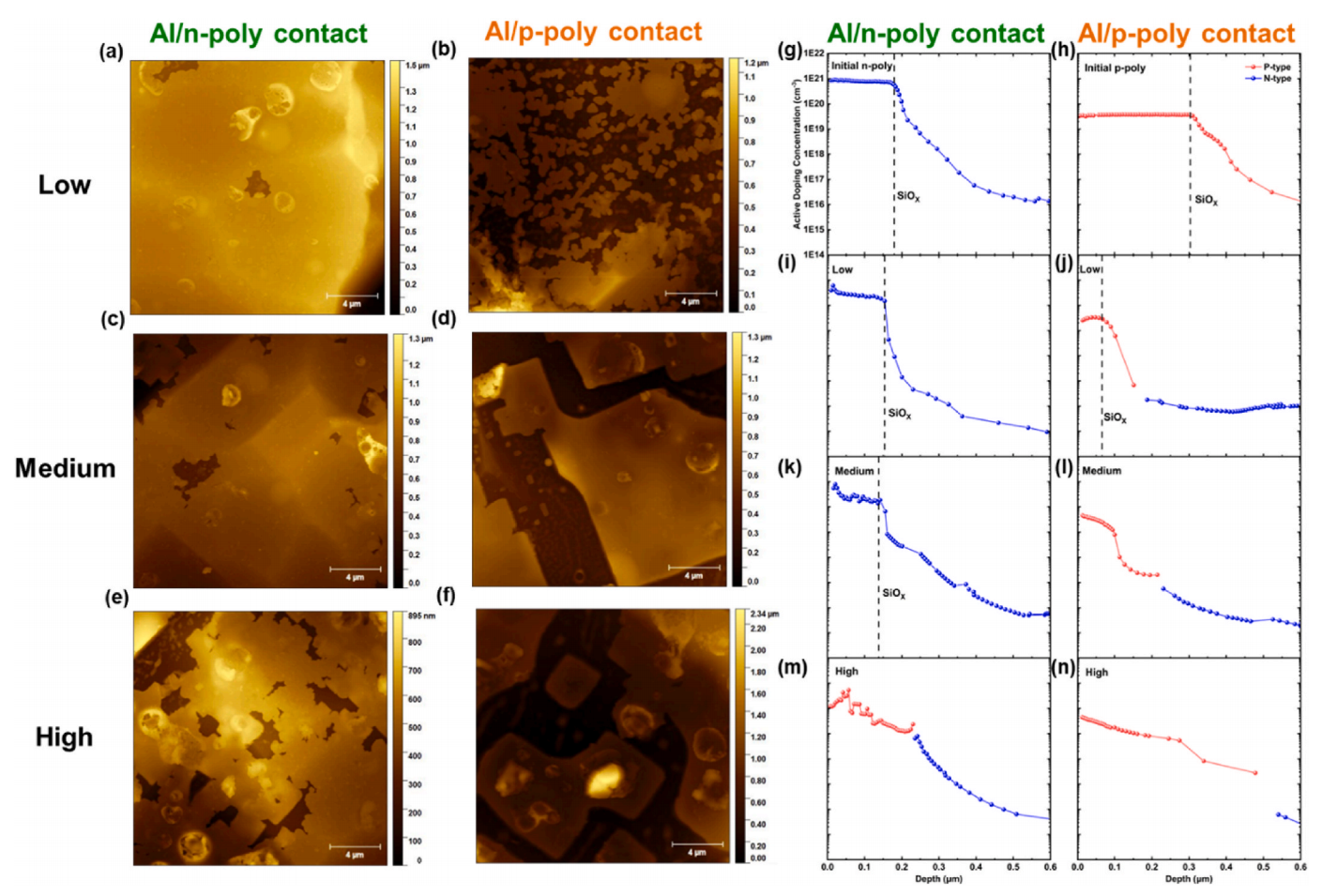
Evolution of interface morphology and dopant distribution at Al/n-type and Al/p-type poly-Si
interfaces under different sintering conditions
Microscopic analysis reveals significant differences in polarity:
At the n-type poly-Si interface :
Reaction areas are localized and discrete
Etch pits form only locally
The poly-Si layer structure remains relatively intact
No continuous deep etching formed
p-type poly-Si interface :
The etched area is significantly larger
More thorough Al-Si reaction
More prone to forming an Al-p⁺ layer
Rapid expansion as temperature increases
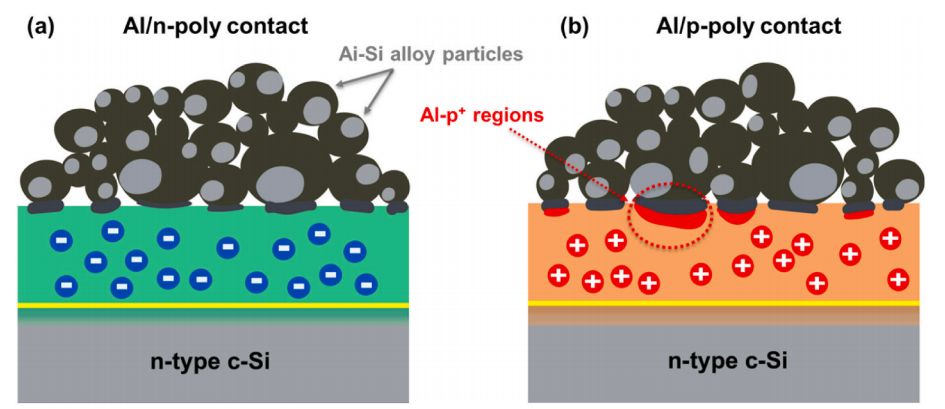
Schematic Diagram of the Reaction Mechanism at the Al/poly-Si Interface
ECV results further show that:
n-type inversion to p-type only occurs at high temperatures
p-type begins to degrade significantly even at low temperatures
The underlying causes include:
Differences in the doping environment (Al’s intrinsic p-type nature)
No reverse doping barrier at the p-type interface
Differences in poly-Si microstructure may enhance diffusion
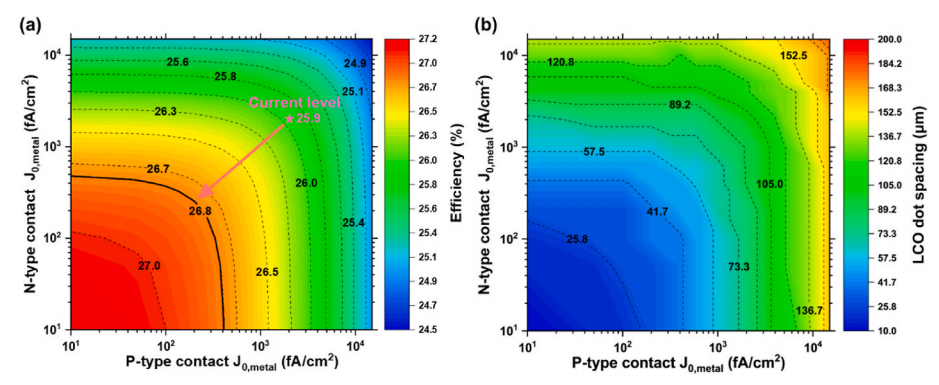
Device Simulation Results and Efficiency Optimization Roadmap for the Al Metallization System in TBC Solar Cells
Based on measured parameters, the study conducted device-level simulation analysis:
It can be observed that JSC remains essentially unchanged; the decrease is primarily attributable to: increased contact recombination and series resistance introduced by localized contacts.
Further analysis indicates that the performance bottleneck is primarily not resistance, but the relatively high J₀,metal (contact recombination)
The model further reveals:
Current Al solution:
J0,metal ≈ 2400–2500 fA/cm²
Corresponding efficiency: ≈25.9%
To reach the level of the Ag system (≈26.8%):
The following condition must be met: Both the n-type and p-type J₀,metal must simultaneously drop below 400–500 fA/cm²
At the same time:
Smaller LCO spacing is permitted
Improve the balance between fill factor and VOC
Optimize the design space for contact patterns
The conclusion is very clear:
The focus of the next phase is not on “whether Al contacts can be implemented,” but on “how to further reduce interfacial recombination.”
This study systematically validated the feasibility of screen-printed aluminum metallization in TBC back-contact silicon solar cells. Through precise LCO aperture formation and sintering process optimization, effective bipolar low-resistance contacts between n-type and p-type poly-Si were achieved, and a stable process window (approximately 700°C) was established; Although Al contacts still exhibit higher interfacial recombination than silver-based systems—resulting in a slight decrease in device efficiency to approximately 25.9% (compared to 26.8% for the Ag system)—the efficiency is already close to 26% and demonstrates clear potential for industrialization.The study further indicates that the current performance bottleneck stems primarily from recombination losses at the Al/poly-Si interface rather than contact resistance. If J₀,metal can be further reduced to below 400–500 fA/cm² in the future through methods such as paste engineering, interface passivation, and laser-enhanced contact, silver-free TBC cells are expected to approach or even match the efficiency levels of existing silver-metallized cells while maintaining their low-cost advantage, thereby providing an important technical pathway for next-generation low-silver/silver-free high-efficiency crystalline silicon cells.
Q1: Why choose aluminum over copper for silver-free metallization of TBC silicon solar cells?
Cu offers excellent conductivity but requires barrier layers and electroplating, making the process more complex. Al can be directly integrated with screen printing and firing, without complex electroplating. It is also widely used in PERC and Al-BSF cells, offering low cost, abundant resources, and mature processing.
Q2: How can femtosecond laser LCO enable precise opening without damaging the poly-Si/SiOx passivating contact?
Use 257 nm femtosecond UV laser LCO . Its high photon energy (~4.8 eV) and shallow absorption depth enable selective removal of AlOx/SiNx with virtually no damage to the underlying poly-Si/SiOx passivation layer
Q3: How can silver-free metallization achieve both low contact resistance and low recombination?
Through precise LCO and optimized firing, effective low-resistance contacts are achieved on both n- and p-type poly-Si, with a stable process window of around 700°C. Further improvements in paste engineering, interface passivation, and laser-enhanced contact formation could reduce J₀,metal to below 400–500 fA/cm², thereby reducing contact recombination and improving cell efficiency.
email:market@millennialsolar.com
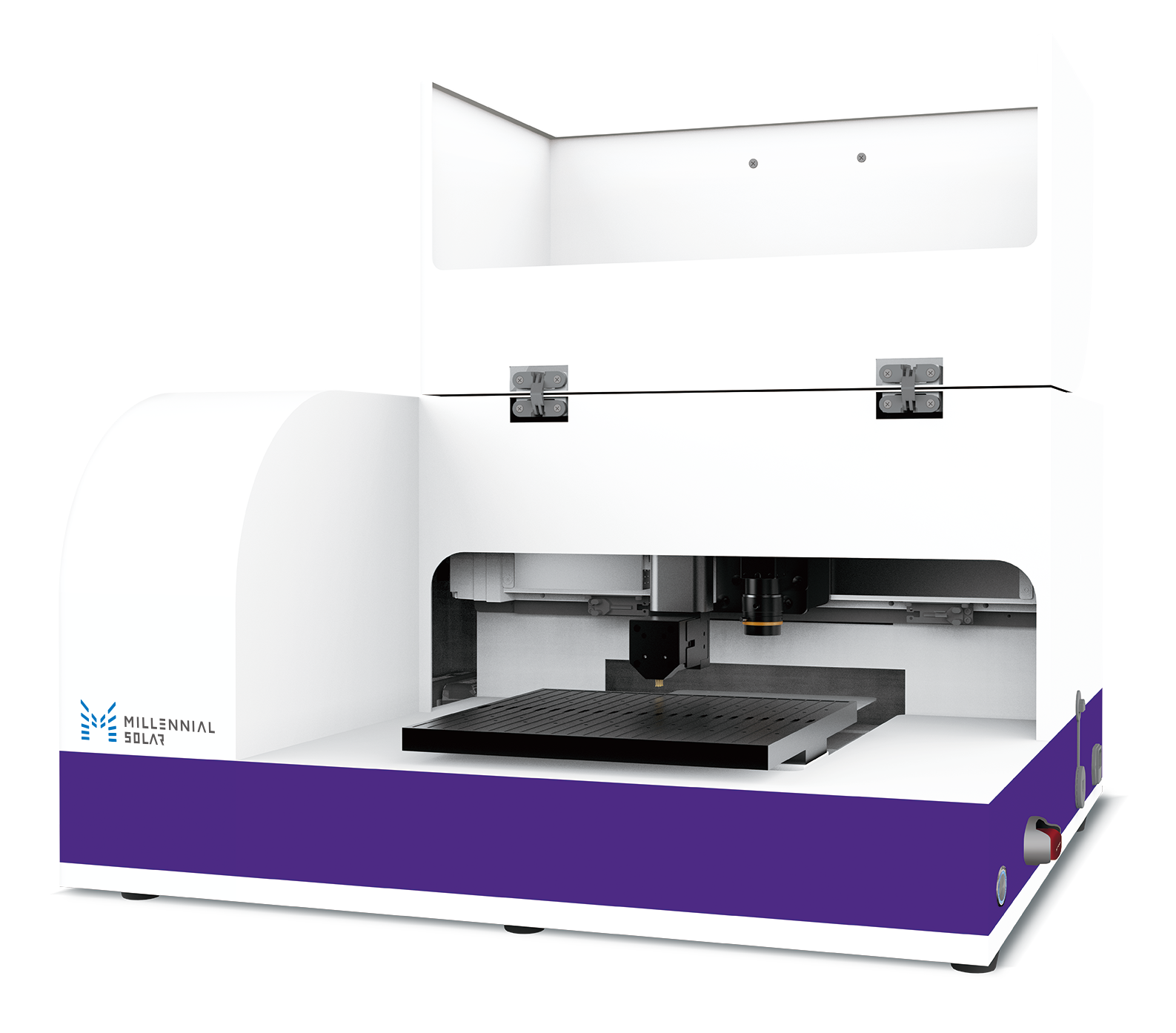
The Millennial Solar TLM Contact Resistance Tester features contact resistivity testing capabilities, enabling fast, flexible, and precise testing.
Static test repeatability ≤ 1%, dynamic test repeatability ≤ 3%
● Line resistance measurement accuracy up to 5% or 0.1 Ω/cm
● Switch between contact resistivity and line resistance testing
● Customizable probes for measurement and analysis
The Millennial Solar TLM Contact Resistance Tester accurately determines contact resistivity by measuring the total resistance of transmission line models at different spacings and performing a linear fit.
Reference: Toward silver-free back-contact silicon solar cells: Dual-polarity screen-printed aluminum contacts on poly-Si/SiOX passivated contacts
Related Products


