


Non-contact IV tester

Quantum Efficiency Tester
PL/EL Integrated System
PV-Reflectumeter
3D Confocal Microscope
In-Line Four Point Probe Tester
Four Point Probe Tester
In-Line Thin Film Thickness Tester
Raman Spectrometer
FTIR Spectrometer
Spectrophotometer
Automatic Spectroscopic Ellipsometer
Contact Resistance Tester
Ultra depth of field 3D microscope
Auto Visual Tester
VMM PV Vision Measuring Machine
Solar Cell Horizontal Tensile Tester
Steady State Solar Simulator for Solar Cell
Solar Cell UV Aging Test Chamber
Solar Cell Comprehensive Tensile Tester
Visual Inspection Tester
Wet Leakage Current Tester
PV Module EL Tester
PV Module UV Preconditioning Chamber
Steady State Solar Simulator for PV Module
Current Continuous Monitor
Potential Induced Degradation Test
Bypass Diode Tester
LeTID Test System
Reverse Current Overload Tester
Impulse Voltage Tester
Hipot Insulation Tester
Ground Continuity Tester
Hipot Insulation Ground Tester
Damp Heat Test Chamber
Humidity Freeze Test
Thermal Cycle Test Chamber
Dynamic Mechanical Load Tester
Static Mechanical Load Tester
Hail Impact Tester
Robustness of Termination Tester
Module Breakage Tester
Cut Susceptibility Tester
Peel Shear Strength Tester
Universal Testing Machine (Single-arm)
Universal Testing Machine (Double-arm)
Glass Transmittance Tester
Acetic Acid Test Chamber
EVA Degree of Crosslinking Test System
Junction Box Comprehensive Tester
Drop ball tester
Semi-automatic scanning four-probe tester
Stylus Profilometer
Maximum Power Point Tracker
Perovskite Glass Transmittance Tester
Perovskite P1 Laser Scribing Multifunctional Testing Machine
Perovskite Online PL Tester
Perovskite Online Sheet Resistance Tester
Online Perovskite Film Thickness Tester
Perovskite Process Inspection Workstation
Portable EL Tester
Portable Thermal Imaging Tester
Solar Module Multi-Channel Testing System
PV Inverter Power Quality Tester
IV Tester
IVEL Cell Sorting Machine
Low Silver Screen Printed Metallization for Industrial Grade TOPCon Cells Achieves 80% Silver Reduction
Date : 9 July 2025Views : 3670
This paper presents a low silver content screen-printed metallization design that significantly reduces silver usage while maintaining high efficiency through the use of silver dots and a floating finger structure with low silver content in TOPCon solar cells. Experiments to characterize the interface quality through advanced diagnostics such as photoluminescence (PL) imaging have shown an 85% reduction in back-side silver usage, bringing the overall cell silver consumption down to 7 mg/W, with an efficiency loss of only 0.1-0.2%. With further optimization of the printing and sintering processes, efficiencies comparable to industry standard silver metallization designs are expected to be achieved. This study provides a viable solution for the sustainable and cost-effective fabrication of TOPCon solar cells.
Research Methodology
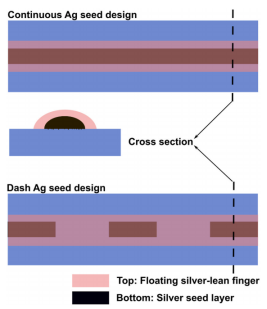
Schematic design of silver-saving metallization structure
Two-step printing process: First, a small amount of conventional silver paste is printed as a seed layer to create contact with the silicon surface. Then, floating finger lines and sink bars are printed, using alternating silver-sparing pastes. This two-step printing process ensures a high-quality metal/silicon interface while reducing the material compatibility requirements of silver-sparing pastes.
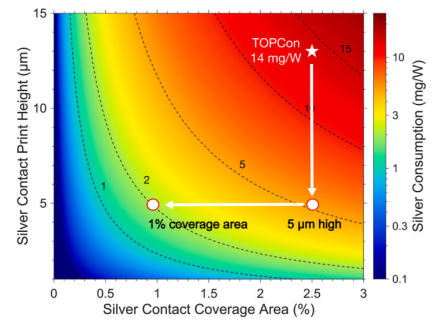
TOPCon Cell Silver Consumption - Contact Coverage as a Function of Print Height
Dot Matrix Seed Layer Configuration: The area covered by the silver contacts is further reduced by printing the silver paste as intermittent dots or dot contacts. This design allows the flexibility to optimize the process by adjusting the spacing between the dots.
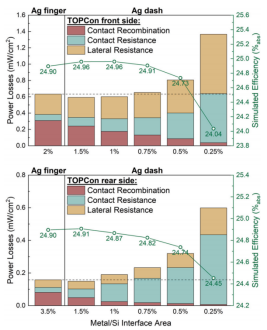
Simulation of cell efficiency and loss decomposition of TOPCon cells with standard silver finger wires and dot matrix structures
Numerical Simulation: Numerical simulations were performed using Quokka 3 to evaluate the potential impact of dot matrix design on cell performance. Simulation parameters are based on current industrial TOPCon cells and include wafer size, thickness, body resistivity, lifetime, number of busbars, finger width, finger spacing, contact resistivity, contact complexity, passivation surface, emitter sheet resistivity, and polysilicon doping density.
Experimental design
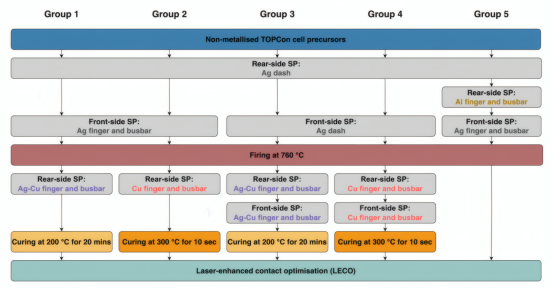
Process flow for preparation of silver-saving metallized TOPCon cells
Data collection: Non-metallized industrial TOPCon cell precursors were used, which were made from n-type industrial grade Cz wafers with a thickness of 130 μm and a body resistivity of 0.6-1.2 Ω cm.
Experimental procedure: the experiment was divided into five groups:
Groups 1 and 2: intermittent silver dots were printed on the rear surface of the TOPCon precursor, followed by conventional silver finger wires, busbars, and solder joints on the front, and an industry-standard sintering process was performed.
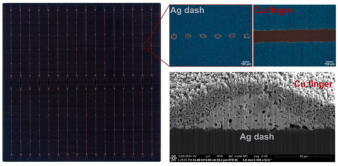
Surface topography characterization after silver-sparing metallization of TOPCon cells
Groups 3 and 4: Silver dots are printed on both the front and back surfaces, followed by the printing of silver clad copper or pure copper finger wires, busbars and solder joints.
Group 5: Only high-temperature pastes were used, omitting the low-temperature curing step, and all screen-printing steps were completed prior to the sintering process.
Sample selection: Preparation of a large area (182 x 182 mm²) TOPCon solar cell using two commercially available burn-through silver pastes for the front and back sides.
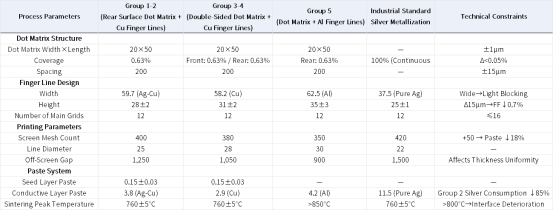
Parameter Configuration: The screen parameters and patterning are detailed in the table below, with a silver dot matrix of 14 μm width, 50 μm length and 0.43% area.
Silver-saving metallization TOPCon cell screen printing parameter design
Results and analysis
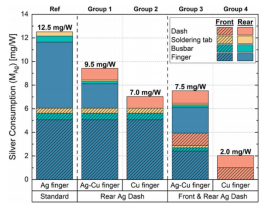
Comparison of Silver Consumption in TOPCon Cells (Multiple Metallization Schemes)
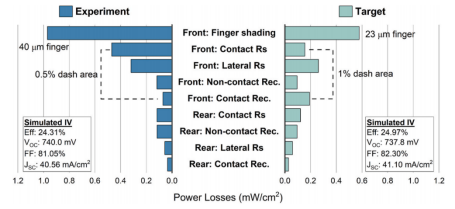
Simulation of efficiency loss and optimization path for double-sided silver-sparing metallization schemes
Silver-sparing metallization vs. low-temperature copper-based paste: The average efficiency of TOPCon cells using a silver-dot design on the rear surface is 24.95% using silver-coated copper finger wires and 25.05% using pure copper finger wires, which is a difference of 0.1-0.2% from the efficiency of standard silver finger wires. The loss of efficiency due to the silver-finger design is mainly due to a 0.5-1% decrease in fill factor (FF), which is mainly due to a decrease in metal/silicon interface area and an increase in contact resistance.
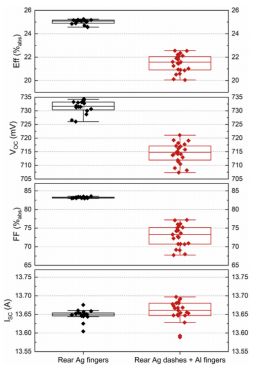
I-V Parameter Degradation of Rear Surface Aluminum Finger Line Scheme
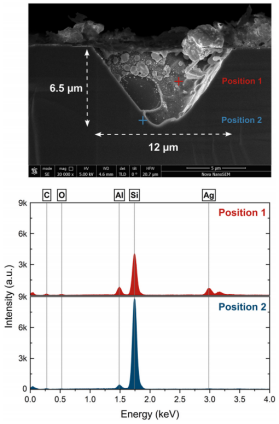
Failure analysis of silver dot/aluminum finger line interface
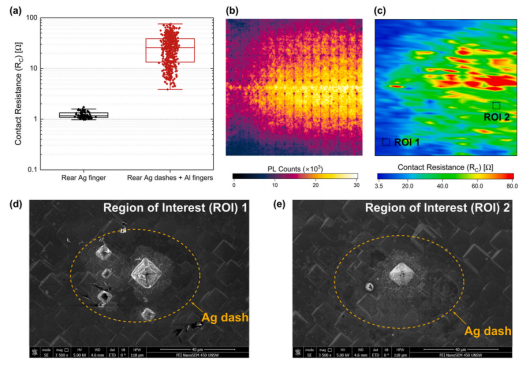
Aluminum-based scheme contact resistance with evidence of material degradation (a) contact resistance comparison (b) photoluminescence PL image (c) contact resistance distribution map (d) and (e) scanning electron microscope image of region 1/2
Silver-sparing metallization with high-temperature Al slurry: TOPCon cells using Ag dots and Al finger wires on both front and back sides showed a significant efficiency degradation, with VOC reduced by up to 25 mV and FF reduced by more than 10%, with an average efficiency of only 21.5%, suggesting a 3.5% efficiency drop. Through analytical means such as PL imaging, it was confirmed that aluminum diffusion triggered material degradation due to the undesirable interaction between Ag dots and Al finger wires during high-temperature sintering, resulting in damage to the metal/Si interface.
In this paper, a silver-saving metallization design based on existing industrial screen-printing techniques is proposed for significantly reducing silver consumption in TOPCon solar cells. By using silver dots and floating finger lines or sink bars on the front and back surfaces, an 85% reduction in silver consumption was achieved, with a total silver consumption of 7 mg/W.
Millennial PL/EL All-in-One Tester
E-mail: market@millennialsolar.com
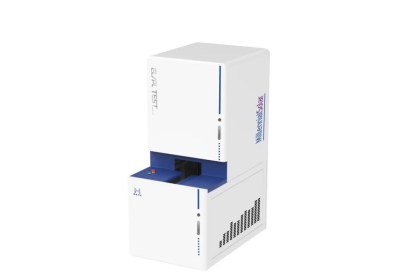
Millennial PL/EL All-in-One Tester simulates sunlight irradiation on a chalcogenide solar cell wafer, uniformly illuminates the whole sample, and captures photoluminescence (PL) signals with a professional lens to obtain PL imaging; electroluminescence (EL) signals to obtain EL imaging. The captured PL/EL imaging is processed and analyzed by image algorithms and software, and PL/EL defects are identified, analyzed, classified, and summarized according to their characteristics.
EL/PL imaging with 5 megapixels for multiple imaging accuracy switching
Spectral response range: 400nm~1200nm
PL light source: blue light (light source size, wavelength, etc. can be customized)
Multiple defects identification analysis (pockmarking, darkening, edge intrusion, etc.) can be customized for defect types
Millennial PL/EL all-in-one tester in this article in photoluminescence (PL) analysis, through the blue light excitation to accurately capture the metallization interface defects. The high-resolution imaging capability and intelligent defect analysis features have become the cornerstone tool for interface failure diagnosis in TOPCon low-silver metallization studies.
Related Products


