


Non-contact IV tester

Quantum Efficiency Tester
PL/EL Integrated System
PV-Reflectumeter
3D Confocal Microscope
In-Line Four Point Probe Tester
Four Point Probe Tester
In-Line Thin Film Thickness Tester
Raman Spectrometer
FTIR Spectrometer
Spectrophotometer
Automatic Spectroscopic Ellipsometer
Contact Resistance Tester
Ultra depth of field 3D microscope
Auto Visual Tester
VMM PV Vision Measuring Machine
Solar Cell Horizontal Tensile Tester
Steady State Solar Simulator for Solar Cell
Solar Cell UV Aging Test Chamber
Solar Cell Comprehensive Tensile Tester
Visual Inspection Tester
Wet Leakage Current Tester
PV Module EL Tester
PV Module UV Preconditioning Chamber
Steady State Solar Simulator for PV Module
Current Continuous Monitor
Potential Induced Degradation Test
Bypass Diode Tester
LeTID Test System
Reverse Current Overload Tester
Impulse Voltage Tester
Hipot Insulation Tester
Ground Continuity Tester
Hipot Insulation Ground Tester
Damp Heat Test Chamber
Humidity Freeze Test
Thermal Cycle Test Chamber
Dynamic Mechanical Load Tester
Static Mechanical Load Tester
Hail Impact Tester
Robustness of Termination Tester
Module Breakage Tester
Cut Susceptibility Tester
Peel Shear Strength Tester
Universal Testing Machine (Single-arm)
Universal Testing Machine (Double-arm)
Glass Transmittance Tester
Acetic Acid Test Chamber
EVA Degree of Crosslinking Test System
Junction Box Comprehensive Tester
Drop ball tester
Semi-automatic scanning four-probe tester
Stylus Profilometer
Maximum Power Point Tracker
Perovskite Glass Transmittance Tester
Perovskite P1 Laser Scribing Multifunctional Testing Machine
Perovskite Online PL Tester
Perovskite Online Sheet Resistance Tester
Online Perovskite Film Thickness Tester
Perovskite Process Inspection Workstation
Portable EL Tester
Portable Thermal Imaging Tester
Solar Module Multi-Channel Testing System
PV Inverter Power Quality Tester
IV Tester
IVEL Cell Sorting Machine
Seasonal Effects of Perovskite Solar Cells: MPPT Reveals Degradation Mechanisms and Stability Optimization
Date : 13 August 2025Views : 2200
The power conversion efficiency (PCE) of perovskite solar cells (PSCs) under standard test conditions (STC) has been improved to 26.95%. Current research efforts are shifting from efficiency enhancement to scalability and stability improvement. This paper uses four years of outdoor data from Berlin to reveal significant seasonal performance fluctuations in perovskite solar cells (PSCs): stable performance in summer but a significant decline in winter (up to 30%), primarily attributed to the combined effects of spectral changes, temperature coefficients, MPPT losses, and metastable effects. Perovskite maximum power point tracking (MPPT) testing enables climate characterization testing to precisely quantify the impact of metastable dynamics.
Experimental Design
A four-year outdoor exposure experiment was conducted on glass-glass encapsulated p-i-n perovskite cells (structure:ITO | 2PACz | Cs₀.₁₅ FA₀.₈₅ PbI₂.₅₅ Br₀.₄₅ | C₆₀ |SnO₂ | Cu ,bandgap 1.65 eV) in Berlin (a temperate low-irradiance climate zone). The data acquisition system recorded spectral, temperature, and irradiance data every 5 minutes, calculated the average power conversion efficiency (PCE) daily, and periodically re-tested the cells under standard test conditions (STC) indoors.
Outdoor Results Overview
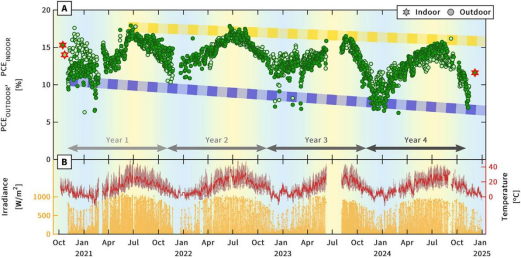
Perovskite Solar Cell 4-Year Outdoor PCE, Temperature, and Irradiance Change Trends
PCE Summer Peak: No degradation in the first 1–2 years; cumulative decrease of approximately 2% in the fourth year.
Winter trough: 30% lower in the first year; cumulative winter-to-winter decline of approximately 40% over four years.
Indoor STC data: Linear decline of 6% per year over four years, but due to seasonal factors, outdoor summer-to-summer decline is only 3% per year, while winter-to-winter decline reaches 9% per year.
Seasonal influencing factors
Spectral changes
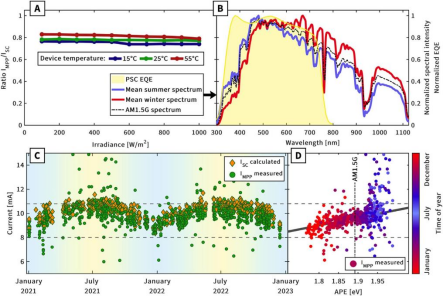
(A) IMPP/ISC ratio under different irradiance-temperature conditions (B) Standardized summer (blue)/winter (red) spectra (C) Short-circuit current calculated based on EQE and spectral data vs. outdoor measured IMPP (D) Distribution of APE values for each data point in Figure C
Spectral conditions are one of the key factors influencing PSC performance. Outdoor spectra vary with season and atmospheric conditions, and PSCs have a narrow spectral response range (approximately 300–800 nm), making them more sensitive to spectral changes. This study quantifies the degree of blue light enrichment and red light enrichment in the spectrum by calculating the average photon energy (APE). The results show that the summer spectrum exhibits blue light enrichment, while the winter spectrum exhibits red light enrichment, leading to a current difference of approximately 10% under the same irradiance.
Temperature coefficient
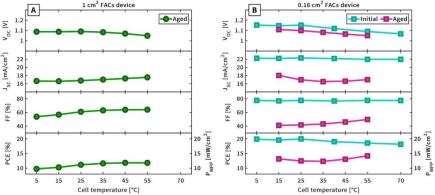
(A) Performance of a 4-year-old battery at different temperatures in Figure 1; (B) Comparison between the initial and aged states of a small-sized battery (0.16 cm²) with the same structure.
The temperature coefficient (γ) of PSC is typically negative, indicating that its performance decreases with increasing temperature. However, as the battery ages, the temperature coefficient of the fill factor (FF) becomes positive, resulting in better performance of the aged PSC under high-temperature conditions in summer. This phenomenon contrasts sharply with traditional photovoltaic technologies (such as silicon-based solar cells).
J-V hysteresis and MPPT tracking loss
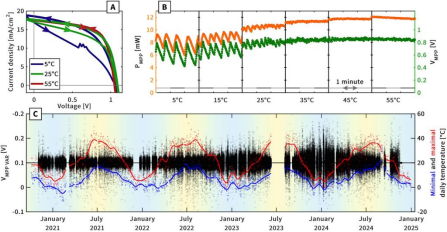
(A) 4-year aged battery forward/reverse scan J-V curve (5/25/55°C); (B) Indoor MPPT tracking power/voltage stability; (C) Outdoor VMPP fluctuation
J-V hysteresis is a common phenomenon in PSCs and can affect the accuracy of maximum power point (MPPT) tracking. Experiments show that J-V hysteresis significantly increases under aged and low-temperature conditions, leading to a decline in MPPT tracking quality. At 5 °C, MPPT tracking voltage fluctuations exceed 35%, resulting in significant energy loss. This effect is particularly pronounced in winter, reducing the energy output of PSCs.
Perovskite metastable state effect
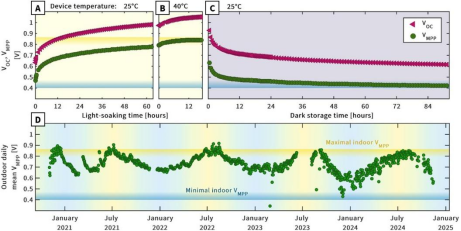
A-C) 4-year aging battery indoor light immersion/dark storage experiment (D) Outdoor average daily VMPP variation
The metastable state caused by the light-induced saturation effect (LSE) is the core factor distinguishing perovskite from traditional photovoltaics. Experiments have shown that new batteries can reach light saturation within minutes, but aged batteries require continuous illumination for over 72 hours to achieve saturation. Additionally, temperature significantly influences LSE. Under winter low-temperature and low-light conditions, LSE remains unsaturated, leading to insufficient voltage gain and performance degradation. This effect is the primary factor influencing PSC seasonal performance.
The amplitude of seasonal variations in perovskite solar cells is influenced by climate and device characteristics. Compared to Berlin, regions closer to the equator experience smaller spectral variations, resulting in reduced current differences caused by spectral effects. Furthermore, low-temperature losses in high-temperature regions may be reduced. However, aging and MPPT losses at low temperatures may be exacerbated in warmer climates. Metastability is the primary factor influencing the seasonal performance of PSCs, particularly under winter conditions of low temperature and low light intensity, where the unsaturated LSE leads to performance degradation.
Perovskite Maximum Power Point Tracking Test (MPPT)
email:market@millennialsolar.com
The Perovskite Maximum Power Point Tracking Test (MPPT) utilizes A+AA+ grade LED solar simulators as aging light sources, leveraging their advanced technology and multi-functional design to provide robust support for research into perovskite solar cells.
▶ Light source grade: A+AA+, spectral matching grade A+, uniformity grade A, long-term stability grade A+
▶ Effective spot size: ≥250×250 mm (customizable)
▶ Adjustable light intensity: 0.2–1.5 sun, adjustable in 0.1 sun increments
▶ Independent power control: 300–400 nm / 400–750 nm / 750–1200 nm
Perovskite Maximum Power Point Tracking Test MPPT can assess and quantify the energy output efficiency of perovskite solar cells under different temperature and light conditions, as well as track their maximum power point during actual outdoor operation, thereby revealing the impact of seasonal changes on cell performance.


