


Non-contact IV tester

Quantum Efficiency Tester
PL/EL Integrated System
PV-Reflectumeter
3D Confocal Microscope
In-Line Four Point Probe Tester
Four Point Probe Tester
In-Line Thin Film Thickness Tester
Raman Spectrometer
FTIR Spectrometer
Spectrophotometer
Automatic Spectroscopic Ellipsometer
Contact Resistance Tester
Ultra depth of field 3D microscope
Auto Visual Tester
VMM PV Vision Measuring Machine
Solar Cell Horizontal Tensile Tester
Steady State Solar Simulator for Solar Cell
Solar Cell UV Aging Test Chamber
Solar Cell Comprehensive Tensile Tester
Visual Inspection Tester
Wet Leakage Current Tester
PV Module EL Tester
PV Module UV Preconditioning Chamber
Steady State Solar Simulator for PV Module
Current Continuous Monitor
Potential Induced Degradation Test
Bypass Diode Tester
LeTID Test System
Reverse Current Overload Tester
Impulse Voltage Tester
Hipot Insulation Tester
Ground Continuity Tester
Hipot Insulation Ground Tester
Damp Heat Test Chamber
Humidity Freeze Test
Thermal Cycle Test Chamber
Dynamic Mechanical Load Tester
Static Mechanical Load Tester
Hail Impact Tester
Robustness of Termination Tester
Module Breakage Tester
Cut Susceptibility Tester
Peel Shear Strength Tester
Universal Testing Machine (Single-arm)
Universal Testing Machine (Double-arm)
Glass Transmittance Tester
Acetic Acid Test Chamber
EVA Degree of Crosslinking Test System
Junction Box Comprehensive Tester
Drop ball tester
Semi-automatic scanning four-probe tester
Stylus Profilometer
Maximum Power Point Tracker
Perovskite Glass Transmittance Tester
Perovskite P1 Laser Scribing Multifunctional Testing Machine
Perovskite Online PL Tester
Perovskite Online Sheet Resistance Tester
Online Perovskite Film Thickness Tester
Perovskite Process Inspection Workstation
Portable EL Tester
Portable Thermal Imaging Tester
Solar Module Multi-Channel Testing System
PV Inverter Power Quality Tester
IV Tester
IVEL Cell Sorting Machine
Improving TOPCon Cell Stability | Enhancing PL/EL Detection Compatibility with LECO-Compatible Silver Paste
Date : 15 August 2025Views : 6210
Laser-Enhanced Contact Optimization (LECO) is an effective technology for enhancing the efficiency of TOPCon cells. However, there is an urgent need to improve LECO-compatible silver paste to ensure the reliability and stability of TOPCon cells. This study optimized the glass-forming process by introducing Al/Ga/Fe elements into the inorganic glass powder of conductive silver paste. Using PL/EL imaging technology, the degradation behavior of TOPCon cells under standard acetic acid conditions was evaluated.
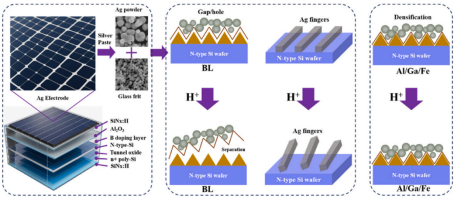
Schematic diagram of TOPCon cell structure and metallization degradation mechanism
Design and verification of corrosion-resistant glass materials
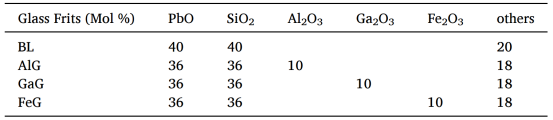
In this study, three modified glass materials were designed: AlG (with Al₂O₃ added), GaG (Ga₂O₃), and FeG (Fe₂O₃), with their molar compositions shown in the table below.
Table 1: Molar percentage composition of glass materials in the control group and experimental group
Using commercial TOPCon cells (N-type CZ silicon wafers, thickness 100 μm) as the substrate, the front electrode was printed with silver paste containing 88 wt% silver powder, 3 wt% glass powder, and 9 wt% organic binder. After sintering in a conveyor furnace, LECO treatment was performed (1064 nm laser, 45 W, 15 V bias).
Stability was evaluated via an acetic acid accelerated aging test (6g glacial acetic acid + 125g KCl + 200mL water, 80°C/8h). Key findings are as follows:
Table 2: Efficiency degradation rate of TOPCon cells after acetic acid treatment

The efficiency decay of silver pastes containing Al/Ga/Fe is less than 10%, with FeG at only 5%.
The unmodified BL group has a decay of up to 54%.
PL and EL imaging
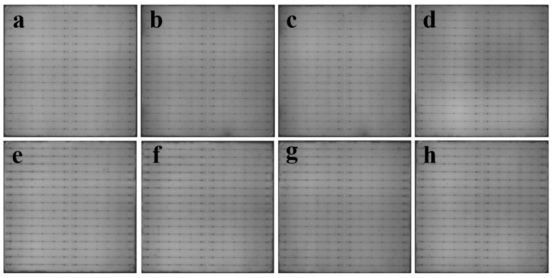
(a–d) PL images of TOPCon cells with LECO silver paste containing BL, AlG, GaG, and FeG before acetic acid treatment; (e–h) PL images of the corresponding samples after acetic acid treatment
The photoluminescence (PL) results show that there are no obvious abnormalities on the surface of the cells using AlG, GaG, and FeG silver paste before and after acetic acid treatment, indicating that these silver pastes do not cause significant damage or corrosion to the cells.
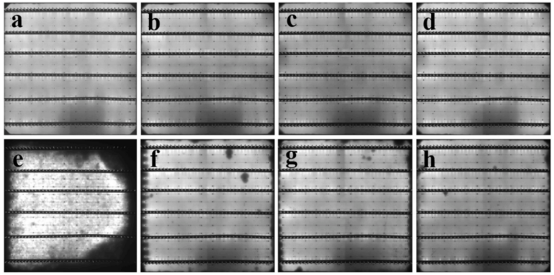
(a–d) EL images of TOPCon cells before acetic acid treatment using LECO silver paste doped with BL, AlG, GaG, and FeG; (e–h) EL images of the corresponding samples after acetic acid treatment
Electroluminescence (EL) characterization revealed: In the BL group, large-area black spots appeared after acetic acid treatment, indicating failure of grid line electrode contact; whereas in the AlG/GaG/FeG groups, only minor blackening occurred at the edges.
Contact resistance and line resistance
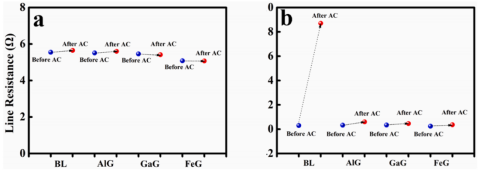
(a) Comparison of grid line resistance before and after acetic acid treatment; (b) Changes in contact resistance (significant increase in the BL group)
The contact resistance test results show that there was no significant change in line resistance before and after treatment for all test samples (including the control group), indicating that the silver grid electrodes did not suffer significant structural damage or corrosion during the treatment process. Combined with the PL characterization results, it can be inferred that the main cause of efficiency loss is the contact issue between the silicon wafer and the silver electrode.
This study optimized glass formation by introducing aluminum (Al), gallium (Ga), and iron (Fe) elements into the inorganic glass component of conductive silver paste, and evaluated the degradation behavior of TOPCon cells under standard acetic acid conditions. The results show that the silver paste containing Al/Ga/Fe exhibits significantly superior resistance to acetic acid corrosion compared to the untreated group, with efficiency loss controlled below 10% (as low as 5%), while the control group experienced over 50% loss. This study provides a high-reliability LECO-compatible silver paste solution for TOPCon solar cells.
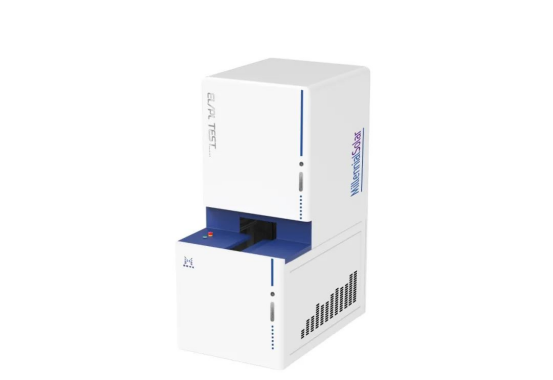
Millennial PL/EL Integrated Testing Instrument
email:market@millennialsolar.com
The Millennial PL/EL Integrated Testing Instrument simulates sunlight exposure on perovskite solar cells, uniformly illuminating the entire sample. It uses specialized lenses to capture photoluminescence (PL) signals, generating PL imaging, and electroluminescence (EL) signals, generating EL imaging. Through image algorithms and software, the captured PL/EL images are processed and analyzed to identify PL/EL defects, which are then analyzed, classified, and summarized based on their characteristics.
EL/PL imaging, 5 million pixels, enabling multiple imaging resolution switching
Spectral response range: 400 nm to 1200 nm
PL light source: Blue light (customizable light source size, wavelength, etc.)
Multiple defect identification and analysis (pitting, darkening, edge intrusion, etc.) with customizable defect types
The Millennial PL/EL integrated tester can perform PL/EL imaging before and after acetic acid aging to “non-destructively, quickly, and visually” verify the acid corrosion resistance of Al/Ga/Fe glass materials and identify the efficiency degradation mechanisms of TOPCon cells.
Related Products


