


Non-contact IV tester

Quantum Efficiency Tester
PL/EL Integrated System
PV-Reflectumeter
3D Confocal Microscope
In-Line Four Point Probe Tester
Four Point Probe Tester
In-Line Thin Film Thickness Tester
Raman Spectrometer
FTIR Spectrometer
Spectrophotometer
Automatic Spectroscopic Ellipsometer
Contact Resistance Tester
Ultra depth of field 3D microscope
Auto Visual Tester
VMM PV Vision Measuring Machine
Solar Cell Horizontal Tensile Tester
Steady State Solar Simulator for Solar Cell
Solar Cell UV Aging Test Chamber
Solar Cell Comprehensive Tensile Tester
Visual Inspection Tester
Wet Leakage Current Tester
PV Module EL Tester
PV Module UV Preconditioning Chamber
Steady State Solar Simulator for PV Module
Current Continuous Monitor
Potential Induced Degradation Test
Bypass Diode Tester
LeTID Test System
Reverse Current Overload Tester
Impulse Voltage Tester
Hipot Insulation Tester
Ground Continuity Tester
Hipot Insulation Ground Tester
Damp Heat Test Chamber
Humidity Freeze Test
Thermal Cycle Test Chamber
Dynamic Mechanical Load Tester
Static Mechanical Load Tester
Hail Impact Tester
Robustness of Termination Tester
Module Breakage Tester
Cut Susceptibility Tester
Peel Shear Strength Tester
Universal Testing Machine (Single-arm)
Universal Testing Machine (Double-arm)
Glass Transmittance Tester
Acetic Acid Test Chamber
EVA Degree of Crosslinking Test System
Junction Box Comprehensive Tester
Drop ball tester
Semi-automatic scanning four-probe tester
Stylus Profilometer
Maximum Power Point Tracker
Perovskite Glass Transmittance Tester
Perovskite P1 Laser Scribing Multifunctional Testing Machine
Perovskite Online PL Tester
Perovskite Online Sheet Resistance Tester
Online Perovskite Film Thickness Tester
Perovskite Process Inspection Workstation
Portable EL Tester
Portable Thermal Imaging Tester
Solar Module Multi-Channel Testing System
PV Inverter Power Quality Tester
IV Tester
IVEL Cell Sorting Machine
Reliability Assessment of Bifacial Single-Glass TOPCon Solar Modules
Date : 18 August 2025Views : 3425
Against the backdrop of global energy transition, photovoltaic power generation, as a clean and renewable energy form, is gradually becoming a key component of the energy sector. In recent years, continuous innovation in photovoltaic technology has brought n-type TOPCon technology into the spotlight, capturing industry-wide attention. Simultaneously, the corresponding encapsulation solutions have been optimized, providing robust support for enhancing the performance and reliability of photovoltaic modules.
The Rise of n-type TOPCon Technology
Rapidly Growing Market Share
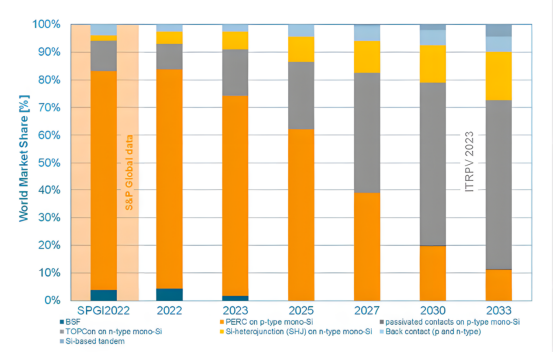
Since 2022 marked the first year of industrialization for n-type TOPCon cells, the technology has developed rapidly. In 2023, n-type cell modules accounted for less than 25% of the market share (with TOPCon at approximately 23%). However, by 2024, this share is expected to exceed 70%, with n-type TOPCon alone contributing 60%. By 2028, n-type TOPCon is projected to maintain a dominant market share of 55.4%.
Significant Technical Advantages
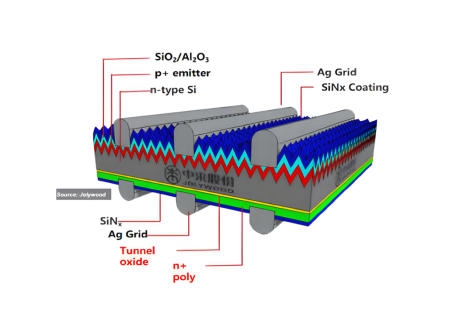
n-type TOPCon cells exhibit an efficiency 1.5% higher than PERC cells and a power output exceeding PERC by 30W. Utilizing an N-type substrate, these cells offer inherent advantages. Under the same metal impurity concentration, N-type substrates demonstrate higher photoelectric conversion efficiency, greater tolerance to metal impurities like iron, longer minority carrier lifetimes, and no light-induced degradation caused by boron-oxygen complexes. Additionally, the open-circuit voltage of TOPCon cells has increased from the initial 710mV during R&D to 740mV in mass production today. With low-temperature coefficients and minimal degradation, TOPCon technology delivers lower Balance of System (BOS) costs and Levelized Cost of Energy (LCOE) for customers. On the supply chain front, TOPCon benefits from stable equipment and raw material suppliers, providing a solid foundation for large-scale industrialization.
Innovations in n-type TOPCon Double-Sided Single-Glass Encapsulation Solutions
Technical Breakthroughs by Jolywood
Among the many companies deeply researching and applying n-type TOPCon technology, Jolywood’s double-sided single-glass encapsulation solution has garnered significant attention. This solution has demonstrated outstanding performance in extreme environments through rigorous laboratory testing. During damp heat aging and UV aging tests, the unique "breathable" property of the transparent backsheet played a critical role. It effectively releases acetic acid generated by the encapsulation film inside the module, preventing corrosion of the cell grid lines and ensuring contact reliability. This significantly enhances the module’s lifespan and reliability in outdoor applications.
Exceptional Mechanical Performance
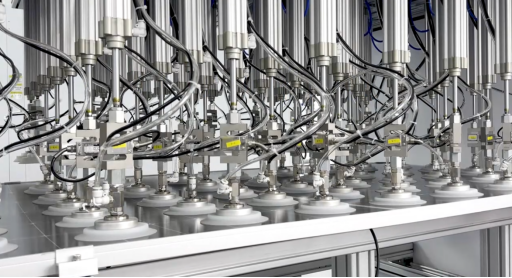
The fully tempered glass modules employing the double-sided single-glass encapsulation solution exhibit "four-proof" characteristics: resistance to hurricanes, heavy snow, hail, and cracking. In static mechanical load tests (SML - 8100/2400pa), the single-glass modules demonstrated remarkable impact resistance. Tests showed that after being subjected to 45mm hail, the power loss of single-glass modules was negligible, whereas double-glass modules experienced cracking on both front and rear glass surfaces. This makes Jolywood’s n-type TOPCon double-sided single-glass encapsulation solution highly valuable for regions with extreme climates.
Higher Power Generation
The n-type TOPCon double-sided single-glass encapsulation solution has performed excellently in outdoor field tests across different regions. Over two years of continuous tracking, single-glass modules achieved an average power generation gain of over 1% compared to double-glass modules. This is primarily attributed to the "three-low" performance of double-sided single-glass modules: low-temperature coefficients, low operating temperatures, and low hot-spot temperatures, ensuring higher power generation efficiency in outdoor environments. Particularly in hot and humid climates, the outdoor power degradation of TOPCon double-sided single-glass modules was less than 1.1% over two years. By optimizing encapsulation materials and processes, this solution not only improves the overall power generation efficiency of photovoltaic systems but also delivers higher economic returns for investors, achieving a win-win outcome for both economic and environmental benefits.
The emergence of n-type TOPCon technology and its double-sided single-glass encapsulation solutions has injected new vitality into the photovoltaic industry. As the technology matures and application scenarios expand, n-type TOPCon technology is poised to play an even more significant role in the global energy transition, contributing to the achievement of sustainable development goals.
Related Products


