


Non-contact IV tester

Quantum Efficiency Tester
PL/EL Integrated System
PV-Reflectumeter
3D Confocal Microscope
In-Line Four Point Probe Tester
Four Point Probe Tester
In-Line Thin Film Thickness Tester
Raman Spectrometer
FTIR Spectrometer
Spectrophotometer
Automatic Spectroscopic Ellipsometer
Contact Resistance Tester
Ultra depth of field 3D microscope
Auto Visual Tester
VMM PV Vision Measuring Machine
Solar Cell Horizontal Tensile Tester
Steady State Solar Simulator for Solar Cell
Solar Cell UV Aging Test Chamber
Solar Cell Comprehensive Tensile Tester
Visual Inspection Tester
Wet Leakage Current Tester
PV Module EL Tester
PV Module UV Preconditioning Chamber
Steady State Solar Simulator for PV Module
Current Continuous Monitor
Potential Induced Degradation Test
Bypass Diode Tester
LeTID Test System
Reverse Current Overload Tester
Impulse Voltage Tester
Hipot Insulation Tester
Ground Continuity Tester
Hipot Insulation Ground Tester
Damp Heat Test Chamber
Humidity Freeze Test
Thermal Cycle Test Chamber
Dynamic Mechanical Load Tester
Static Mechanical Load Tester
Hail Impact Tester
Robustness of Termination Tester
Module Breakage Tester
Cut Susceptibility Tester
Peel Shear Strength Tester
Universal Testing Machine (Single-arm)
Universal Testing Machine (Double-arm)
Glass Transmittance Tester
Acetic Acid Test Chamber
EVA Degree of Crosslinking Test System
Junction Box Comprehensive Tester
Drop ball tester
Semi-automatic scanning four-probe tester
Stylus Profilometer
Maximum Power Point Tracker
Perovskite Glass Transmittance Tester
Perovskite P1 Laser Scribing Multifunctional Testing Machine
Perovskite Online PL Tester
Perovskite Online Sheet Resistance Tester
Online Perovskite Film Thickness Tester
Perovskite Process Inspection Workstation
Portable EL Tester
Portable Thermal Imaging Tester
Solar Module Multi-Channel Testing System
PV Inverter Power Quality Tester
IV Tester
IVEL Cell Sorting Machine
Reliability Testing of Crystalline Silicon Pv Modules—PID Testing
Date : 24 September 2025Views : 2550
Crystalline silicon Pv Modules are power-generating devices installed outdoors that require full exposure to solar radiation to produce electricity. Due to various environmental factors, modules inevitably endure exposure to dust, salt spray, strong winds, rain, snow, hail, humid heat, dry cold, condensation and evaporation of water vapor, atmospheric gas pollution, seasonal temperature fluctuations across spring, summer, autumn, and winter, and intense ultraviolet radiation. They must maintain stable and effective power generation performance for 25 years or longer. Therefore, assessing Pv Module reliability is a particularly critical concern. The following analysis focuses on Potential Induced Degradation (PID) testing.
I. What is PID?
PID testing evaluates potential induced degradation.
Polarization, electrolytic corrosion, and electrochemical corrosion. When modules operate under high voltage for extended periods, leakage currents occur between the cover glass, encapsulation materials, and frame. This causes significant charge accumulation on the cell surface, degrading the passivation effect. Consequently, the fill factor, short-circuit current, and open-circuit voltage decrease, resulting in module performance below design standards. The purpose of PID testing is to verify a module's ability to withstand performance changes under high-intensity voltage conditions.
II. Three Modes of PID Degradation
1. Current diversion at the p-n junction within the solar cell: When a negative voltage is applied across the cell and a positive voltage to the frame (i.e., when the Pv Module is subjected to negative bias), leaking anode ions flow into the cell. Impurities within the semiconductor form conductive pathways inside the cell, reducing its parallel resistance.
2. Moisture readily penetrates the edges of modules. When EVA undergoes hydrolysis, it produces acetic acid. This acetic acid reacts with Na⁺ ions in the glass, generating large quantities of freely mobile Na⁺ ions. Sodium ions on the glass surface migrate through the encapsulation material to the cell surface, where they undergo electrochemical corrosion reactions with the silver grid lines on the cell surface. This corrodes the grid lines, leading to low fill factor, high series resistance, and module performance degradation. This type of degradation is irreversible. POE, being a non-polar molecule with saturated bonds, is resistant to hydrolysis and exhibits low water vapor permeability. Its high volume resistivity significantly impedes the migration rate of positive charge ions (e.g., Na+) toward the cell surface, thereby mitigating PID to a certain extent.
3. This refers to long-term operation of the module under high voltage, where leakage currents exist between the cover glass, encapsulation materials, and frame. Substantial charge accumulation on the cell surface creates an electric field opposite to the passivation field, degrading the passivation effect on the cell surface. This polarization effect reduces the fill factor, short-circuit current, and open-circuit voltage, causing the module performance to fall below design standards. However, this degradation is reversible.
EL Characteristics of PID Failure
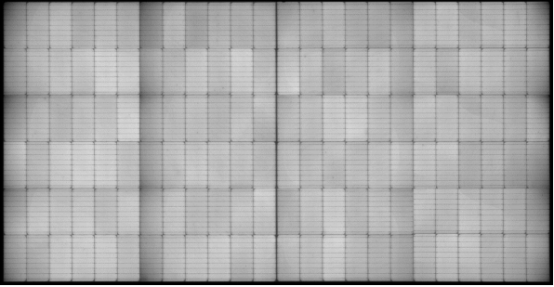
EL Image of Bifacial Module Before PID Testing
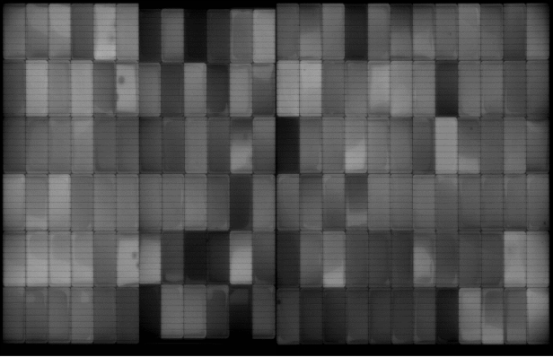
EL Image of Bifacial Module After PID Testing
The outer perimeter shows significant darkening after PID testing compared to before testing. This occurs because voltage is applied to the frame, and cells closer to the frame experience greater potential, leading to more severe PID.
Distribution and Magnitude of the Strong Electric Field Formed by the Metal Frame on the Solar Cell Under Bias
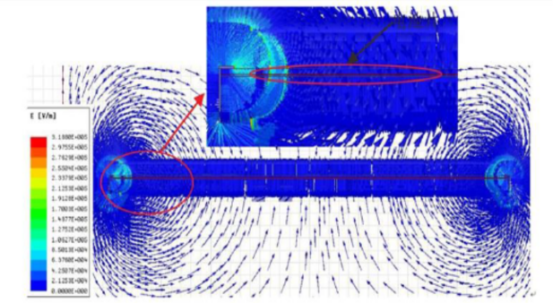
The closer to the frame, the higher the electric field strength and the greater the potential.
III. Factors Affecting PID Degradation
Cell Variation
Impact of Module Encapsulation Materials
Inverter Influence
Environmental Factors
IV. PID Prevention and Solutions
Cell Impact: The refractive index of the cell's anti-reflective coating affects the module's PID resistance. By optimizing the passivation layer on the cell surface and enhancing the density of SiN₄, a more compact protective layer can be formed while maintaining efficiency. This approach improves PID performance.
Module Encapsulation Material Impact: Reducing leakage current pathways, selecting glass with low sodium ion content, opting for transparent backsheets, employing high-barrier POE, and using adhesives with superior sealing properties are effective approaches to prevent PID occurrence. Transparent backsheets primarily address PID issues in P-PERC modules, where the N-type PN junction is located on the front surface. The N-type PN junction area is significantly affected, and protection for N-type modules relies heavily on encapsulation materials. High-barrier POE is one effective solution.

Inverter Influence: When both the inverter's negative output terminal and the modules are under negative bias conditions, the effect becomes more pronounced as the distance between the modules and the inverter's negative output terminal decreases. If both the inverter's positive output terminal and the modules are under positive bias conditions, the position of the Pv Modules does not affect PID, and the PID phenomenon is not significant under these conditions. For PID caused by system factors, grounding the negative output terminals of both the modules and the inverter can mitigate the effect.
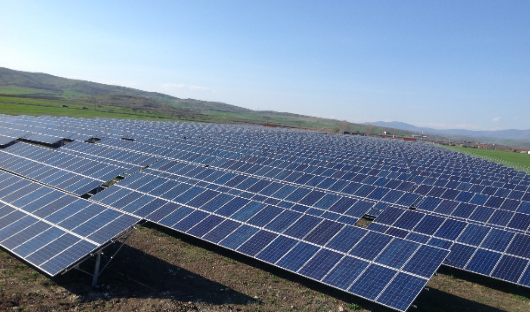
Environmental Factors: As ambient temperature increases, the reverse saturation current within the cells rises sharply, causing leakage current to grow rapidly and exacerbating PID. Thus, higher ambient temperatures lead to more pronounced PID.
The PID effect in Pv Modules intensifies with rising temperature, humidity, and bias voltage, leading to decreased output power and reduced project-level electricity generation. To mitigate PID at the module level, it is crucial to increase the insulation resistance between external circuits and internal cells, reduce leakage current, and select encapsulation materials with excellent insulation properties. This approach fundamentally prevents the occurrence of PID.
Related Solutions

HJT Solar Cell
Optimized HJT cell efficiency through tested structures and key process analysis.
View DetailsRelated Products


