


Non-contact IV tester

Quantum Efficiency Tester
PL/EL Integrated System
PV-Reflectumeter
3D Confocal Microscope
In-Line Four Point Probe Tester
Four Point Probe Tester
In-Line Thin Film Thickness Tester
Raman Spectrometer
FTIR Spectrometer
Spectrophotometer
Automatic Spectroscopic Ellipsometer
Contact Resistance Tester
Ultra depth of field 3D microscope
Auto Visual Tester
VMM PV Vision Measuring Machine
Solar Cell Horizontal Tensile Tester
Steady State Solar Simulator for Solar Cell
Solar Cell UV Aging Test Chamber
Solar Cell Comprehensive Tensile Tester
Visual Inspection Tester
Wet Leakage Current Tester
PV Module EL Tester
PV Module UV Preconditioning Chamber
Steady State Solar Simulator for PV Module
Current Continuous Monitor
Potential Induced Degradation Test
Bypass Diode Tester
LeTID Test System
Reverse Current Overload Tester
Impulse Voltage Tester
Hipot Insulation Tester
Ground Continuity Tester
Hipot Insulation Ground Tester
Damp Heat Test Chamber
Humidity Freeze Test
Thermal Cycle Test Chamber
Dynamic Mechanical Load Tester
Static Mechanical Load Tester
Hail Impact Tester
Robustness of Termination Tester
Module Breakage Tester
Cut Susceptibility Tester
Peel Shear Strength Tester
Universal Testing Machine (Single-arm)
Universal Testing Machine (Double-arm)
Glass Transmittance Tester
Acetic Acid Test Chamber
EVA Degree of Crosslinking Test System
Junction Box Comprehensive Tester
Drop ball tester
Semi-automatic scanning four-probe tester
Stylus Profilometer
Maximum Power Point Tracker
Perovskite Glass Transmittance Tester
Perovskite P1 Laser Scribing Multifunctional Testing Machine
Perovskite Online PL Tester
Perovskite Online Sheet Resistance Tester
Online Perovskite Film Thickness Tester
Perovskite Process Inspection Workstation
Portable EL Tester
Portable Thermal Imaging Tester
Solar Module Multi-Channel Testing System
PV Inverter Power Quality Tester
IV Tester
IVEL Cell Sorting Machine
Hot Spot Effect in Solar Panels
Date : 19 November 2025Views : 1935
The hot spot effect in Solar Panels occurs when one or more cells (individual solar cells) within a module generate significantly less current than other normal cells under sunlight due to various reasons (such as shading, damage, aging, internal defects, or mismatch). These abnormal cells transform from power-generating units into energy-consuming units, resulting in localized high-temperature spots.
I. Mechanism of Hot Spot Formation
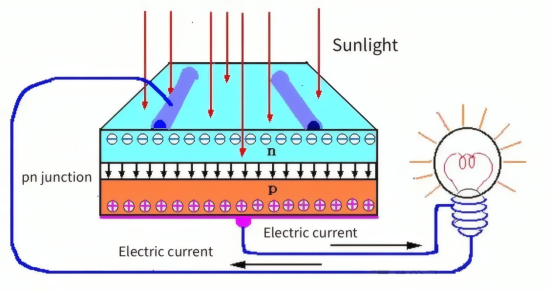
The Mechanism of Hot Spot Formation
Solar Panels generate electricity because sunlight strikes the p-n junctions within the cells. This interaction creates new electron-hole pairs. Under the influence of the p-n junction electric field, holes flow from the n-region to the p-region, while electrons flow from the p-region to the n-region. When the circuit is closed, a current is formed—this is the photovoltaic effect of the module/cell.
During this power generation process, if an abnormal cell fails to absorb light energy normally, it blocks the occurrence of the photoelectric effect within that cell. The PN junction of the abnormal cell remains electrically neutral and in a blocked state. Meanwhile, the adjacent cell group undergoes the photoelectric effect normally, resulting in a higher voltage at the P-side of the silicon semiconductor compared to the N-side. This creates a potential difference across the abnormal cell, generating voltage. The internal resistance and dark current of the faulty cell also undergo significant changes, transforming it into a power-consuming component. This generates a forward conduction current from the P-side to the N-side. As current flows through this power-consuming component (the faulty cell), heat is generated, leading to the hot spot effect.
II. Causes of Hot Spot Formation
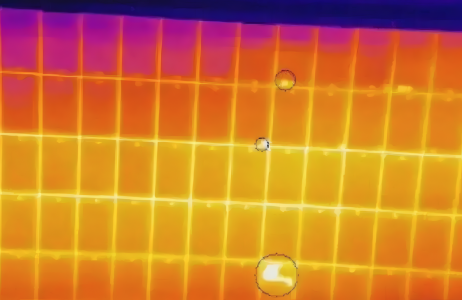
Hot spots caused by cell defects
1. Shading: Shading-induced hot spots are the most common issue in Solar Panel applications. Bird droppings, leaves, dust, shadows from nearby structures or objects, and surface contaminants on the module can all lead to hot spot formation. Shaded cells absorb less light energy, resulting in lower current output compared to other cells, which readily triggers the hot spot effect.
2. Cell Defects: Internal defects within the module's cells (such as cracks, microcracks, fragments, sintering defects, or edge leakage) or abnormally low parallel resistance or high series resistance within the cells.
3. Cell mismatch: Different cells within a module may exhibit varying electrical performance parameters (especially current) due to mixed batches or differing aging rates. This mismatch can easily cause hot spots.
4. Internal module connection failure: Poor soldering or breaks in the busbars, or poor contact in the interconnect strips, can cause abnormal operation in some cells or cell strings.
III. Impacts and Hazards
1. Power Loss: Cells within hot spots cease generating electricity or even consume power, directly reducing the overall output of the module. This decrease in power generation impacts the profitability of photovoltaic power plants.
2. Permanent Module Damage: Local temperatures can exceed 100°C, far surpassing normal operating conditions. Such heat may cause backsheet blistering, carbonization, or cracking, compromising insulation and sealing integrity. Extreme temperatures can directly burn through metal electrodes (bonder wires, busbars) on cells or even shatter the cells themselves. Localized high temperatures generate significant thermal stress, potentially causing glass breakage.
3. Safety Hazards: Persistent hot spots pose a potential fire hazard, especially when the backsheet or encapsulation film ignites. This represents the most severe risk of hot spots. Flexible modules, lacking glass front and back panels, require even more immediate attention when hot spots occur!
5. Reduced Module Lifespan: Even if immediate severe damage is avoided, repeated or prolonged hot spots significantly accelerate material aging and performance degradation, shortening the module's operational lifespan.
IV. Measures to Prevent Hot Spots
1. Module Quality: Select reputable brands with mature manufacturing processes, stringent quality control, and well-designed bypass diodes to prevent hot spots caused by internal cell defects, cell mismatches, or substandard bypass diodes. Bypass diodes enable current generated by other cells to flow through them, ensuring the solar power system continues generating electricity. This prevents circuit interruption due to a single faulty cell. Cell series-parallel circuits and bypass diodes in Solar Panels
2. Proper Installation: Position Solar Panels appropriately, avoiding nearby trees, utility poles, columns, or other structures that could cause localized shading.
3. Maintenance: Regularly clean and maintain Solar Panels, promptly removing obstructions like dust, bird droppings, leaves, and debris accumulated along frame edges from the module surface.
Related Products


