


Non-contact IV tester

Quantum Efficiency Tester
PL/EL Integrated System
PV-Reflectumeter
3D Confocal Microscope
In-Line Four Point Probe Tester
Four Point Probe Tester
In-Line Thin Film Thickness Tester
Raman Spectrometer
FTIR Spectrometer
Spectrophotometer
Automatic Spectroscopic Ellipsometer
Contact Resistance Tester
Ultra depth of field 3D microscope
Auto Visual Tester
VMM PV Vision Measuring Machine
Solar Cell Horizontal Tensile Tester
Steady State Solar Simulator for Solar Cell
Solar Cell UV Aging Test Chamber
Solar Cell Comprehensive Tensile Tester
Visual Inspection Tester
Wet Leakage Current Tester
PV Module EL Tester
PV Module UV Preconditioning Chamber
Steady State Solar Simulator for PV Module
Current Continuous Monitor
Potential Induced Degradation Test
Bypass Diode Tester
LeTID Test System
Reverse Current Overload Tester
Impulse Voltage Tester
Hipot Insulation Tester
Ground Continuity Tester
Hipot Insulation Ground Tester
Damp Heat Test Chamber
Humidity Freeze Test
Thermal Cycle Test Chamber
Dynamic Mechanical Load Tester
Static Mechanical Load Tester
Hail Impact Tester
Robustness of Termination Tester
Module Breakage Tester
Cut Susceptibility Tester
Peel Shear Strength Tester
Universal Testing Machine (Single-arm)
Universal Testing Machine (Double-arm)
Glass Transmittance Tester
Acetic Acid Test Chamber
EVA Degree of Crosslinking Test System
Junction Box Comprehensive Tester
Drop ball tester
Semi-automatic scanning four-probe tester
Stylus Profilometer
Maximum Power Point Tracker
Perovskite Glass Transmittance Tester
Perovskite P1 Laser Scribing Multifunctional Testing Machine
Perovskite Online PL Tester
Perovskite Online Sheet Resistance Tester
Online Perovskite Film Thickness Tester
Perovskite Process Inspection Workstation
Portable EL Tester
Portable Thermal Imaging Tester
Solar Module Multi-Channel Testing System
PV Inverter Power Quality Tester
IV Tester
IVEL Cell Sorting Machine
Solar Panel TC Cycling Test
Date : 25 November 2025Views : 2785
I. What is the Solar Panel TC Cycling Test?
Solar Panel Thermal Cycling Test, fully known as Thermal Cycling Test, is one of the most fundamental and critical environmental adaptation tests in Solar Panel reliability testing. Its core purpose is to evaluate a Solar Panel's ability to resist fatigue failure, aging, and electrical performance degradation caused by thermal expansion and contraction under repeatedly changing temperature conditions. Simply put, it simulates whether the module can still function normally after enduring countless temperature cycles during the alternating day and night cycles and seasonal changes experienced outdoors.
II. Test Purpose and Significance
1. Identifying Material Compatibility: Modules are assembled through various processes using multiple materials including glass, EVA/POE encapsulant, solar cells, interconnect ribbons, backsheets, and frames. These materials possess differing thermal expansion coefficients. TC testing effectively reveals incompatibilities between them, such as module delamination or microcracks in solar cells during testing.
2. Evaluating Connection Reliability: Assesses the bonding strength between interconnect strips (bonder wires) and cell busbars, as well as the connection points between busbars and bonder wires. These junctions may fatigue under thermal cycling stress, potentially causing cold solder joints, debonding, or fractures.
3. Predicting Long-Term Lifespan: By performing a large number of temperature cycles (typically 200) in a short period, it simulates 20 years or more of outdoor service life to evaluate the module's long-term durability.
4.Quality Control: TC testing is a critical step for module manufacturers and third-party testing agencies to validate the stability of product design and production processes.
III. Test Principle and Procedure
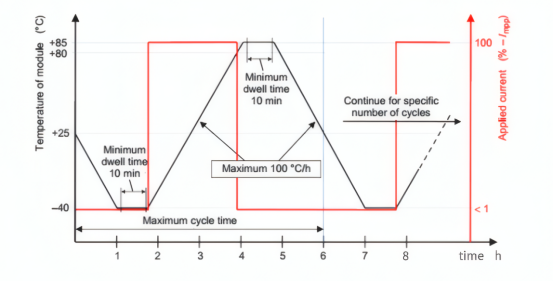
Testing is conducted in a dedicated environmental test chamber.
1. Sample Preparation: Select intact Solar Panels for testing. Prior to testing, perform initial electrical performance tests (maximum power Pmax, insulation resistance, etc.) and visual inspections (EL inspection is particularly crucial for detecting initial microcracks).
2. Chamber Placement: Position the module inside the temperature-controlled chamber and connect its terminals to external monitoring equipment to track real-time electrical performance changes (e.g., open-circuit voltage, short-circuit current) throughout testing.
3. Temperature Profile Setup: Testing follows a strictly defined thermal cycling curve, typically comprising the following stages:
High-Temperature Phase: Raise the chamber temperature to 85°C and maintain it for a period (e.g., 10-15 minutes) to ensure overall thermal stabilization of the module.
Cooling Phase: Reduce the temperature to -40°C at a specified rate (typically not exceeding 100°C/hour).
Low-Temperature Phase: Maintain at -40°C for a period to ensure complete cooling of the module.
Rewarm Phase: The temperature is gradually raised back to 85°C at a specified rate.
This completes one full “cycle.”
5.Cycle Count: According to standards, TC200 represents the baseline requirement, involving 200 cycles. More stringent testing may mandate TC400 or TC600 to evaluate higher reliability levels.
IV. Post-Test Requirements
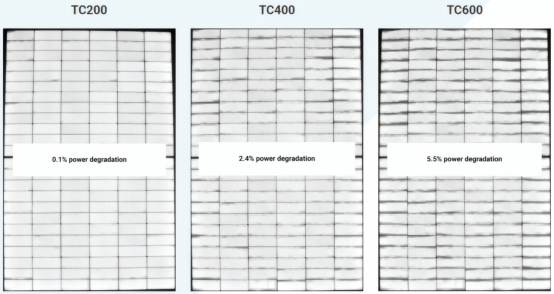
After TC testing, modules exhibiting the following issues shall be deemed non-compliant:
1. Severe electrical performance degradation: Maximum power output (Pmax) degradation exceeds the specified standard limit (typically 5%).
2. Insulation failure: Insulation resistance fails to meet requirements, posing leakage risks.
3. Visual defects:
Cell cracking/microcracks: The most common failure mode. Post-test EL (electroluminescence) imaging clearly reveals hidden crack patterns.
Tape breakage/de-soldering: Causes partial or complete circuit disconnection in cell strings, resulting in significant power reduction.
Bubbles or delamination: Stress-induced separation between material layers, impairing heat dissipation and insulation.
Junction box seal failure: Allows moisture ingress.
Back sheet or glass cracking.
Related Products


