


Non-contact IV tester

Quantum Efficiency Tester
PL/EL Integrated System
PV-Reflectumeter
3D Confocal Microscope
In-Line Four Point Probe Tester
Four Point Probe Tester
In-Line Thin Film Thickness Tester
Raman Spectrometer
FTIR Spectrometer
Spectrophotometer
Automatic Spectroscopic Ellipsometer
Contact Resistance Tester
Ultra depth of field 3D microscope
Auto Visual Tester
VMM PV Vision Measuring Machine
Solar Cell Horizontal Tensile Tester
Steady State Solar Simulator for Solar Cell
Solar Cell UV Aging Test Chamber
Solar Cell Comprehensive Tensile Tester
Visual Inspection Tester
Wet Leakage Current Tester
PV Module EL Tester
PV Module UV Preconditioning Chamber
Steady State Solar Simulator for PV Module
Current Continuous Monitor
Potential Induced Degradation Test
Bypass Diode Tester
LeTID Test System
Reverse Current Overload Tester
Impulse Voltage Tester
Hipot Insulation Tester
Ground Continuity Tester
Hipot Insulation Ground Tester
Damp Heat Test Chamber
Humidity Freeze Test
Thermal Cycle Test Chamber
Dynamic Mechanical Load Tester
Static Mechanical Load Tester
Hail Impact Tester
Robustness of Termination Tester
Module Breakage Tester
Cut Susceptibility Tester
Peel Shear Strength Tester
Universal Testing Machine (Single-arm)
Universal Testing Machine (Double-arm)
Glass Transmittance Tester
Acetic Acid Test Chamber
EVA Degree of Crosslinking Test System
Junction Box Comprehensive Tester
Drop ball tester
Semi-automatic scanning four-probe tester
Stylus Profilometer
Maximum Power Point Tracker
Perovskite Glass Transmittance Tester
Perovskite P1 Laser Scribing Multifunctional Testing Machine
Perovskite Online PL Tester
Perovskite Online Sheet Resistance Tester
Online Perovskite Film Thickness Tester
Perovskite Process Inspection Workstation
Portable EL Tester
Portable Thermal Imaging Tester
Solar Module Multi-Channel Testing System
PV Inverter Power Quality Tester
IV Tester
IVEL Cell Sorting Machine
m-FPEAI passivation technology combined with MPPT testing achieves 24.6% efficiency in perovskite solar cells with stable operation for 1750 consecutive hours
Date : 5 December 2025Views : 2005
In recent years, perovskite solar cells (PSCs) have garnered significant attention for their high efficiency, yet stability issues remain a hurdle for commercialization. Traditional PEAI passivators readily permeate the 3D layer, leading to performance degradation. This study innovatively designed three fluorinated PEAI derivatives (o/m/p-FPEAI). It was discovered that the meta-substituted m-FPEAI, leveraging steric hindrance effects, ultimately achieved 24.63% efficiency, maintaining over 80% efficiency during 1750 hours of MPPT testing. Millennial Perovskite Maximum Power Point Tracking Test MPPT employs AAA-grade LED solar simulators as aging light sources, enabling multi-faceted temperature control and environmental atmosphere regulation for long-term stable performance testing.
m-FPEAI Passivation Technology Principle
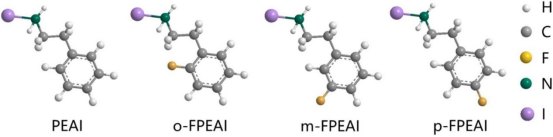
Molecular Structures of PEAI, o-FPEAI, m-FPEAI, and p-FPEAI
Molecular structural analysis reveals that the key difference in the molecular structures of PEAI and its three fluorinated derivatives (o/m/p-FPEAI) lies in the spatial steric effects exerted by the fluorine atom positions. Among these, m-FPEAI effectively inhibits 2D penetration into 3D layers due to the strong steric hindrance of the meta-fluorine, thereby preserving the structural integrity of the 3D perovskite.
Photoluminescence (PL) Testing
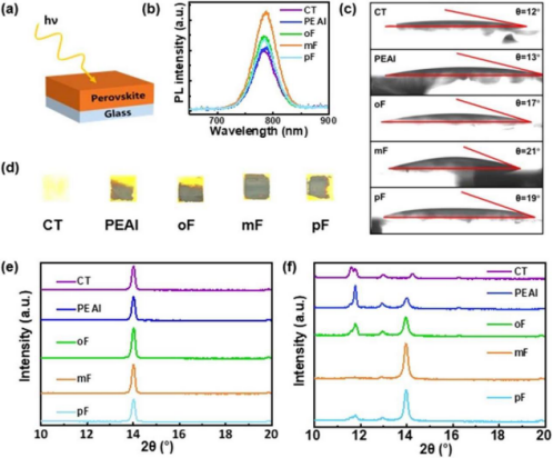
(a) Sample structure for PL testing; perovskite films from the control group, PEAI-treated group, and o/m/p-FPEAI-treated group: (b) PL intensity, (c) water contact angle measurements, (d) appearance after 120 days of storage at 25°C and 60% RH air; (e) XRD patterns of samples prior to storage; (f) XRD patterns of samples after 120 days of storage
Photoluminescence (PL) testing revealed that perovskite films treated with o-FPEAI, m-FPEAI, and p-FPEAI exhibited significantly higher PL intensities than the control (CT) and PEAI-treated samples, indicating that fluorine atom introduction effectively reduces non-radiative recombination (enhanced defect passivation). Among these, the m-FPEAI-treated film exhibited a 60% higher PL intensity than the control sample. This superior passivation effect stems from its limited penetration, allowing it to accumulate more extensively on defect-rich surfaces.
Film Morphology and Charge Dynamics
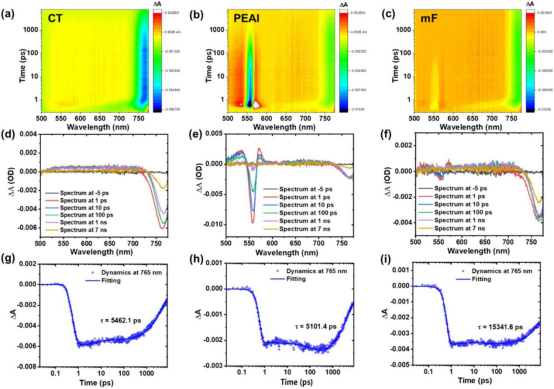
(a–c) TA spectrum contour plots, (d–f) TA spectra at different decay times, (g–i) Decay curves of the bleaching peak at 765 nm
Transient absorption (TA) spectra reveal that the control group exhibits only a 3D phase (765 nm), while samples treated with PEAI and fluorinated derivatives display dual peaks corresponding to both 2D (555 nm) and 3D phases. Among these, the 2D phase peak of m-FPEAI was the weakest, indicating its optimal penetration inhibition effect. Carrier lifetime measurements revealed that the m-FPEAI-treated film exhibited the longest carrier lifetime, attributed to its effective suppression of 2D phase formation and reduction of defects.
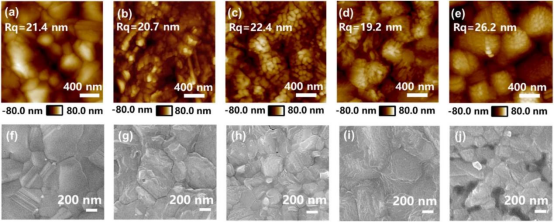
Surface morphology characterization of perovskite films: (a–e) AFM images: (a) control group, (b) PEAI-treated group, (c) o-FPEAI-treated group, (d) m-FPEAI-treated group, (e) p-FPEAI-treated group; (f–j) Top-view SEM images: (f) Control group, (g) PEAI-treated group, (h) o-FPEAI-treated group, (i) m-FPEAI-treated group, (j) p-FPEAI-treated group
SEM and AFM images reveal that the m-FPEAI-treated film exhibits the lowest surface roughness with uniform grain size, whereas the p-FPEAI sample shows a rough surface with PbI₂ crystal agglomerates, indicating potential corrosion effects on the film. In contrast, m-FPEAI significantly improves the morphological quality of the film.
Perovskite Cell Performance and Stability
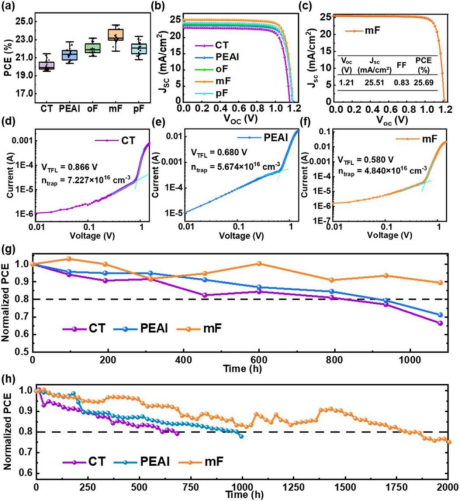
(a) Distribution of photovoltaic parameters; (b) J-V characteristic curves (same composition); (c) Optimal J-V characteristic curves for five PSC groups; (d–f) SCLC curves for control PSC, PEAI-treated PSC, and m-FPEAI-treated PSC; (g) Evolution of normalized PCE under AM 1.5G illumination; (h) Normalized power output under maximum power point tracking (MPPT) with continuous AM 1.5G illumination.
Testing of cells based on the ITO/SnO₂/perovskite/spiro-OMeTAD/Au structure revealed that the m-FPEAI cell achieved an average efficiency of 24.63%, with an open-circuit voltage (Voc) of 1.18 V, a short-circuit current density (Jsc) of 25.52 mA/cm², and a fill factor (FF) of 0.80.
Under continuous AM 1.5G illumination, the m-FPEAI cell maintained 90% of its initial efficiency after 1080 hours. In maximum power point tracking (MPPT) tests, the efficiency retention exceeded 80% after 1750 hours, significantly outperforming other samples.
This study conducted maximum power point tracking (MPPT) tests on perovskite solar cells (PSCs) treated with m-FPEAI, PEAI, and untreated (CT) samples. Results demonstrate that cells surface-modified with m-FPEAI exhibit significantly improved long-term stability, maintaining 80% of initial efficiency after approximately 1750 hours of continuous AM 1.5G irradiation.
Millennial Perovskite Maximum Power Point Tracking Test MPPT
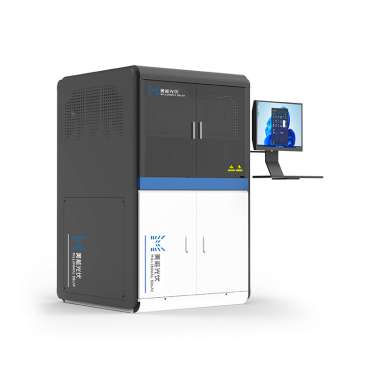
The Perovskite Maximum Power Point Tracking Test MPPT utilizes A+AA+ grade LED solar simulators as aging light sources. With its advanced technology and multifunctional design, it provides robust support for perovskite solar cell research.
email:market@millennialsolar.com
▶ Light Source Rating: A+AA+, Spectral Matching Grade A+, Uniformity Grade A, Long-Term Stability Grade A+
▶ Effective Spot Size: ≥250*250mm (customizable)
▶ Adjustable Irradiance: 0.2-1.5 sun, adjustable in 0.1 sun increments
▶ Independently Controllable Power Bands: 300-400 nm / 400-750 nm / 750-1200 nm
Millennial Perovskite Maximum Power Point Tracking (MPPT) Testing is not only a performance verification tool but also provides robust support for perovskite solar cell (PSC) research.


