


Non-contact IV tester

Quantum Efficiency Tester
PL/EL Integrated System
PV-Reflectumeter
3D Confocal Microscope
In-Line Four Point Probe Tester
Four Point Probe Tester
In-Line Thin Film Thickness Tester
Raman Spectrometer
FTIR Spectrometer
Spectrophotometer
Automatic Spectroscopic Ellipsometer
Contact Resistance Tester
Ultra depth of field 3D microscope
Auto Visual Tester
VMM PV Vision Measuring Machine
Solar Cell Horizontal Tensile Tester
Steady State Solar Simulator for Solar Cell
Solar Cell UV Aging Test Chamber
Solar Cell Comprehensive Tensile Tester
Visual Inspection Tester
Wet Leakage Current Tester
PV Module EL Tester
PV Module UV Preconditioning Chamber
Steady State Solar Simulator for PV Module
Current Continuous Monitor
Potential Induced Degradation Test
Bypass Diode Tester
LeTID Test System
Reverse Current Overload Tester
Impulse Voltage Tester
Hipot Insulation Tester
Ground Continuity Tester
Hipot Insulation Ground Tester
Damp Heat Test Chamber
Humidity Freeze Test
Thermal Cycle Test Chamber
Dynamic Mechanical Load Tester
Static Mechanical Load Tester
Hail Impact Tester
Robustness of Termination Tester
Module Breakage Tester
Cut Susceptibility Tester
Peel Shear Strength Tester
Universal Testing Machine (Single-arm)
Universal Testing Machine (Double-arm)
Glass Transmittance Tester
Acetic Acid Test Chamber
EVA Degree of Crosslinking Test System
Junction Box Comprehensive Tester
Drop ball tester
Semi-automatic scanning four-probe tester
Stylus Profilometer
Maximum Power Point Tracker
Perovskite Glass Transmittance Tester
Perovskite P1 Laser Scribing Multifunctional Testing Machine
Perovskite Online PL Tester
Perovskite Online Sheet Resistance Tester
Online Perovskite Film Thickness Tester
Perovskite Process Inspection Workstation
Portable EL Tester
Portable Thermal Imaging Tester
Solar Module Multi-Channel Testing System
PV Inverter Power Quality Tester
IV Tester
IVEL Cell Sorting Machine
Zhejiang University's Latest Breakthrough: 33.15% Efficiency Performed by Pyramid-Structured Perovskite/Silicon Tandem Solar Cells
Date : 12 December 2025Views : 1940
Perovskite/silicon tandem solar cells have garnered significant attention due to their high efficiency and low-cost potential. However, when utilizing industrial textured silicon (ITS) substrates with micrometer-scale pyramidal structures (>2 μm), uniform coverage of the hole selection layer over the perovskite layer becomes a critical challenge, leading to severe interfacial recombination losses. This study proposes a novel tandem cell architecture. By introducing SiOₓ nanospheres to establish localized submicron contacts, combined with in-situ statistical measurements of SiNx/SiON layer reflectance on industrial-grade velvet silicon wafers using a Millennial velvet reflectometer, the “iceberg-like” pyramidal morphology on the ITS surface is effectively controlled. The fabricated tandem cell achieved a certified efficiency of 33.15% over a 1 cm² area and demonstrated excellent stability.
SiO₂ Nanospheres Construct “Iceberg Structure”
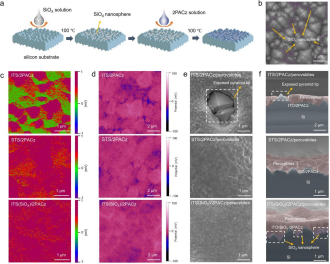
Characterization of SAMs Anchoring and Perovskite Deposition on Velvet Silicon
To achieve high-quality perovskite layer deposition via solution methods, SiO₂ nanospheres were introduced as dielectric fillers to occupy pyramid valleys, forming an “iceberg-like” structure. Comparing SiO₂ nanospheres of varying sizes (20–500 nm), 100 nm particles were found to strike the optimal balance between filling efficiency and subsequent layer coverage.
Further investigations examined the coverage of the common SAM material 2PACz on different substrates. AFM-IR and KPFM results revealed discontinuous 2PACz distribution and uneven potential distribution on ITS substrates. In contrast, on SiO₂-modified ITS(SiO₂) substrates, 2PACz exhibited uniform coverage and significantly improved potential distribution, favoring reduced contact losses.
Perovskite Deposition and Crystallization Behavior
Despite improving interfacial properties, 2PACz still causes perovskite ink dehumidification on ITS. The introduction of SiO₂ significantly enhances perovskite coverage, with crystal quality comparable to STS. In-situ photoluminescence (PL) monitoring revealed higher PL intensity after perovskite crystallization on ITS(SiO₂)/2PACz, indicating effective suppression of non-radiative recombination.
Carrier Dynamics Study
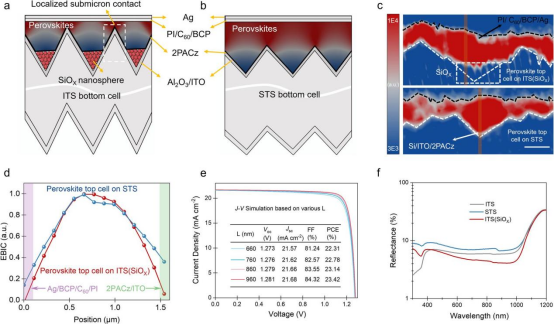
Carrier Dynamics in Localized Submicron Contacts and Reflectance Spectra of Different Textured Silicon Substrates
Electron beam-induced current (EBIC) imaging and transient PL mapping were employed to evaluate carrier collection and diffusion behavior under localized contact structures. Results indicate that perovskite top cells on ITS(SiO₂) exhibit carrier collection capabilities comparable to STS, with a calculated carrier diffusion length of approximately 860 nm. Based on this, simulations verified that the cell fill factor (FF) significantly increases with diffusion length, further supporting the effectiveness of the local contact structure.
Optical Performance Optimization and Cell Efficiency
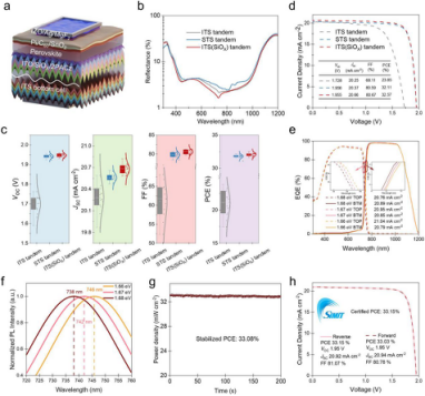
Performance and Efficiency of Multilayer Cells Under Photoelectric Regulation
Reflectance spectrum testing indicates that the introduction of SiO₂ further reduces ITS reflection loss and enhances light capture capability. SiO₂ nanospheres may excite Mie resonance modes, further decreasing optical loss.
By optimizing the SiO₂ concentration (finalized at 5 mg/mL), a high-performance, highly reproducible ITS(SiO₂) tandem cell was achieved with an average efficiency of 32.2%, outperforming the STS tandem (31.8%). The best laboratory cell efficiency reached 32.57% (reverse scan), with Jsc, Voc, and FF values of 20.66 mA/cm², 1.955 V, and 80.67%, respectively.
Current matching was further optimized by adjusting the perovskite composition (reducing bromine content, lowering the bandgap from 1.68 eV to 1.66 eV), enhancing overall current output. Ultimately, combining the local contact structure with bandgap tuning achieved a steady-state efficiency of 33.08% and a certified efficiency of 33.15%, representing the highest efficiency to date for monolithic perovskite/silicon tandem cells based on ITS.
Perovskite/Silicon Tandem Cell Stability
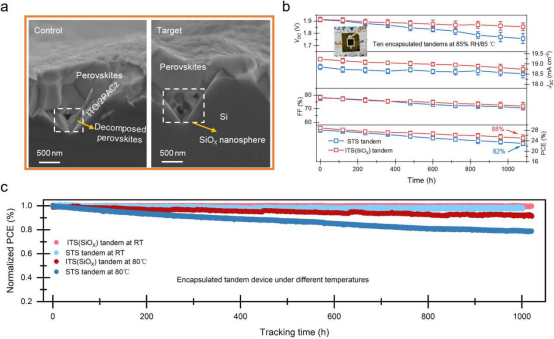
SEM Images and MPPT Curves of Perovskite/Silicon Tandem Cells
Under ISOS standard testing, ITS (SiO₂) tandem cells maintained 86.7% of their initial efficiency after 1100 hours at 85°C/85%RH, significantly outperforming STS cells (81.8%). In continuous 80°C illumination MPPT testing, ITS (SiO₂) cells maintained 91.7% efficiency after 1000 hours, substantially higher than STS cells (78.4%), demonstrating outstanding thermal tolerance and operational stability.
This study modulates the surface morphology of ITS via SiO₂ nanospheres to establish localized submicron contacts. Industrial textured silicon (ITS) with micron-scale (approximately 2μm) pyramidal structures exhibits particular advantages. Reflectance spectrum testing revealed that SiO₂ incorporation reduced ITS reflection losses, enhanced light trapping capability, and further minimized optical losses. This approach successfully achieved a high-performance, highly stable perovskite/silicon tandem cell compatible with existing production lines, with a certified peak efficiency of 33.15%. This strategy provides a viable solution for integrating perovskite on industrial textured silicon, advancing the commercialization of tandem cells.
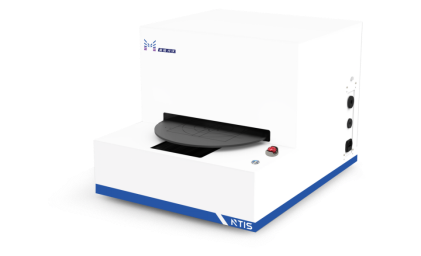
Millennial Diffuse Reflectance Tester
The Millennial Diffuse Reflectance Tester RTIS excites solar cells via diffuse reflection and then detects them using a spectrometer at an 8-degree angle. RTIS features a positioning platform and guide rails, enabling convenient and rapid sample loading, achieving precise positioning of solar cell samples, and enhancing operator efficiency.
email:market@millennialsolar.com
▶ Spectral measurement range: 350-1050nm
▶ Rapid, automated multi-point measurement
▶ Approx. 0.1s per point, reducing testing time to 1/10th of conventional reflectometers
▶ Precise measurement of critical parameters including reflectance and film thickness
The Millennial diffuse reflectometer employs 8° diffuse excitation combined with multi-point matrix scanning to achieve in-situ statistical measurement of SiNx/SiON layer reflectance on industrial-grade velvet silicon wafers for perovskite/silicon tandem cells. Its rapid, non-destructive testing capabilities accelerate the transition of this technology from laboratory to production line implementation.
Related Products


