


Non-contact IV tester

Quantum Efficiency Tester
PL/EL Integrated System
PV-Reflectumeter
3D Confocal Microscope
In-Line Four Point Probe Tester
Four Point Probe Tester
In-Line Thin Film Thickness Tester
Raman Spectrometer
FTIR Spectrometer
Spectrophotometer
Automatic Spectroscopic Ellipsometer
Contact Resistance Tester
Ultra depth of field 3D microscope
Auto Visual Tester
VMM PV Vision Measuring Machine
Solar Cell Horizontal Tensile Tester
Steady State Solar Simulator for Solar Cell
Solar Cell UV Aging Test Chamber
Solar Cell Comprehensive Tensile Tester
Visual Inspection Tester
Wet Leakage Current Tester
PV Module EL Tester
PV Module UV Preconditioning Chamber
Steady State Solar Simulator for PV Module
Current Continuous Monitor
Potential Induced Degradation Test
Bypass Diode Tester
LeTID Test System
Reverse Current Overload Tester
Impulse Voltage Tester
Hipot Insulation Tester
Ground Continuity Tester
Hipot Insulation Ground Tester
Damp Heat Test Chamber
Humidity Freeze Test
Thermal Cycle Test Chamber
Dynamic Mechanical Load Tester
Static Mechanical Load Tester
Hail Impact Tester
Robustness of Termination Tester
Module Breakage Tester
Cut Susceptibility Tester
Peel Shear Strength Tester
Universal Testing Machine (Single-arm)
Universal Testing Machine (Double-arm)
Glass Transmittance Tester
Acetic Acid Test Chamber
EVA Degree of Crosslinking Test System
Junction Box Comprehensive Tester
Drop ball tester
Semi-automatic scanning four-probe tester
Stylus Profilometer
Maximum Power Point Tracker
Perovskite Glass Transmittance Tester
Perovskite P1 Laser Scribing Multifunctional Testing Machine
Perovskite Online PL Tester
Perovskite Online Sheet Resistance Tester
Online Perovskite Film Thickness Tester
Perovskite Process Inspection Workstation
Portable EL Tester
Portable Thermal Imaging Tester
Solar Module Multi-Channel Testing System
PV Inverter Power Quality Tester
IV Tester
IVEL Cell Sorting Machine
University of New South Wales Study Reveals Degradation Mechanism of TOPCon Cells: Role of Wavelength Dependence and Hydrogen Redistribution
Date : 16 December 2025Views : 2520
Tunnel Oxide Passivated Contact (TOPCon) solar cells dominate the global photovoltaic market due to their high efficiency and low cost. TOPCon solar cells and modules undergo ultraviolet-induced degradation (UVID) under ultraviolet (UV) radiation. This study employed UV-A (315–400 nm) and UV-B (280–315 nm) exposure experiments to investigate the effects of UV radiation on TOPCon precursors and lifetime structures. The Millennial composite UV aging chamber provided critical technical support through its controllable UV light source and temperature/humidity regulation capabilities. Results indicate that UV-B and UV-A exposure cause similar degradation levels, but the degradation process is significantly faster under UV-B, suggesting UV-B can be used to accelerate UV degradation testing.
TOPCon Cell Fabrication and Experimental Design
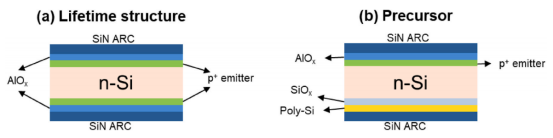
(a) Symmetrical lifetime structure; (b) TOPCon precursor
Sample Preparation: Symmetrical lifetime structures and TOPCon precursors were fabricated using n-type CZ silicon wafers (182 × 182 mm², thickness 140 ± 10 μm) manufactured on an industrial line. The lifetime structures featured boron-diffused emitters on both sides, with a passivation layer of 5 nm Al₂O₃ (atomic layer deposition) over a 75 nm PECVD SiN₂:H antireflection layer. The front side of the TOPCon precursor featured the same structure, while the back side comprised ~1.5 nm tunnel SiOₓ, a 150 nm phosphorus-doped polysilicon layer, and a 75 nm SiNₓ:H layer. Some samples underwent sintering at a peak temperature of 850°C.
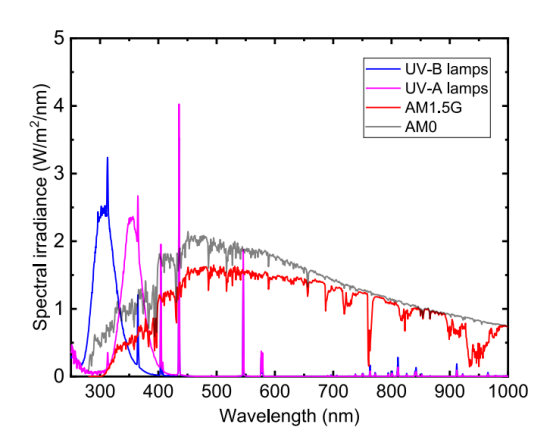
AM0 and AM1.5G standard spectra and UV-A and UV-B light spectrum irradiance
UV Irradiation and Experimental Design: Irradiation was conducted at 60°C using a proprietary UV lamp system. The UV-A lamp delivered an irradiance of 102 W/m² in the 315–420 nm range, while the UV-B lamp provided 114 W/m² in the 250–385 nm range. Total doses were 49 kWh/m² for UV-A and 61.1 kWh/m² for UV-B. Samples were divided into three groups: Group A: 60°C dark annealing (DA), serving as a thermal effect control; Group B: UV-B irradiation; Group C: UV-A irradiation. Each group included sintered and unsintered samples, with testing conducted on both front and back surfaces.
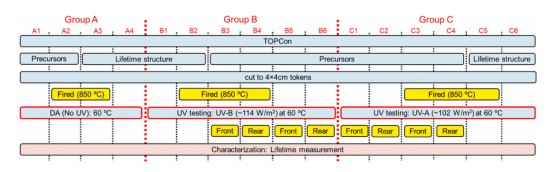
Schematic of the experimental workflow for investigating the effects of ultraviolet radiation on TOPCon precursors and lifetime structures
Characterization and Simulation: Effective minority carrier lifetime and emitter saturation current density (J₀ₑ) were measured via quasi-steady-state photocurrent (QSS-PC) measurements, with normalized defect density (NDD) calculated. Time-of-flight secondary ion mass spectrometry (ToF-SIMS) analyzed elemental depth profiles, complemented by optical simulation software SunSolve to evaluate the back-surface structure's UV absorption characteristics.
Thermal Stability and LeTID Behavior
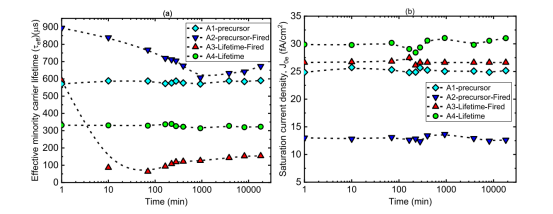
(a) Changes in effective lifetime of all samples in Group A during dark annealing at 60 °C; (b) Saturated current density extracted based on effective lifetime versus dark annealing time
During dark annealing, the effective lifetime of unsintered samples in Group A remained stable, while sintered samples exhibited a trend of initial decay followed by recovery. The constant J₀ₑ indicates stable surface passivation, with bulk defects driving the changes—consistent with light-induced thermal decay (LeTID) characteristics.
UV-B Radiation Experiment
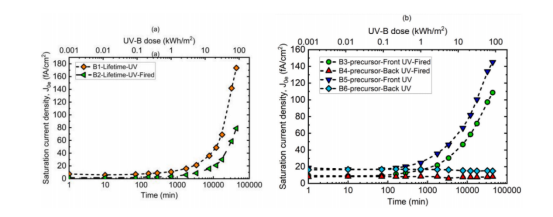
Saturation current density of Group B samples at 60 °C as a function of UV-B exposure time: (a) aged samples, (b) precursor samples (UV irradiation applied to front and back sides respectively)
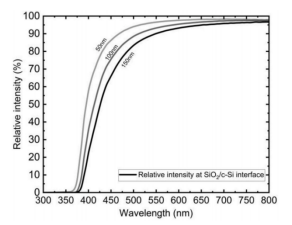
Simulated reflectance (red) on the rear side of the TOPCon structure and simulated absorption rates for polysilicon layers of 50 nm, 100 nm, and 150 nm thickness
Optical simulations indicate strong absorption and reflection of UV light <370 nm by the polysilicon layer. A 150 nm polysilicon layer effectively protects the tunnel oxide layer; reducing thickness to 50 or 100 nm increases UVID risk.
UV-A radiation experiments
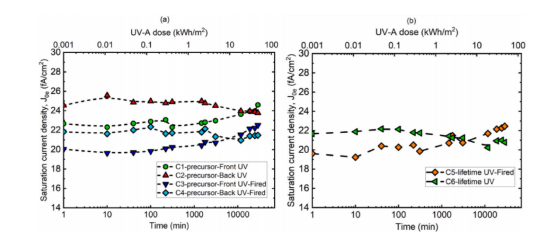
At 60°C, the variation in saturation current density of Group C samples with UV-A exposure time: (a) Precursor: (b) Lifetime structure
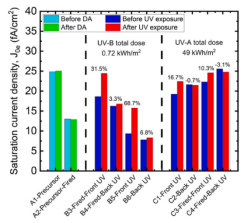
Saturation current density of Groups A, B, and C samples before and after testing
Both UV-B and UV-A exposure caused an increase in front-side J₀ₑ, indicating enhanced surface recombination. UV-B exhibited a faster decay rate but ultimately reached a similar attenuation level to UV-A. Under back-side irradiation, J₀ₑ showed minimal change, demonstrating the ultraviolet shielding effect of the polysilicon layer.
Hydrogen kinetics and bulk defect behavior
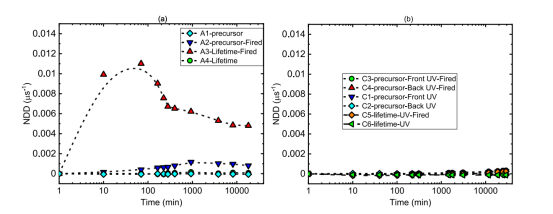
Changes in normalized defect density (NDD) at 60°C: (a) Group A samples over annealing time; (b) Group C samples over UV-A exposure time
NDD analysis reveals that dark-annealed sintered samples exhibit a LeTID-like pattern of initially rising then decreasing NDD, whereas UV-irradiated samples show minimal NDD variation. This indicates that UV radiation suppresses bulk defect formation but intensifies surface recombination.
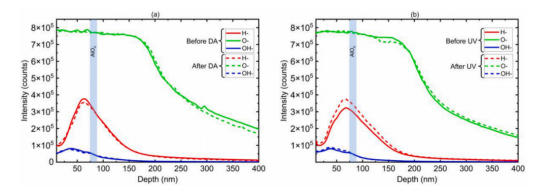
ToF-SIMS depth profiles: Pre-sintered precursors (a) A2 before and after dark annealing; (b) C3 before and after UV-A irradiation
ToF-SIMS revealed increased hydrogen concentration at the AlOₓ/p⁺/Si interface post-UV irradiation, indicating hydrogen redistribution due to Si-H bond cleavage. The absence of LeTID under UV irradiation suggests UV suppression of bulk defect formation.
This paper systematically reveals the degradation behavior and mechanisms of TOPCon solar cells under ultraviolet radiation. Both UV-A and UV-B can cause similar types of surface degradation, but UV-B exhibits a faster degradation rate, making it suitable for accelerated UVID testing of ultraviolet-induced degradation in solar cells. The front surface exhibits significant sensitivity to UVID, whereas the rear surface demonstrates superior degradation resistance due to the high UV absorption of the polycrystalline silicon layer. UV irradiation disrupts Si–H bonds, triggers hydrogen redistribution, and suppresses the occurrence of light-induced thermal degradation (LeTID). These findings provide crucial insights for enhancing the UV resistance and reliability of TOPCon cells.
Millennial Composite UV Aging Test Chamber
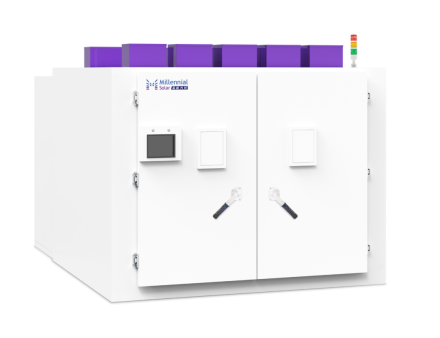
The Millennial Composite UV Aging Test Chamber performs accelerated aging tests. This chamber delivers ultraviolet spectra ranging from 280 to 400 nm, simulating the UV component of sunlight while maintaining an irradiance intensity of 150 to 250 W/m² to accelerate the aging process.
email:market@millennialsolar.com
Irradiance: 150-250 W/m² (Customizable 500-1000 W/m² Super UV)
UVB Content: 3%-9%
Spectral Range: 280-400nm
Through controllable UV light sources, temperature and humidity regulation, and other conditions, Millennial composite UV aging test chamber achieves accelerated testing of ultraviolet-induced degradation (UVID) in solar cells. This provides crucial data for reliability optimization of TOPCon cells and design of bifacial modules.
Related Products


