


Non-contact IV tester

Quantum Efficiency Tester
PL/EL Integrated System
PV-Reflectumeter
3D Confocal Microscope
In-Line Four Point Probe Tester
Four Point Probe Tester
In-Line Thin Film Thickness Tester
Raman Spectrometer
FTIR Spectrometer
Spectrophotometer
Automatic Spectroscopic Ellipsometer
Contact Resistance Tester
Ultra depth of field 3D microscope
Auto Visual Tester
VMM PV Vision Measuring Machine
Solar Cell Horizontal Tensile Tester
Steady State Solar Simulator for Solar Cell
Solar Cell UV Aging Test Chamber
Solar Cell Comprehensive Tensile Tester
Visual Inspection Tester
Wet Leakage Current Tester
PV Module EL Tester
PV Module UV Preconditioning Chamber
Steady State Solar Simulator for PV Module
Current Continuous Monitor
Potential Induced Degradation Test
Bypass Diode Tester
LeTID Test System
Reverse Current Overload Tester
Impulse Voltage Tester
Hipot Insulation Tester
Ground Continuity Tester
Hipot Insulation Ground Tester
Damp Heat Test Chamber
Humidity Freeze Test
Thermal Cycle Test Chamber
Dynamic Mechanical Load Tester
Static Mechanical Load Tester
Hail Impact Tester
Robustness of Termination Tester
Module Breakage Tester
Cut Susceptibility Tester
Peel Shear Strength Tester
Universal Testing Machine (Single-arm)
Universal Testing Machine (Double-arm)
Glass Transmittance Tester
Acetic Acid Test Chamber
EVA Degree of Crosslinking Test System
Junction Box Comprehensive Tester
Drop ball tester
Semi-automatic scanning four-probe tester
Stylus Profilometer
Maximum Power Point Tracker
Perovskite Glass Transmittance Tester
Perovskite P1 Laser Scribing Multifunctional Testing Machine
Perovskite Online PL Tester
Perovskite Online Sheet Resistance Tester
Online Perovskite Film Thickness Tester
Perovskite Process Inspection Workstation
Portable EL Tester
Portable Thermal Imaging Tester
Solar Module Multi-Channel Testing System
PV Inverter Power Quality Tester
IV Tester
IVEL Cell Sorting Machine
Output Performance Comparison Between BC and TOPCon Modules Under Actual Shading Conditions - Combined with MPPT Analysis
Date : 23 December 2025Views : 1525
Back-contact (BC) solar cells exhibit unique soft breakdown characteristics under reverse bias due to their rear-side cross-finger PN junction design. It is widely believed that under partial shading conditions, they demonstrate superior power output performance compared to TOPCon modules. However, this study experimentally demonstrates through MPPT testing on Millennial perovskite modules under simulated outdoor shading scenarios that BC modules outperform TOPCon modules only when fewer than three cells within a sub-string are shaded. This advantage stems from the matching relationship between the breakdown voltage of BC cells (–5 V) and the reverse bias required for bypass diode activation (–15 V).
Experimental Methodology
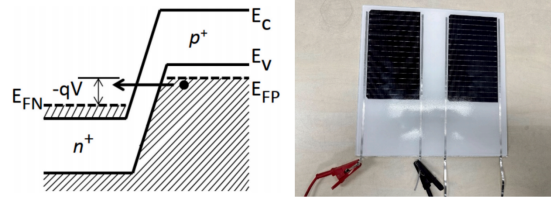
Left: Schematic diagram of semiconductor tunneling effect; Right: Schematic diagram of battery reverse characteristic testing
Battery reverse characteristic testing experiment: In a darkroom environment, by reversing the battery terminals, adjusting the voltage, and recording the current, the I–V characteristic curves of both battery types under different reverse voltages were obtained. BC cells, featuring a narrow back PN junction spacing (typically <100 μm), significantly reduce the barrier width, increasing the tunneling probability by 2–3 orders of magnitude. This enables soft breakdown to occur at lower reverse voltages.
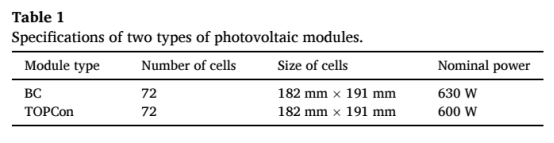
Specification Parameters of Both Photovoltaic Modules
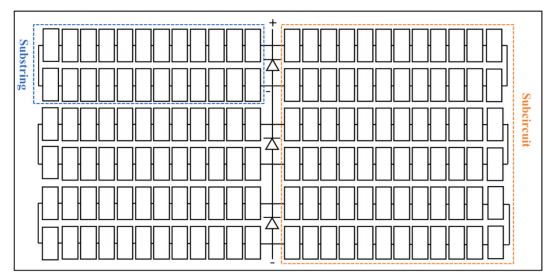
Schematic Diagram of Photovoltaic Module Internal Circuitry
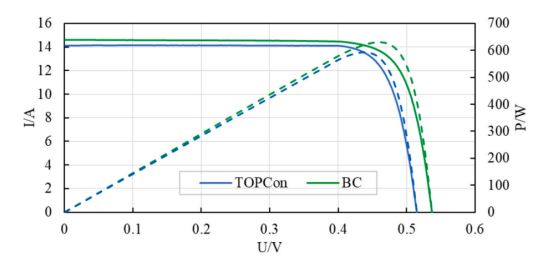
Characteristic Curves of Both Module Types Under Standard Test Conditions
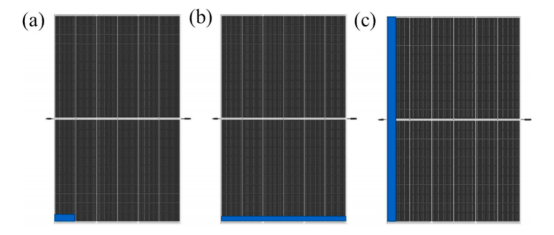
Schematic of Shading Experiments: (a) Single-cell shading, (b) Module short-edge shading, (c) Module long-edge shading
Module Output Performance Experiment Under Shading Conditions: Using BC modules as the experimental group and TOPCon modules as the control group, under standard test conditions (irradiance 1000 W/m², temperature 25°C), modules were shaded using black opaque plastic sheets at the single-cell level, along the entire short side, and along the entire long side. I–V and P–V curves were recorded.
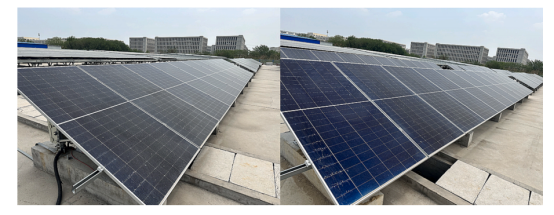
Outdoor PV String Experiment Site
Outdoor power plant testing: At the demonstration site, strings comprised 12 modules of each type to study shading's impact on string power output. Outdoor experiments were conducted during stable environmental conditions on clear days, with irradiance around 950 W/m² and temperatures around 20°C. Power generation data was collected via inverter communication interfaces at 5-minute intervals, with string output capacity expressed as normalized power.
Analysis of Experimental Results
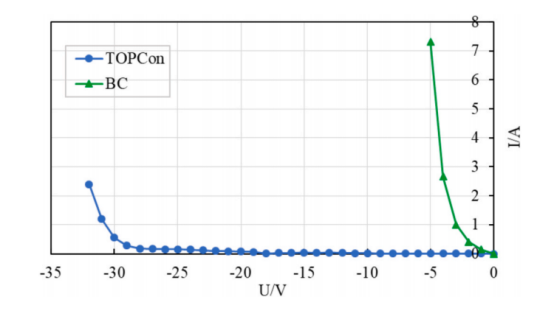
Reverse I-V Characteristics of Two Cell Types
Reverse Characteristics: The reverse breakdown voltage of BC cells is approximately –5 V, while TOPCon cells exhibit a higher breakdown voltage. BC cells generate tunneling current at lower reverse voltages, mitigating current mismatch in shaded cells.
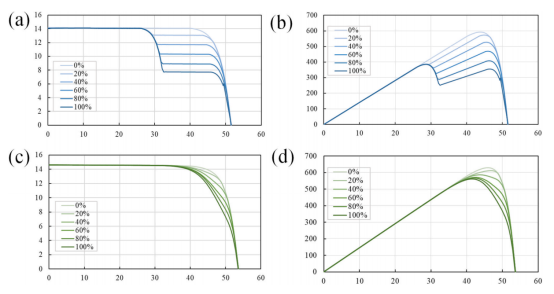
Single-Cell Shading Scenario: I-V Curves: (a) TOPCon Module (c) BC Module; P-V Curves: (b) TOPCon Module (d) BC Module
Single-Cell Shading Scenario: As shading intensity increases, the I–V curve of TOPCon modules exhibits a step-like pattern, while the P–V curve displays a double-peak shape. When shading reaches 100%, bypass diodes activate, reducing module output power to two-thirds of its original value. In contrast, the I-V and P-V curves of BC modules show minimal changes, exhibiting only slight concavity at high shading levels with a slight leftward shift of the MPP.
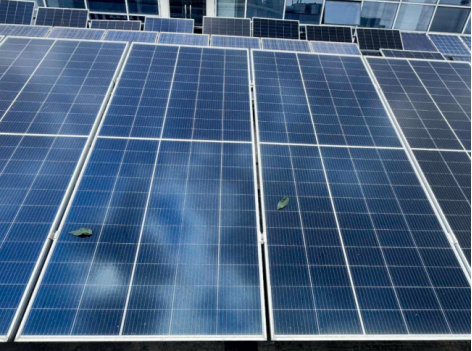
Schematic of single-cell shading by foreign objects such as bird droppings or leaves
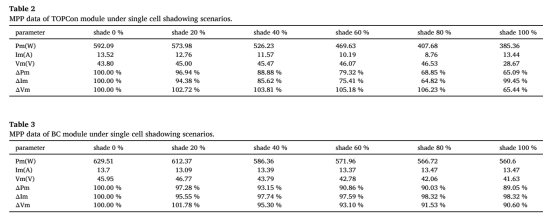
MPP data for TOPCon and BC modules under single-cell shading scenarios
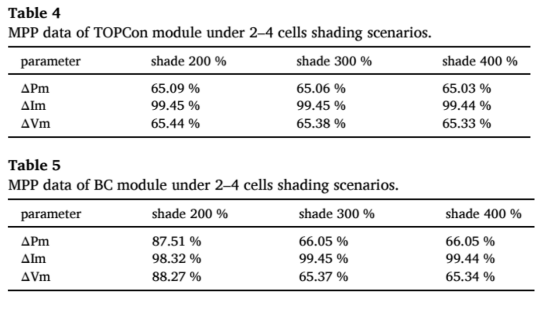
MPP Data for TOPCon and BC Modules Under 2-4 Cell Shading Scenarios
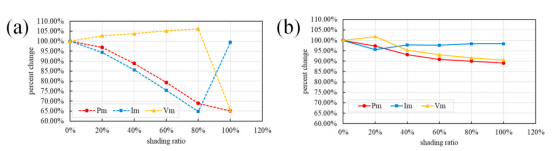
(a) TOPCon and (b) BC Module MPP Parameter Variations
Under single-cell shading, the bypass diodes in BC modules do not activate because a single BC cell provides a maximum reverse voltage of –5 V, whereas diode activation requires –15 V. Experiments show that BC modules' diodes only activate when at least three cells are fully shaded, at which point their power loss matches that of TOPCon modules. When fewer than three cells are shaded (e.g., initial minor shading from fallen leaves or bird droppings), BC modules exhibit output advantages. However, if prolonged or extensive shading causes more than three cells to be shaded, both module types perform identically.
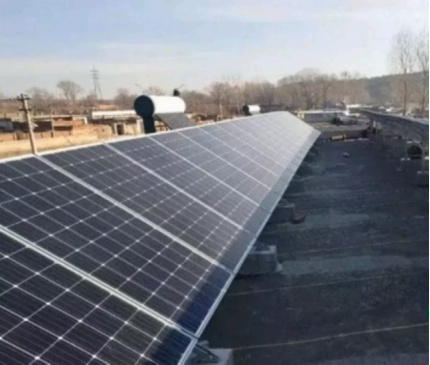
Schematic Diagram of Short-Side Shading Scenario for PV Modules
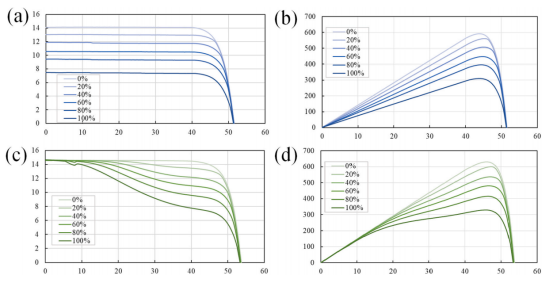
Short-Side Shading Scenario: I-V Curves: (a) TOPCon Module (c) BC Module; P-V Curves: (b) TOPCon Module (d) BC Module
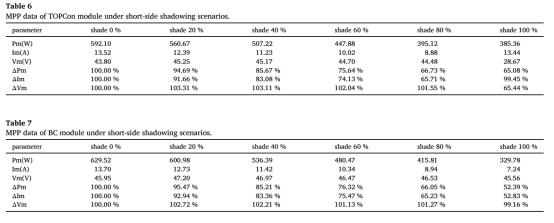
MPP Data for TOPCon and BC Modules Under Short-Side Shading Scenario
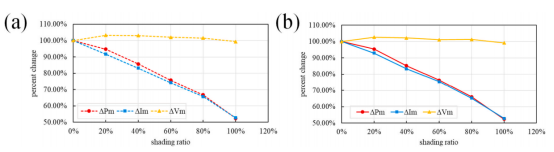
MPP Parameter Changes for (a) TOPCon and (b) BC Modules Under Short-Side Shading Scenario
Short-Side Full-Row Shading Scenario: In fixed-tilt photovoltaic arrays, short-side shading commonly occurs during early morning and late afternoon when the sun's elevation angle is low. At this time, the output characteristic curves of both TOPCon and BC modules shift downward overall, with neither exhibiting step or double-peak phenomena. At the maximum power point, the cells show no current mismatch and are not in reverse bias, resulting in identical actual power outputs for both module types.
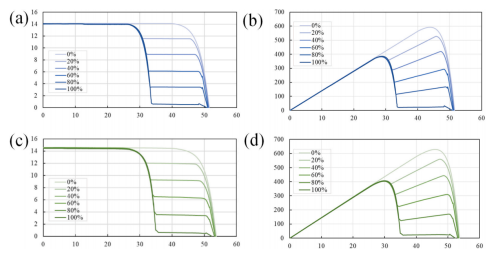
Long-edge shading scenario: I-V curves: (a) TOPCon module (c) BC module; P-V curves: (b) TOPCon module (d) BC module
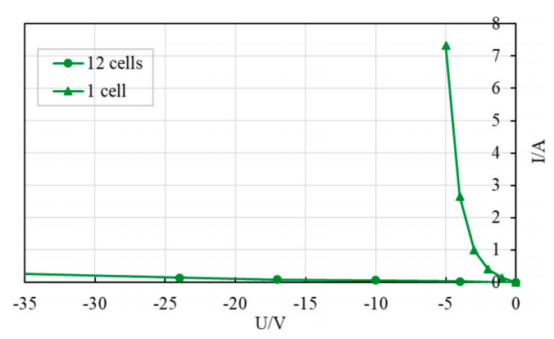
Combined reverse bias characteristic curve of 12 cells (one sub-string) in BC module
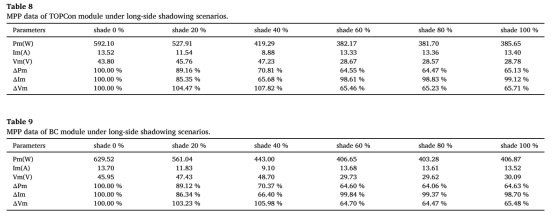
MPP data of TOPCon and BC modules under long-edge shading scenario
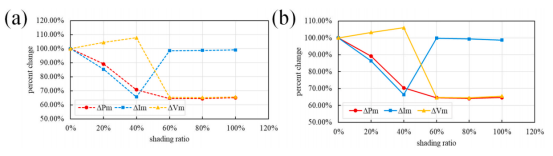
MPP parameter variations for (a) TOPCon and (b) BC modules under long-edge shading
Long-edge full-row shading scenario: Under full-row shading along the long edge, the output curves of both modules are nearly identical, exhibiting a stepped, double-peak shape. Since 12 cells within the sub-string are simultaneously shaded, their combined reverse characteristics fail to provide effective tunnel current, causing the BC module to lose its output advantage.
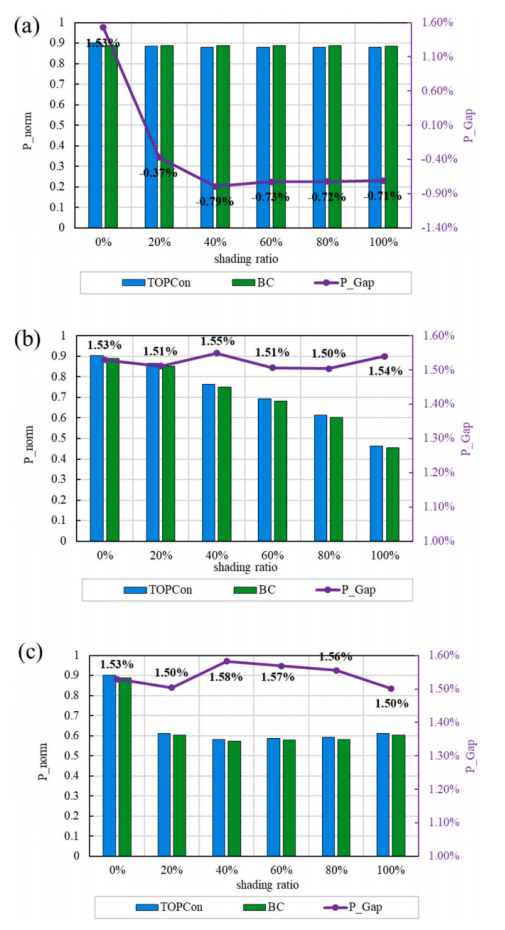
Normalized power of PV strings and their variations: (a) Single-cell shading scenario, (b) Short-side shading scenario, (c) Long-side shading scenario
Field Power Plant Validation: Under unshaded conditions, TOPCon modules exhibit a 1.5%–1.6% higher string output capacity than BC modules due to their superior bifaciality. In single-cell shading scenarios, BC modules demonstrate output advantages. However, both module types show identical output performance under short-side and long-side shading conditions, consistent with laboratory findings.
This study employs a cross-validated system combining laboratory single-module testing with outdoor string experiments to systematically compare the output performance of BC and TOPCon modules under actual shading conditions: In single-cell shading scenarios, MPPT precisely captures that when fewer than three cells in a sub-string are shaded, BC modules exhibit output advantages due to their soft breakdown characteristics; when exceeding three cells, their performance aligns with TOPCon modules. This research establishes a standardized framework for evaluating PV module output under real-world shading conditions, providing guidance for engineering selection and full-lifecycle cost analysis of power plants.
Millennial Perovskite Maximum Power Point Tracking Test MPPT
email:market@millennialsolar.com
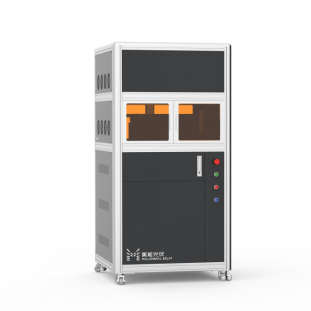
Perovskite Maximum Power Point Tracking Test MPPT employs A+AA+ grade LED solar simulators as aging light sources. With advanced technology and multifunctional design, it provides robust support for perovskite solar cell research.
▶ Light Source Rating: A+AA+, Spectral Matching Grade A+, Uniformity Grade A, Long-Term Stability Grade A+
▶ Effective Spot Size: ≥250*250mm (customizable)
▶ Adjustable Irradiance: 0.2-1.5 sun, adjustable in 0.1 sun increments
▶ Independently Controllable Power Bands: 300-400 nm / 400-750 nm / 750-1200 nm
Leveraging precise data from Millennial perovskite maximum power point tracking (MPPT) testing, this research establishes a standardized framework for evaluating actual shading output of photovoltaic modules. This framework provides critical guidance for engineering selection and full lifecycle cost analysis of power plants.


