


Non-contact IV tester

Quantum Efficiency Tester
PL/EL Integrated System
PV-Reflectumeter
3D Confocal Microscope
In-Line Four Point Probe Tester
Four Point Probe Tester
In-Line Thin Film Thickness Tester
Raman Spectrometer
FTIR Spectrometer
Spectrophotometer
Automatic Spectroscopic Ellipsometer
Contact Resistance Tester
Ultra depth of field 3D microscope
Auto Visual Tester
VMM PV Vision Measuring Machine
Solar Cell Horizontal Tensile Tester
Steady State Solar Simulator for Solar Cell
Solar Cell UV Aging Test Chamber
Solar Cell Comprehensive Tensile Tester
Visual Inspection Tester
Wet Leakage Current Tester
PV Module EL Tester
PV Module UV Preconditioning Chamber
Steady State Solar Simulator for PV Module
Current Continuous Monitor
Potential Induced Degradation Test
Bypass Diode Tester
LeTID Test System
Reverse Current Overload Tester
Impulse Voltage Tester
Hipot Insulation Tester
Ground Continuity Tester
Hipot Insulation Ground Tester
Damp Heat Test Chamber
Humidity Freeze Test
Thermal Cycle Test Chamber
Dynamic Mechanical Load Tester
Static Mechanical Load Tester
Hail Impact Tester
Robustness of Termination Tester
Module Breakage Tester
Cut Susceptibility Tester
Peel Shear Strength Tester
Universal Testing Machine (Single-arm)
Universal Testing Machine (Double-arm)
Glass Transmittance Tester
Acetic Acid Test Chamber
EVA Degree of Crosslinking Test System
Junction Box Comprehensive Tester
Drop ball tester
Semi-automatic scanning four-probe tester
Stylus Profilometer
Maximum Power Point Tracker
Perovskite Glass Transmittance Tester
Perovskite P1 Laser Scribing Multifunctional Testing Machine
Perovskite Online PL Tester
Perovskite Online Sheet Resistance Tester
Online Perovskite Film Thickness Tester
Perovskite Process Inspection Workstation
Portable EL Tester
Portable Thermal Imaging Tester
Solar Module Multi-Channel Testing System
PV Inverter Power Quality Tester
IV Tester
IVEL Cell Sorting Machine
Summary of Reliability Testing for Crystalline Silicon Solar Cells
Date : 16 January 2026Views : 1785
High-efficiency crystalline silicon solar cell reliability testing aims to comprehensively evaluate the performance stability and environmental adaptability of cells during long-term operation. This testing encompasses multiple critical components, including mechanical load testing, thermal cycling testing, freeze-thaw testing, and potential-induced degradation (PID) testing. By simulating extreme climatic conditions and complex operational scenarios, it verifies the cells' resistance to degradation under combined stresses of humidity, temperature, and voltage. This ensures sustained high power output and structural integrity throughout their lifecycle, thereby providing robust technical assurance for the long-term stable operation of photovoltaic systems.
Core Test Types and Mechanisms
The following outlines the fundamental differences between LID, LeTID, CID, PID, TC, DH, and UV from three dimensions: degradation triggers, core mechanisms, and affected components.
1. LID (Light-Induced Degradation)
• Trigger: Light exposure (primarily AM1.5 spectrum).
• Mechanism: Primarily occurs in boron-doped p-type silicon cells. Under illumination, boron (B) in the silicon wafer combines with interstitial oxygen (Oi) to form boron-oxygen complexes (Bs-Oi). These complexes act as highly efficient recombination centers, significantly reducing minority carrier (electron) lifetime, leading to decreased short-circuit current (Isc) and fill factor (FF).
• Characteristics: Rapid decay rate (most pronounced within the first 100 hours), partially reversible (high-temperature annealing decomposes boron-oxygen complexes, restoring efficiency).
2. LeTID (Light and Elevated Temperature Induced Degradation)
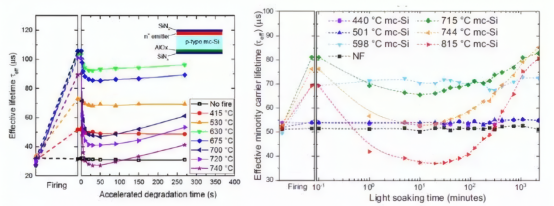
Effect of Sintering Temperature on LeTID
• Triggers: Light exposure + elevated temperature (40–80°C, typically 60°C).
• Mechanism: Primarily affects p-type PERC cells, centered on hydrogen (H) migration and defect activation. Photogenerated carriers (electron-hole pairs) from illumination promote hydrogen diffusion from passivation layers (e.g., AlOx/SiNx) into the silicon substrate. Hydrogen combines with lattice defects (e.g., vacancies, metallic impurities) to form new recombination centers (e.g., Si-H bond cleavage, metal hydrides), leading to reduced minority carrier lifetime.
• Characteristics: The degradation process is slower than LID (100–1000 hours), exhibits a “degradation-recovery” phenomenon (partial recovery occurs upon stopping illumination/increasing temperature), and is more difficult to eliminate than LID.
3. CID (Carrier Injection Degradation)
• Cause: Carrier injection (either photoinjection or electroinjection, distinct from simple illumination).
• Mechanism: Broadly refers to the process where injected carriers (electrons/holes) activate defects. It can be viewed as an “extended version” of LeTID—where LeTID involves “photo-injected carriers + high temperature,” while CID emphasizes the “injection of carriers” itself (regardless of photo- or electro-injection). The core mechanism involves carrier injection providing energy to promote hydrogen migration or movement of lattice defects (e.g., vacancies, interstitial atoms), forming recombination centers (e.g., metal impurity diffusion, silicon-hydrogen bond breaking).
Photo-injected CID: LeTID (photo-generated carrier injection);
Electro-injected CID: Carrier injection via applied bias (e.g., forward current) directly activates defects without illumination.
• Characteristics: Closely related to cell type (p-type/n-type), doping concentration, and hydrogen content. Currently dominated by research-level testing with no unified standards.
4.PID (Potential Induced Degradation)
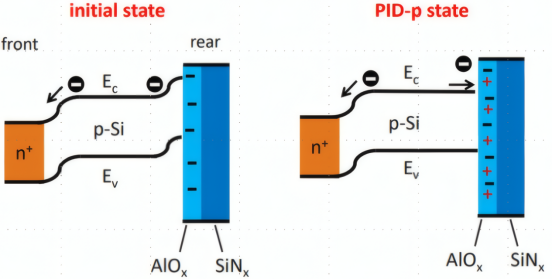
PID Schematic Diagram
• Cause: High voltage difference (between the module and the ground terminal, typically ±500V to ±1500V).
• Mechanism: Under high voltage, mobile ions like sodium ions (Na+) in the glass migrate toward the cell surface under the influence of the electric field. These ions deposit on the SiNx passivation layer or PN junction, forming conductive pathways or surface recombination layers. This leads to a decrease in shunt resistance (Rsh) and a reduction in open-circuit voltage (Voc).
• Characteristics: Closely related to module encapsulation materials (glass, EVA) and cell passivation layers (SiNx). Exhibits rapid decay (hours to days) and partial reversibility (Na+ can be expelled by reverse bias or elevated temperatures).
5. TC (Temperature Cycle)
• Cause: Extreme temperature cycling (-40°C to +85°C).
• Mechanism: Differences in thermal expansion coefficients among materials (glass, EVA, silicon wafers, solder ribbons) generate mechanical stress under cyclic temperature variations. This leads to solder ribbon fatigue fracture, hidden cracks in solar cells, and encapsulation layer delamination (EVA separation), ultimately affecting electrical performance (increased series resistance Rs).
• Characteristics: Evaluates module mechanical reliability; irreversible; primarily impacts physical structure rather than carrier lifetime.
6.DH (Damp Heat Test)
• Causative Factors: High temperature and humidity (85°C/85%RH).
• Mechanism: Combined action of water and heat accelerates material degradation: EVA hydrolysis produces acidic substances that corrode grid lines; aging and cracking of backsheets (e.g., TPT) allow moisture ingress; passivation layers (SiNx) lose effectiveness due to moisture absorption, ultimately causing reductions in fill factor (FF) and open-circuit voltage (Voc).
•Characteristics: Evaluates material weather resistance; irreversible; primarily impacts chemical stability (e.g., corrosion, hydrolysis).
7. UV (Ultraviolet Radiation, UV Aging Test)
• Cause: Ultraviolet light (UV-A/B bands, 280-400nm).
• Mechanism: UV photon energy disrupts molecular chains in encapsulation materials (e.g., EVA ester bond cleavage, Si-N bond oxidation in SiNx), causing EVA yellowing (reduced light transmittance), backsheet embrittlement, and passivation layer failure. This ultimately impacts short-circuit current (Isc) and efficiency.
• Characteristics: Targets photochemical aging; irreversible; primarily affects optical properties and material stability.


