


Non-contact IV tester

Quantum Efficiency Tester
PL/EL Integrated System
PV-Reflectumeter
3D Confocal Microscope
In-Line Four Point Probe Tester
Four Point Probe Tester
In-Line Thin Film Thickness Tester
Raman Spectrometer
FTIR Spectrometer
Spectrophotometer
Automatic Spectroscopic Ellipsometer
Contact Resistance Tester
Ultra depth of field 3D microscope
Auto Visual Tester
VMM PV Vision Measuring Machine
Solar Cell Horizontal Tensile Tester
Steady State Solar Simulator for Solar Cell
Solar Cell UV Aging Test Chamber
Solar Cell Comprehensive Tensile Tester
Visual Inspection Tester
Wet Leakage Current Tester
PV Module EL Tester
PV Module UV Preconditioning Chamber
Steady State Solar Simulator for PV Module
Current Continuous Monitor
Potential Induced Degradation Test
Bypass Diode Tester
LeTID Test System
Reverse Current Overload Tester
Impulse Voltage Tester
Hipot Insulation Tester
Ground Continuity Tester
Hipot Insulation Ground Tester
Damp Heat Test Chamber
Humidity Freeze Test
Thermal Cycle Test Chamber
Dynamic Mechanical Load Tester
Static Mechanical Load Tester
Hail Impact Tester
Robustness of Termination Tester
Module Breakage Tester
Cut Susceptibility Tester
Peel Shear Strength Tester
Universal Testing Machine (Single-arm)
Universal Testing Machine (Double-arm)
Glass Transmittance Tester
Acetic Acid Test Chamber
EVA Degree of Crosslinking Test System
Junction Box Comprehensive Tester
Drop ball tester
Semi-automatic scanning four-probe tester
Stylus Profilometer
Maximum Power Point Tracker
Perovskite Glass Transmittance Tester
Perovskite P1 Laser Scribing Multifunctional Testing Machine
Perovskite Online PL Tester
Perovskite Online Sheet Resistance Tester
Online Perovskite Film Thickness Tester
Perovskite Process Inspection Workstation
Portable EL Tester
Portable Thermal Imaging Tester
Solar Module Multi-Channel Testing System
PV Inverter Power Quality Tester
IV Tester
IVEL Cell Sorting Machine
Fabrication of a Perovskite/Organic Tandem Cell with 26.46% Efficiency via a Hybrid Deposition Method and Study on Its Stability
Date : 26 March 2026Views : 1460
In recent years, perovskite-based tandem solar cells have garnered significant attention due to their theoretically higher efficiency compared to single-junction cells. Among these, wide-bandgap (>1.8 eV) perovskites are key to enhancing the performance of perovskite/ organic stack performance. To address the issues of toxic solvents and scalability limitations associated with traditional solution-based methods, this study employs a green, scalable vacuum-assisted hybrid deposition process and introduces a PACI additive. This effectively regulates the in-plane stacking behavior of perovskites, significantly improving crystal quality and carrier transport properties. For the maximum power point tracking (MPPT) testing of Millennial perovskite cells, an AAA-grade LED solar simulator is used as the aging light source. The cell temperature and ambient atmosphere can be controlled through various methods to conduct long-term stability testing.
Single-junction wide-bandgap perovskite cells fabricated using this process achieved an efficiency of 17.48% with an open-circuit voltage exceeding 1.315 V. Furthermore, the efficiency of the resulting perovskite/organic tandem cells was increased to 26.46% (certified efficiency: 25.82%), and they maintained 90% of their initial efficiency after 400 hours of continuous operation, demonstrating excellent stability. Currently, hybrid deposition technology has achieved efficiencies exceeding 32% in perovskite/silicon tandem cells, with a 16 cm² large-area module efficiency of 26.3%, fully demonstrating the method’s value in advancing the industrialization of tandem cells.
Film Preparation and Crystal Structure Control
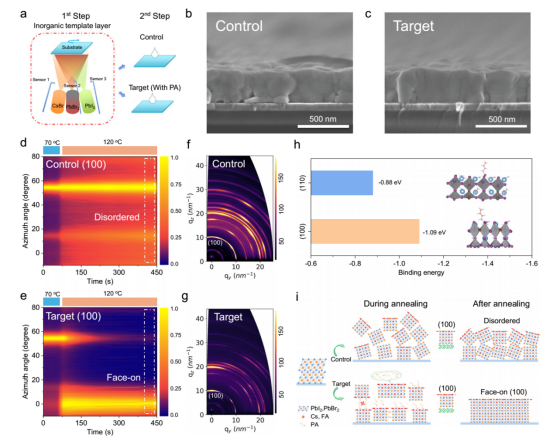
a Schematic diagram of the preparation process; b and c Cross-sectional SEM images of the control and target group films, respectively; In-situ synchrotron GIWAXS patterns of the (100) crystal plane for d the control group and e the target group WBG perovskite films during annealing; f GIWAXS patterns of the control group and g the target group films after annealing; h Calculated binding energies of PA molecules on the (100) and (110) crystal planes; i Schematic of crystal growth during annealing
Perovskite films were prepared using a hybrid process involving spin-coating with a co-evaporation solution of three sources (PbI₂, PbBr₂, and CsBr), with crystal growth controlled by adding 10 mol% PACI to the organic cationic solution. SEM analysis revealed that the target group films exhibited better grain quality and fewer vertical grain boundaries. XRD analysis indicated that both groups formed a well-defined perovskite phase, but the target group exhibited higher texture coefficients for the (100) and (200) crystal planes (2.44 vs. 2.32), suggesting enhanced crystal orientation. In-situ GIWAXS further revealed that the introduction of PACI guided the (100) crystal plane to gradually form a highly ordered face-up stacking structure during annealing, whereas the control group remained in a disordered state throughout. This oriented growth helps reduce grain boundaries and defects, thereby promoting carrier transport.
To investigate the mechanism of action of PACI, ¹H NMR analysis revealed that PACI escapes from the film after high-temperature annealing, indicating that it acts as a temporary template agent. DFT calculations revealed that the binding energy of PA molecules in PACI to the perovskite (100) plane (-1.09 eV) is higher than that to the (110) plane (-0.88 eV), thereby preferentially adsorbing and guiding the (100) crystal plane to grow outward.
Optical Properties and Carrier Dynamics
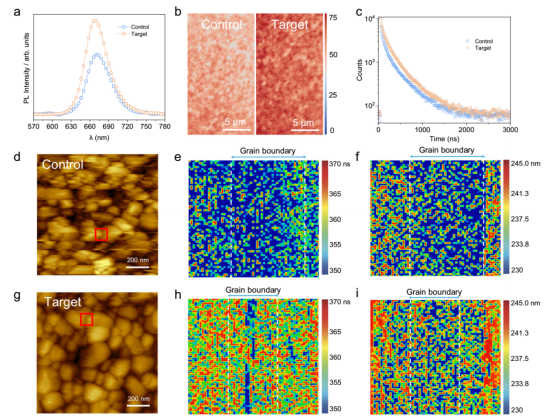
a PL spectra of perovskite films from the control group and the target group; b confocal PL maps and c TRPL test results; d AFM topography images of films from the control group and g the target group, with corresponding TP-AFM scan regions marked (red boxes, 100 × 100 nm²); ; e TPV carrier recombination lifetime (τᵣ) maps of the control group and h target group films; f Diffusion length maps of the control group and i target group films
Photoluminescence (PL) spectra show a significant enhancement in PL intensity for the target group films doped with PACI; confocal PL maps reveal improved luminescence uniformity, and time-resolved PL (TRPL) measurements indicate prolonged carrier lifetime. Space-charge-limited current (SCLC) measurements indicate that the defect density in the target group decreased from 0.86 × 10¹⁵ cm⁻³ in the control group to 0.65 × 10¹⁵ cm⁻³.
Transient-response atomic force microscopy (TP-AFM) was used to map carrier dynamics at the nanoscale. The results indicate that the recombination lifetime in both grain and grain boundary regions was prolonged in the target group, while the transport time was shortened. Statistical analysis shows that the proportion of carriers with a diffusion length (LD) exceeding 233 nm in the target group increased from 43.7% (control group) to 66.8%, representing an increase of over 20%. This confirms that PACI effectively enhances carrier extraction and transport efficiency by optimizing crystal quality and orientation. Furthermore, the phase stability of the target group’s thin films in air was significantly improved.
Performance of Single-Junction WBG Perovskite Cells
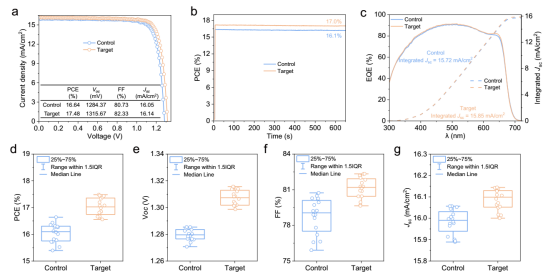
a Current density–voltage curve; b Maximum power point (MPP) tracking; c EQE curve and integrated current density; d–g Box-and-whisker plots showing the effects of different PACI concentrations on cell performance parameters (PCE, Voc, Jsc, FF)
Based on the optimized film, a single-junction perovskite solar cell was fabricated (structure: Glass / ITO / Me-4PACz / Perovskite / C₆₀ / SnOₓ / Ag). The optimized cell in the target group achieved a photoconversion efficiency (PCE) of 17.48%, with a Voc as high as 1.315 V, a fill factor (FF) of 82.33%, and a short-circuit current density (Jsc) of 16.14 mA/cm²; all parameters outperformed those of the control group (16.64%). Maximum power point tracking (MPPT) validated the stability of the cell’s output. The integrated current of the external quantum efficiency (EQE) was consistent with the J-V test results. High-resolution EQE analysis showed that the Urbach energy (Eu) of the target group decreased to 19.59 meV (compared to 20.15 meV in the control group), indicating a reduction in subbandgap defect states and improved material order.
Performance of Perovskite/Organic Stacked Cells
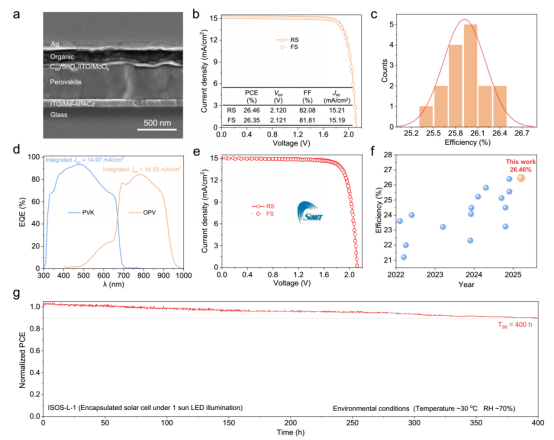
a Cross-sectional SEM image of the cell; b J-V curve (active area = 0.05 cm²); c Statistical distribution of efficiencies for 16 stacked cells; d EQE curves and corresponding integrated current densities; e J-V curves of devices certified by SIMIT; f Summary of reported perovskite/organic stacked cell efficiencies over the past three years; g Maximum power point (MPP) tracking stability test (ISOS-L-1 protocol)
A 1.84 eV perovskite was used as the front cell and integrated with a narrow-bandgap (1.38 eV) organic subcell (PM6:Y18 system) to fabricate a two-terminal monolithic perovskite/ organic tandem cell (structure: ITO / Me-4PACz / Perovskite / C₆₀ / SnOₓ / ITO / MoOₓ / Organic / PDINN / Ag). The optimized stack achieved an efficiency of 26.46%, with a Voc of 2.120 V, an FF of 82.08%, and a Jsc of 15.21 mA/cm². Furthermore, the efficiency distribution across the 16 cells was concentrated, demonstrating excellent reproducibility. EQE testing revealed highly matched integrated current densities for the two sub-cells (perovskite: 14.97 mA/cm²; organic: 14.93 mA/cm²), confirming excellent current balance. This result was independently certified by a third-party organization (SIMIT), with a certified efficiency of 25.82%, ranking among the highest efficiencies reported to date for perovskite/organic tandem cells. Under the ISOS-L-1 test protocol, the encapsulated tandem cell maintained 90% of its initial efficiency after 400 hours of continuous operation, demonstrating excellent operational stability.
This study successfully achieved the co-deposition of 1.84 eV perovskite, providing a sustainable solution for the green synthesis of wide-bandgap (WBG) perovskites. By adding PACl, the interaction between cations and lead halides was effectively regulated, enabling stacking growth with the (100) crystal plane oriented upward. After 400 hours of MPPT testing under the ISOS-L-1 protocol, this tandem cell retained 90% of its initial efficiency, demonstrating excellent stability. This study provides a practical design approach for the large-scale development of perovskite-based tandem solar cells.
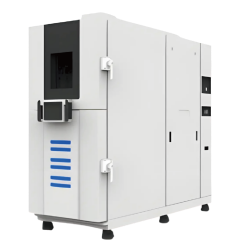
Millennial Perovskite Maximum Power Point Tracking Tester
The Perovskite Maximum Power Point Tracking (MPPT) Tester utilizes an A+AA+ grade LED solar simulator as the aging light source. With its advanced technology and versatile design, it provides robust support for perovskite solar cell research.
email:market@millennialsolar.com
▶ 3A+ light source, accurately replicating actual illumination conditions across various scenarios
▶ Equipped with a constant temperature and humidity chamber to meet ISO standards
▶ Multiple electronic load models available, with multi-channel independent operation
▶ Nitrogen fixture for unencapsulated devices to prevent oxygen corrosion
Millennial perovskite MPPT tester is primarily used for stability testing of finished perovskite single-junction and tandem solar cells. Since the output characteristics of perovskite cells are easily affected by environmental factors such as light intensity and temperature, their maximum power point fluctuates frequently. By continuously tracking and locking onto the maximum power point in real time, the MPPT controller ensures the system always operates at optimal power output. This not only maximizes power generation but also enhances the operational stability and economic efficiency of the entire photovoltaic system.


